Umbwe ROUTE
6-Day Rongai Route, Price and Itinerary.
Price
On request
Age
10-80
Duration
6 Days
Read This First
Umbwe is not the right route for most people. We say this not to gatekeep the trail, but because the mountain doesn’t care about ambition — it responds to physiology.
Here’s the honest situation: Umbwe is the steepest, most direct, and fastest route on Kilimanjaro. That speed is exactly the problem. Your body’s ability to acclimatize is physiologically limited — you can’t rush it. Umbwe compresses the altitude profile into fewer days than almost any other route, which means the window for acclimatization is narrow.
If you’re asking yourself whether Umbwe is right for you, the most useful questions are: Have you been above 4,500m before? Did you handle it well? Do you have a specific reason — time constraint, personal challenge, prior high-altitude experience — that makes Umbwe the right call? Or does Umbwe appeal primarily because it sounds harder and therefore more impressive?
We’ll have this conversation with you directly before you book. We’ve guided experienced clients on Umbwe and we’ll do it well. We’ll also redirect you to Lemosho if that’s the honest recommendation.
UMBWE CIRCUIT
UMBWE ROUTE AT A GLANCE
Pricing by route: for New Year and Christmas, the price is $200 more per person.
Duration
7 Days
Price on request!
Distance
~53 km (32.9 mi.)
Start gate
Umbwe Gate, 1,600m (5,249 ft)
Summit
Uhuru Peak, 5,895 m (19,341 ft)
Highest camp
Barafu Camp, 4,673m (15,331 ft)
Difficulty
Hard
Accommodation
Camping throughout
Success rate
Lower — compressed acclimatization is the challenge
Best season
January–March, June–October
Trail traffic
Very low — one of the least-used routes
Quietest of the main routes
Recommended for
Experienced trekkers with prior high-altitude exposure
UMBWE
WHO THIS ROUTE IS FOR
Rongai suits climbers who want a different perspective on the mouA good fit if:
- You have verified, recent experience above 4,500m(14,764 ft) and know your body acclimatizes well
- You’re a fit, experienced trekker seeking Kilimanjaro’s most challenging standard route
- You have prior mountaineering or high-altitude trekking background
- Your timeline genuinely constrains you to 5–6 days (though in this case, consider Marangu or Rongai first)
Not a good fit if:
- You’re drawn to Umbwe primarily because it sounds challenging
- This is your first time on a high-altitude mountain
- You haven’t been above 3,500m(11,483 ft)
THE ROUTE:
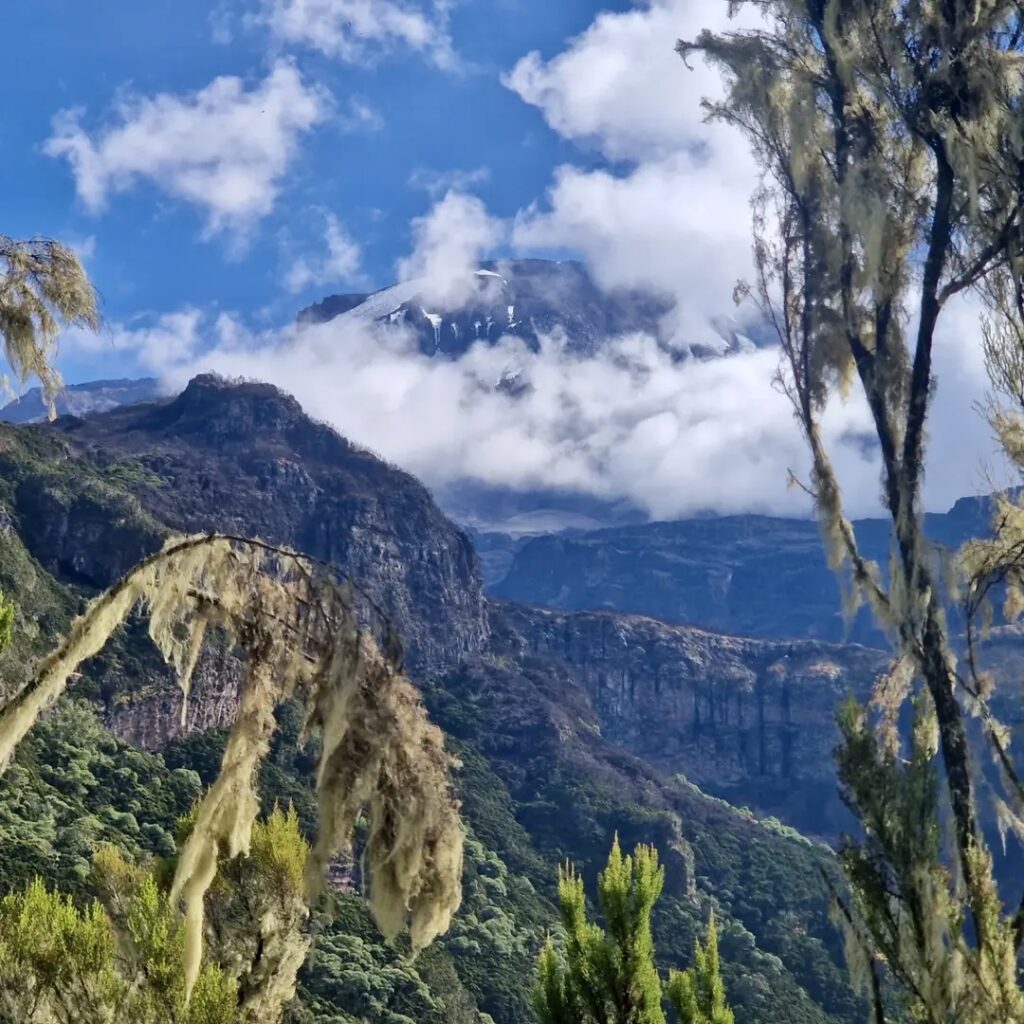
Umbwe begins at Umbwe Gate (1,600m) — the lowest starting point of any Kilimanjaro route. The trail immediately starts climbing, and it doesn’t stop. The first two days are among the steepest on the mountain, cutting directly up through dense forest on a single, narrow ridge trail. >
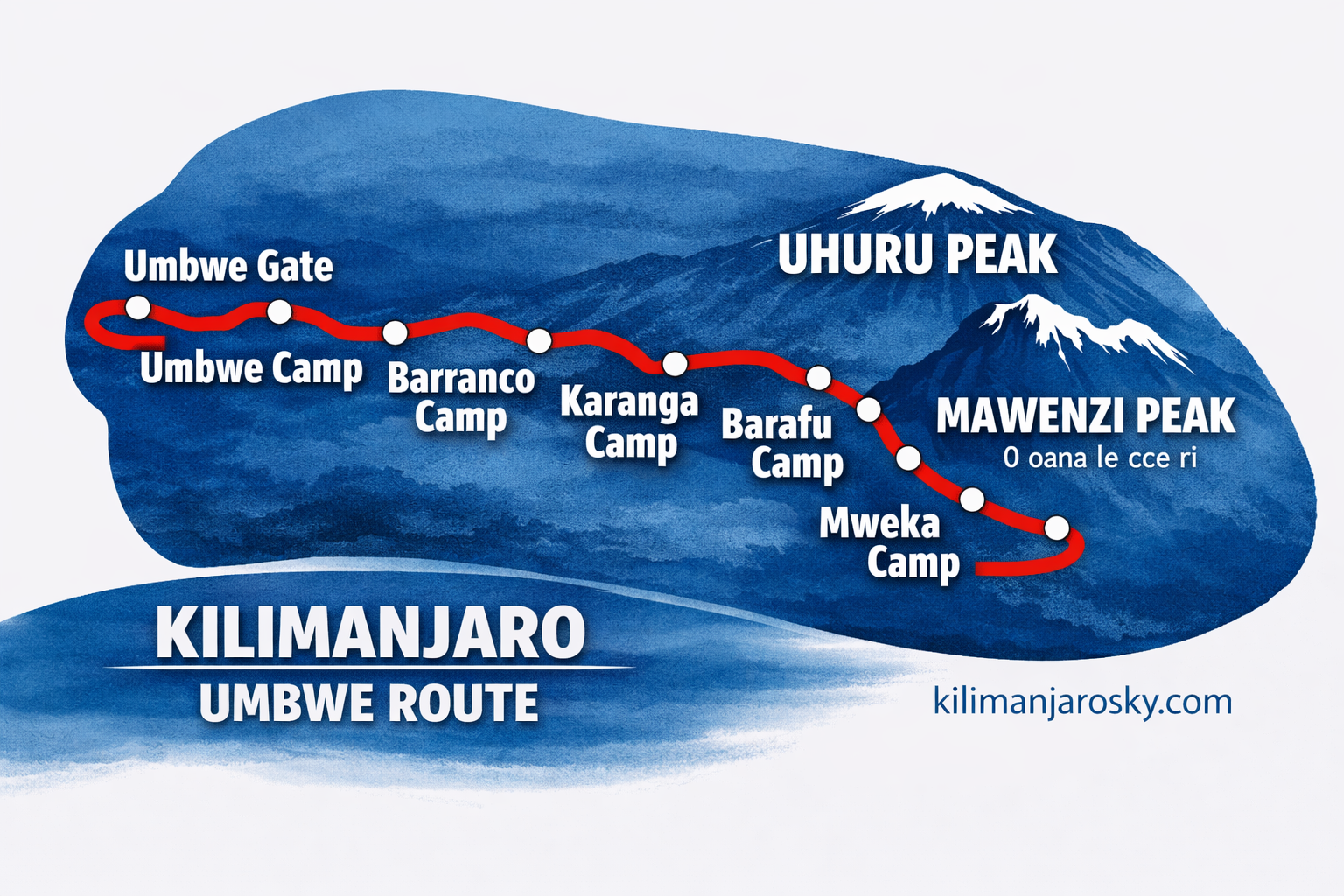
By day two you emerge from the forest at Barranco Camp (3,960m). That’s a gain of roughly 2,360m in two days of hiking — approximately twice the daily gain of Lemosho’s opening days. Your body is at nearly 4,000m with two days of hiking behind it.
From Barranco, Umbwe joins the Machame and Lemosho corridor — Barranco Wall, Karanga, Barafu, summit. The terrain is shared; the difference is in how you arrived at Barranco. Umbwe climbers have had less time to adjust to altitude by the time they join this section than any other route.
Descent is via Mweka Gate.
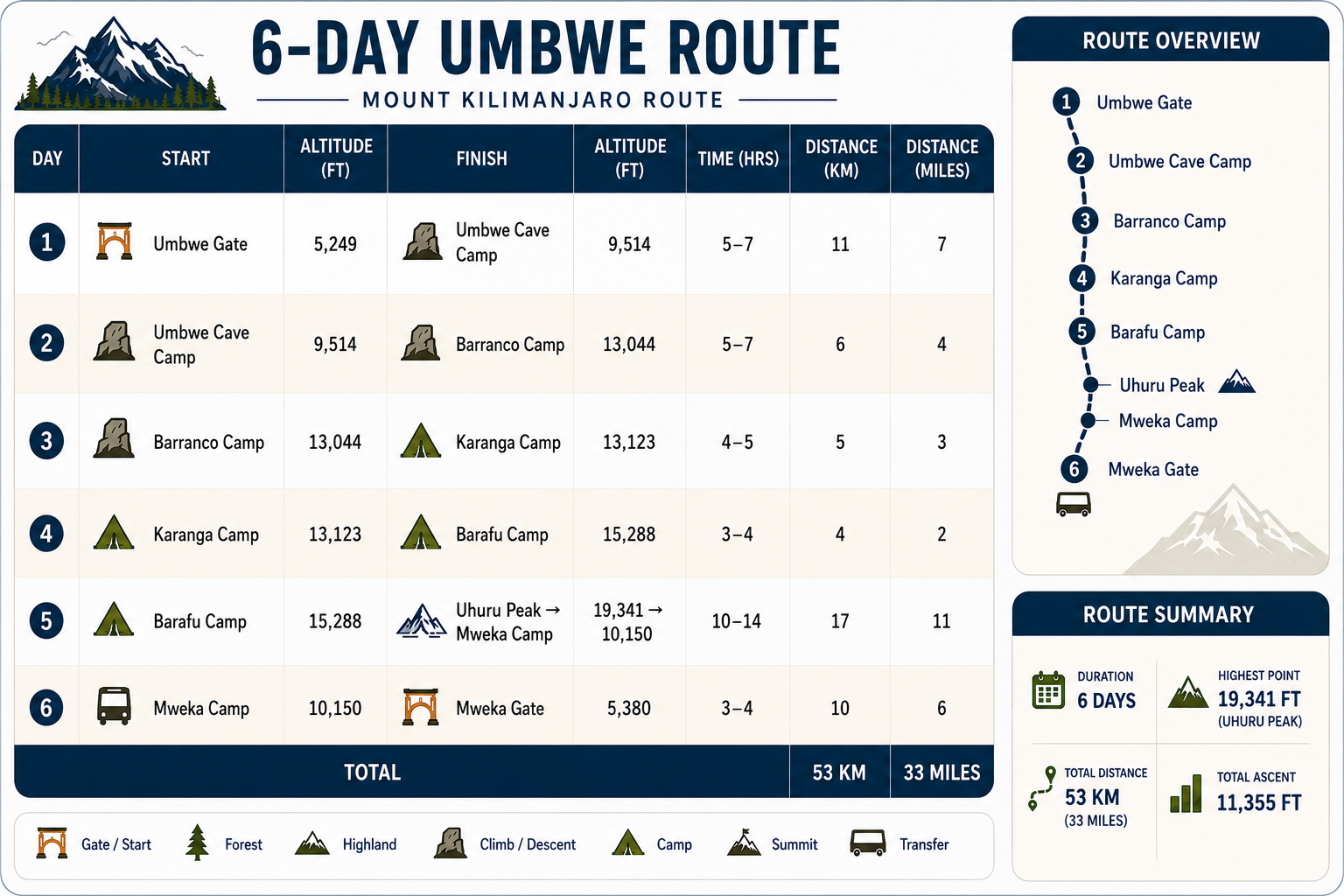
6-DAY ITINERARY – RONGAI Route Kilimanjaro
Day 1 — Umbwe Gate to Umbwe Cave Camp
Umbwe Gate (1,600 m / 5,249 ft) → Umbwe Cave Camp (2,940 m / 9,646 ft) | ~4–5 hours | Elevation gain: ~1,340 m / 4,400 ft
Entry through farmland and then immediately into forest. The trail narrows and steepens quickly. Umbwe’s forest is darker, denser, with a tunnel-like quality in places. The ridge is narrow; you’re essentially climbing a spine. Umbwe Cave Camp is small and intimate — often quiet compared to other routes.
Day 2 — Umbwe Cave to Barranco Camp
Umbwe Cave Camp (2,940 m / 9,646 ft) → Barranco Camp (3,960 m / 12,992 ft) | ~5–6 hours | Elevation gain: ~1,020 m / 3,346 ft
Continued steep ascent through forest into the heather zone. By midday the vegetation thins and the upper mountain comes into view. Barranco Camp sits dramatically beneath the Barranco Wall. Two days of climbing; 2,360 m / 7,740 ft gained in total. How you feel here is a strong indicator of your acclimatization.
Day 3 — Barranco Camp to Karanga Camp (via Barranco Wall)
Barranco Camp (3,960 m / 12,992 ft) → Karanga Camp (4,035 m / 13,238 ft) | ~4–5 hours
The Barranco Wall scramble — hands-on, exposed, and unforgettable. Guides pace you carefully. Karanga Camp in the afternoon. A shorter day by distance, giving time for rest and acclimatization checks.
Day 4 — Karanga Camp to Barafu Camp
Karanga Camp (4,035 m / 13,238 ft) → Barafu Camp (4,673 m / 15,331 ft) | ~4–5 hours
The final camp. Vegetation disappears; volcanic desert dominates. Barafu is perched high and exposed. Rest, eat, and sleep early — summit night begins at midnight or 1 am.
Day 5 — Summit Day and Descent to Mweka Camp
Barafu Camp (4,673 m / 15,331 ft) → Stella Point (5,756 m / 18,885 ft) → Uhuru Peak (5,895 m / 19,341 ft) → Mweka Camp (3,100 m / 10,171 ft) | ~14–16 hours
The standard summit push from Barafu — slow, deliberate, and cold. The climb to Stella Point is the hardest section; from there, the crater rim walk to Uhuru Peak is gradual but exhausting. Descent to Mweka Camp the same day — a huge altitude drop, demanding on knees and stamina.
Day 6 — Mweka Camp to Mweka Gate
Mweka Camp (3,100 m / 10,171 ft) → Mweka Gate (1,640 m / 5,381 ft) | ~3–4 hours
Forest descent. The air thickens, the greenery returns. Certificates awarded at the gate. Transfer to Moshi for rest and celebration.
THE ACCLIMATIZATION REALITY
- On Night 1, you sleep at Umbwe Cave Camp (2,940 m / 9,646 ft). Compare this to Lemosho’s first night at Mti Mkubwa (2,650 m / 8,694 ft) — the difference seems modest. But the real divergence shows up quickly.
- By Night 2, Umbwe already places you at Barranco Camp (3,960 m / 12,992 ft). On Lemosho, you’re still easing upward, with more gradual forest days behind you.
- By Night 3, Umbwe pushes you to Karanga Camp (4,035 m / 13,238 ft). Lemosho’s third night is at Shira 2 (3,840 m / 12,598 ft), after two forest acclimatization days. That extra buffer matters.
- On Night 4, Umbwe reaches Barafu Camp (4,673 m / 15,331 ft) — the high base camp before summit night.
- Summit night climbs to Uhuru Peak (5,895 m / 19,341 ft), the roof of Africa, before descending.
- Finally, Night 5 is spent at Mweka Camp (3,100 m / 10,171 ft), a sharp drop in altitude that helps recovery.
The key distinction: Umbwe is direct and compressed. There’s no Lava Tower detour (4,630 m / 15,190 ft) for “climb high, sleep low” acclimatization, and no extra plateau day to build tolerance. The route’s steepness and short window mean your body has less time to adapt, which is why Umbwe is considered the most demanding in terms of acclimatization profile.
THE UMBWE FOREST: WHAT MAKES IT WORTH CONSIDERING
Setting the summit ambition aside for a moment: Umbwe’s forest is one of the least-visited sections of Kilimanjaro National Park. The lower ridge trail cuts through ecosystem that Machame and Lemosho trekkers don’t access. Wildlife is more likely here — colobus monkeys, forest birds, the occasional glimpse of larger animals. The narrow trail and dense canopy create a genuinely different atmosphere from the broader, more-trafficked southern routes.
Climbers who have done Umbwe before — and there are a few — often mention the forest as what they remember longest.
HEALTH MONITORING ON UMBWE
Because Umbwe’s compressed profile carries higher altitude sickness risk, monitoring is more frequent and our response threshold is the same as every route:
- SpO2 checks on arrival at each camp and whenever your guide notices changes in pace, breathing, or responsiveness
- Specific attention at Barranco on Day 2 — this is the earliest point where altitude illness typically manifests on this route
- Our guide’s authority to initiate descent is absolute, regardless of how far you’ve come or how close the summit is
We carry supplemental oxygen on every Umbwe climb. It is part of the standard kit, not a luxury add-on.
WHAT’S INCLUDED
Every Kilimanjaro Sky Route climb includes:
- 1 lead guide + 1 assistant guide per 2 clients
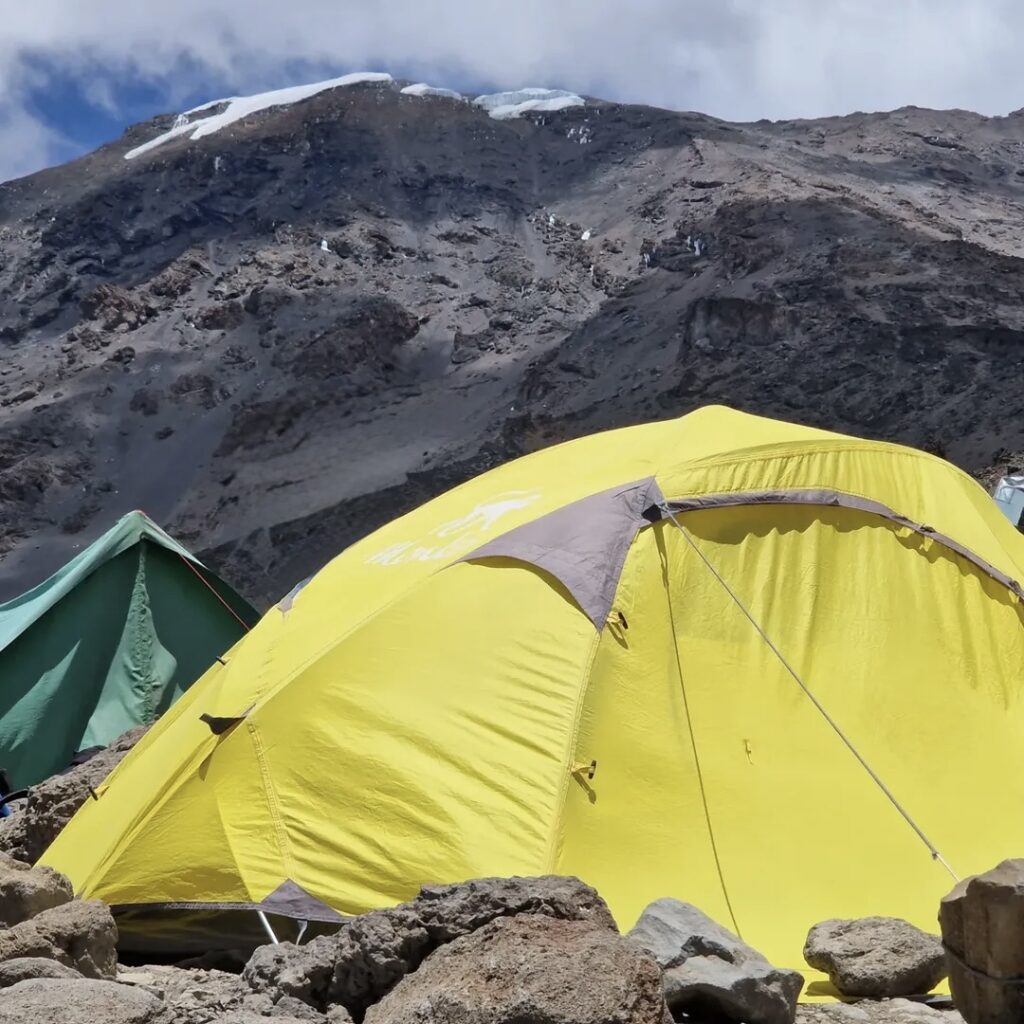
- Quality, waterproof mountain sleeping tents
- Cook and assistant cook
- 3–4 porters per client (20kg maximum, weighed at Londorossi Gate)
- All meals throughout the 7 days — breakfast, lunch, dinner, trail snacks
- Pulse oximeters, supplemental oxygen cylinders, full medical kit
- Camping equipment — tents, sleeping mats, dining tent, cooking equipment
- Emergency oxygen
- Clean drinking water
- TANAPA park fees and rescue levy
- Kilimanjaro Airport transfers
- Accommodation in Moshi on arrival and before departure
- Portable Toilet
- Londorossi Gate 4WD transfer (included)
- Certificate of completion
Not Included
- Flights
- Alcoholic and soft drinks
- Visa fees
- Travel insurance
CTA: Inquire about Umbwe route dates and pricing→ [Contact]
CTA2: Compare all routes → [Routes overview]
UMBWE ROUTE FAQ
Umbwe Route Frequently asked questions