MARANGU route
Marangu Route Kilimanjaro | 5-6-Days Hut-to-Hut, Price and Itinerary.
Price
$2250
Age
10-80
Duration
5-6 Days
MARANGU
MARANGU ROUTE AT A GLANCE
Pricing by route: for New Year and Christmas, the price is $200 more per person.
Duration
6 days (5-day option available)
$2250 for 6 days.
Distance
~64km-39.8 miles. total (ascent + descent)
Start gate
Marangu Gate, 1,850 m (6,070 ft)
Summit
Uhuru Peak, 5,895 m (19,341 ft)
Highest camp
Kibo Hut, 4,700m (15,420 ft)
Difficulty
Moderate
Accommodation
Shared dormitory huts (Mandara, Horombo, Kibo)
Success rate
Lower than 7–8 day routes
Best season
January–March, June–October
Trail traffic
High — same trail used for ascent and descent
MARANGU
THE HONEST ASSESSMENT
We’ll tell you what we tell all our clients who ask about Marangu: it has historically had the lowest summit success rate of all seven routes we offer. That’s not an opinion — it’s the consistent pattern from two decades on this mountain.
The reason is simple: five days doesn’t give most people enough time to acclimatize. You sleep at 2,700 m on night one, 3,720 m on night two, 4,700 m on night three, and attempt the summit on the morning of day four. That altitude gain is fast. The mountain doesn’t care how fit you are; acclimatization is a physiological process that takes time.
The 6‑day Marangu option changes this equation. By adding a second night at Horombo Hut, you gain an acclimatization day — hiking toward Mawenzi Ridge, then returning to sleep low. This “climb high, sleep low” principle significantly improves summit success rates compared to the 5‑day version. It’s still not as strong as Lemosho or Machame, but it’s a meaningful improvement.
So why do we offer Marangu? Because it’s the right route for some people. Those who’ve climbed at altitude before, those who specifically want hut accommodation rather than tents, and those with a tight timeline who understand and accept the trade‑off. If that’s you, we’ll give you the same guide team, the same safety protocols, and the same honest attention as every other route.
If you’re choosing Marangu because it seems easier — it’s not. If you’re choosing it because it seems cheaper — it’s not significantly. If you’re choosing it because it’s shorter and you’ve never been above 4,000 m — consider Lemosho instead.
We’ll have this conversation directly if you contact us.
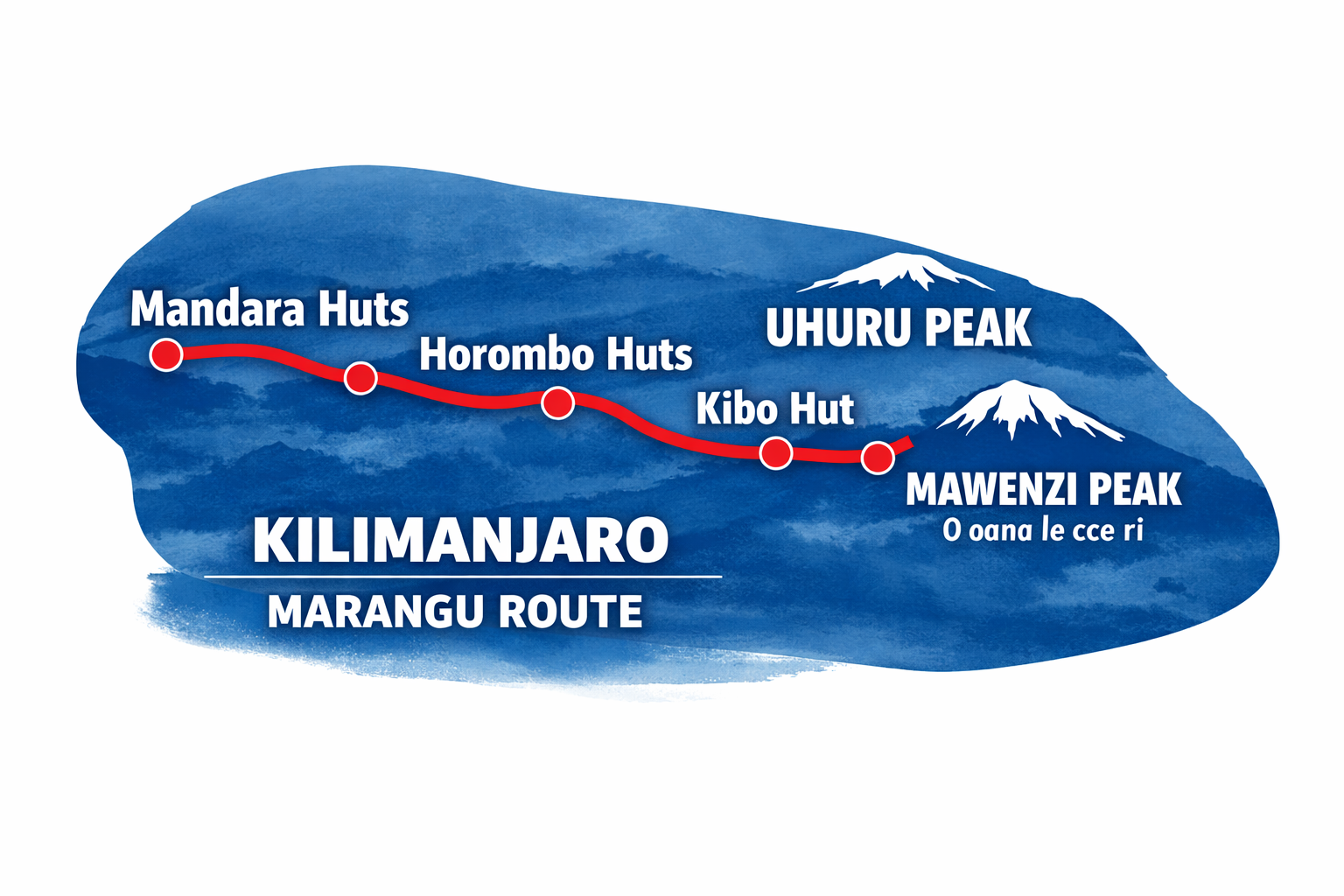
WHO MARANGU IS FOR
Good fit:
- Climbers with prior high-altitude experience (above 4,000m)
- Those who strongly prefer sleeping in beds over tents
- Tight schedules where 5 days is the maximum
- Clients who have done Marangu before and want to return
Not a good fit:
- Climbers who assume shorter = easier
- First-time Kilimanjaro climbers without altitude experience
- Anyone whose primary goal is reaching Uhuru Peak (choose Lemosho)
Marangu is nicknamed the “Coca Cola Route” — a label that implies ease and underestimates the mountain. What Marangu actually is: a well-maintained, direct trail up Kilimanjaro’s southeastern side, using the same path for ascent and descent, with three permanent hut camps along the way.
The path climbs through Kilimanjaro’s ecosystems at a faster pace than other routes. Day one takes you through montane rainforest to Mandara Hut at 2,700m. Day two crosses the moorland and crosses the saddle to Horombo Hut at 3,720m — a substantial jump. Day three is an acclimatization day at Horombo (on the 6-day option) or a direct push to Kibo Hut at 4,700m. Summit night follows from Kibo Hut, with descent the same day.
6-DAY ITINERARY – MARANGU ROUTE KILIMANJARO
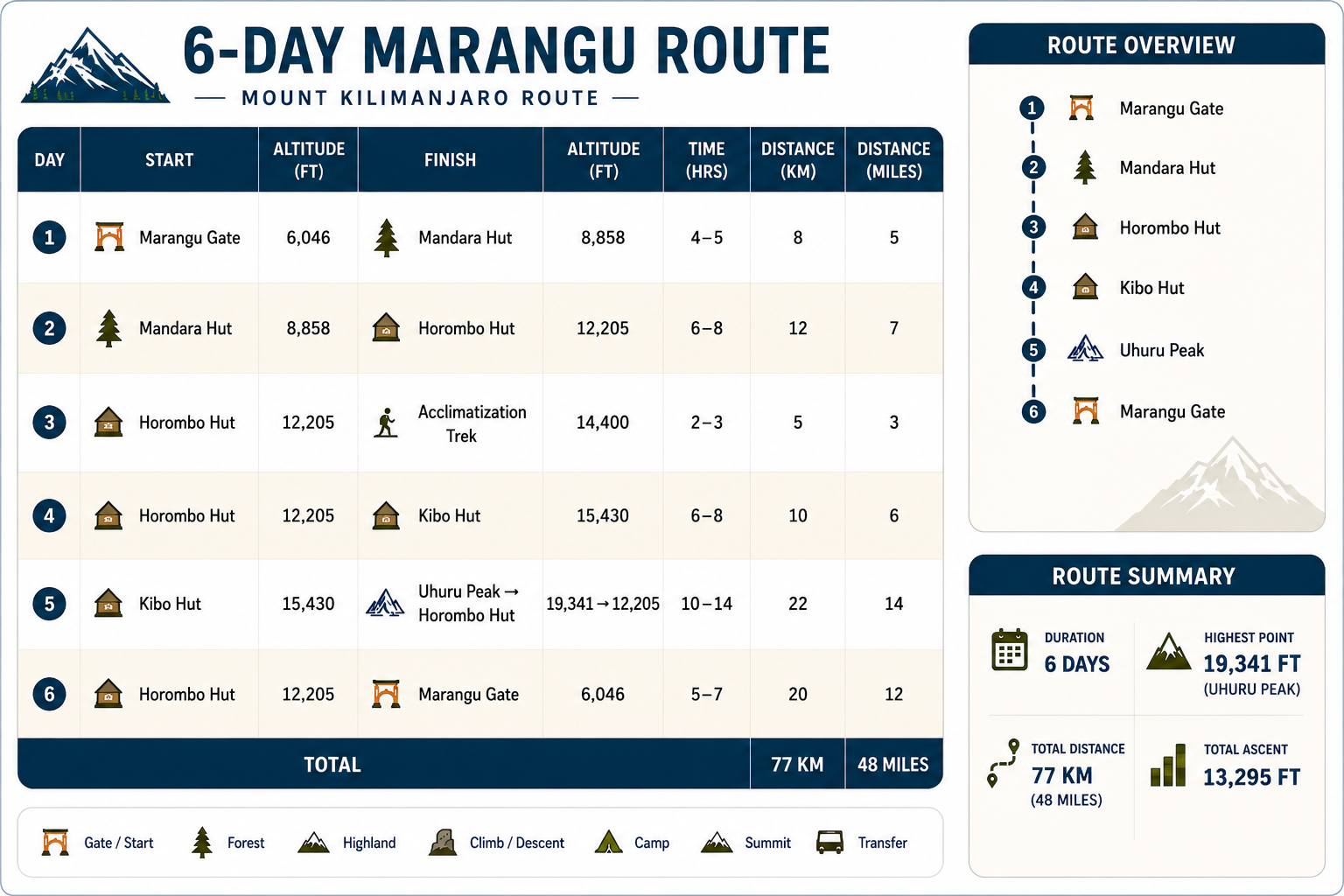
Day 1 — Marangu Gate to Mandara Hut
Marangu Gate (1,860 m / 6,102 ft) → Mandara Hut (2,720 m / 8,924 ft) | ~3–4 hours hiking | Elevation gain: ~860 m / 2,822 ft
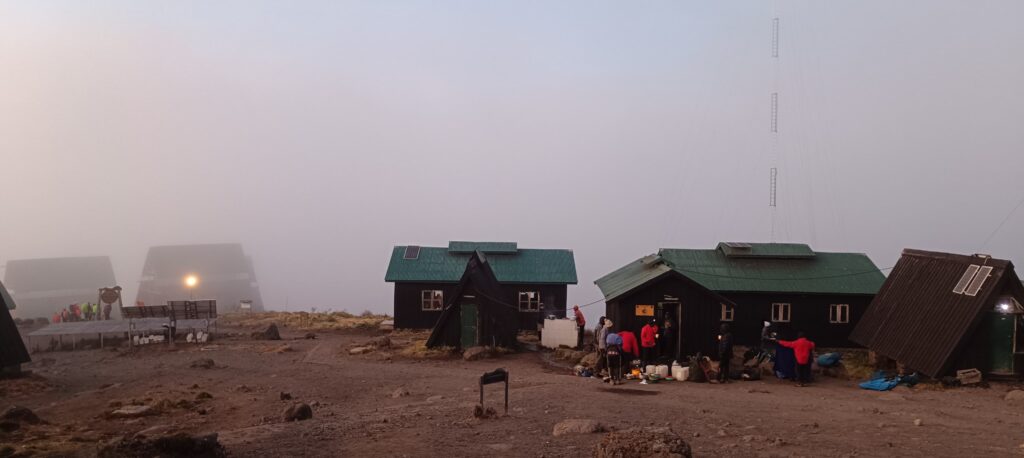
Entrance through the park gate, then into rainforest. The trail is well-marked and wide. Mandara Hut sits in a forest clearing — a cluster of wooden A-frame dormitory buildings with basic but functional facilities. The first night at altitude.
Day 2 — Mandara Hut to Horombo Hut
Mandara Hut (2,720 m / 8,924 ft) → Horombo Hut (3,720 m / 12,204 ft) | ~5–6 hours hiking | Elevation gain: ~1,000 m / 3,280 ft
The forest gives way to heather and moorland. The vegetation thins; the mountain opens up. You’ll cross a ridge and get your first proper views of Kibo — the volcanic cone that holds Uhuru Peak. Shira Camp sits on the edge of the ancient Shira Plateau, one of Kilimanjaro’s three volcanic peaks, now an open, windswept highland.
Day 3 — Acclimatization Day at Horombo Hut
Horombo Hut (3,720 m / 12,204 ft) → Mawenzi Ridge (approx. 4,300 m / 14,108 ft) → return to Horombo Hut | ~4–5 hours hiking | Elevation gain: ~580 m / 1,904 ft (then descent back)
Crossing the saddle — a wide, bare, rocky plateau between Kilimanjaro’s Kibo and Mawenzi peaks. The landscape is lunar, striking, and windswept. Kibo Hut arrives in early afternoon; you rest, eat, and sleep by 7 pm. With the extra acclimatization day, this ascent is more manageable.
Day 4 — Horombo Hut to Kibo Hut
Horombo Hut (3,720 m / 12,204 ft) → Kibo Hut (4,700 m / 15,420 ft) | ~5–6 hours hiking | Elevation gain: ~980 m / 3,216 ft
Barranco Wall first. The scramble is hands-on, sometimes exposed, always memorable. Your guide will be with you through every section. From the top, the path continues across the southern face of the mountain to Karanga Camp. It’s a relatively short day by distance but significant by experience.
Day 5 — Summit Day and Descent to Horombo Hut
Kibo Hut (4,700 m / 15,420 ft) → Gillman’s Point (5,681 m / 18,638 ft) → Uhuru Peak (5,895 m / 19,341 ft) → Horombo Hut (3,720 m / 12,204 ft) | ~12–15 hours total
Departure at midnight or 1 am. Marangu’s summit approach goes via Gillman’s Point on the crater rim — a recognized summit point in its own right, approximately 45 minutes below Uhuru Peak. Many Marangu climbers reach Gillman’s Point; continuing to Uhuru Peak requires additional time and oxygen capacity. Descent to Horombo the same day.
Day 6 — Horombo Hut to Marangu Gate
Horombo Hut (3,720 m / 12,204 ft) → Mandara Hut (2,720 m / 8,924 ft) → Marangu Gate (1,860 m / 6,102 ft) | ~6–7 hours hiking
The descent is straightforward, through familiar terrain in reverse. Certificates are issued at Marangu Gate.
ACCOMMODATION ON THE MARANGU ROUTE
Marangu is the only Kilimanjaro route where you sleep in huts. This is genuinely different from camping:
- Mandara Hut (2,720m): Wooden A-frame structures in a forest clearing. Shared dormitory bunks. Basic toilets and washing facilities nearby.
- Horombo Hut (3,720m): The largest hut complex on the mountain. Similar dormitory setup. Often busy — this is where Marangu ascending and descending trekkers overlap.
- Kibo Hut (4,700m): Simpler stone structure near the summit cone. Basic sleeping and toilet facilities. You’re here for one night only.
A private room option is available at some huts at additional cost. Book in advance through us. One thing camping routes have: privacy. Hut dormitories are shared with all trekkers using the route that day, regardless of operator.
ACCLIMATIZATION ON MARANGU ROUTE
The challenge of Marangu’s acclimatization lies in how quickly altitude is gained. You sleep at 2,720 m on the first night, 3,720 m on the second, spend a third night again at Horombo Hut for acclimatization, then move to 4,700 m at Kibo Hut before attempting the summit at 5,895 m. That gives you four nights of sleeping altitude before the summit push — a schedule that is still demanding, but far more balanced than a compressed climb.
The extra day at Horombo Hut is not just rest; it’s an acclimatization hike toward Mawenzi Ridge, followed by a return to sleep lower. This “climb high, sleep low” principle is proven to improve summit success rates.
The 6‑day Marangu option adds one more park fee night and extends your timeline, but it meaningfully raises your odds of reaching Uhuru Peak. It remains hut‑based, straightforward in logistics, and is the right choice for those who want the comfort of huts, a clear trail, and a stronger acclimatization profile.
If you’re set on Marangu, we’ll recommend the 6‑day version — it’s the most responsible way to approach this route.
HEALTH MONITORING ON MARANGU
The monitoring protocols on Marangu are identical to every other route we offer:
- SpO2 checks every morning, every evening, and on demand
- Thresholds: readings below 75%, or a drop of more than 5% from prior reading, trigger increased monitoring and possible action
- Symptoms of severe AMS trigger mandatory descent
- Supplemental oxygen carried on every climb
- Your guide has full authority to call a descent at any point
- The hut setting doesn’t change what we carry or how we monitor you. It changes where you sleep; it doesn’t change the standard of care.
WHAT’S INCLUDED
Every Kilimanjaro Sky Marangu Route climb includes:
- 1 lead guide + 1 assistant guide per 2 clients
- Quality, waterproof mountain sleeping tents
- Hut accommodation (shared room)
- Cook and assistant cook
- 3–4 porters per client (20kg maximum, weighed at Londorossi Gate)
- All meals throughout the 8 days — breakfast, lunch, dinner, trail snacks
- Pulse oximeters, supplemental oxygen cylinders, full medical kit
- Camping equipment — tents, sleeping mats, dining tent, cooking equipment
- Emergency oxygen
- Clean drinking water
- TANAPA park fees and rescue levy
- Kilimanjaro Airport transfers
- Accommodation in Moshi on arrival and before departure
- Portable Toilet
- Londorossi Gate 4WD transfer (included)
- Certificate of completion
Note: Hut accommodation is shared dormitories. Private room upgrade available on request at additional cost.
Not Included
- Flights
- Alcoholic and soft drinks
- Visa fees
- Travel insurance
CTA: Inquire about MARANGU Route dates and pricing→ [Contact]
CTA2: Compare all routes → [Routes overview]
See why most first-timers choose Lemosho → [Lemosho route page]
MARANGU ROUTE FAQ
Marangu Route Frequently asked questions