“Kilimanjaro” is one of the most recognisable place names in the world, and yet — unusually for a mountain this famous — nobody knows exactly what it means. The name almost certainly has multiple roots in the languages of the people who have lived at the foot of the mountain for centuries, and linguists and historians have been arguing about the etymology for well over 100 years.
Here’s what the leading theories say, what the summit itself is called, and why the meaning matters to anyone planning to climb.
The Short Answer
The most widely accepted explanation is that “Kilimanjaro” comes from two roots:
- Kilima — a Swahili word meaning “hill” or “small mountain”
- Njaro — of contested origin, variously proposed as:
- A Chagga word meaning “whiteness” (as in, the snow-capped summit)
- An older word for “caravan” (the mountain as a landmark for trading caravans)
- A Swahili word for a demon or spirit believed to live on the mountain
- A reference to Maasai spring water
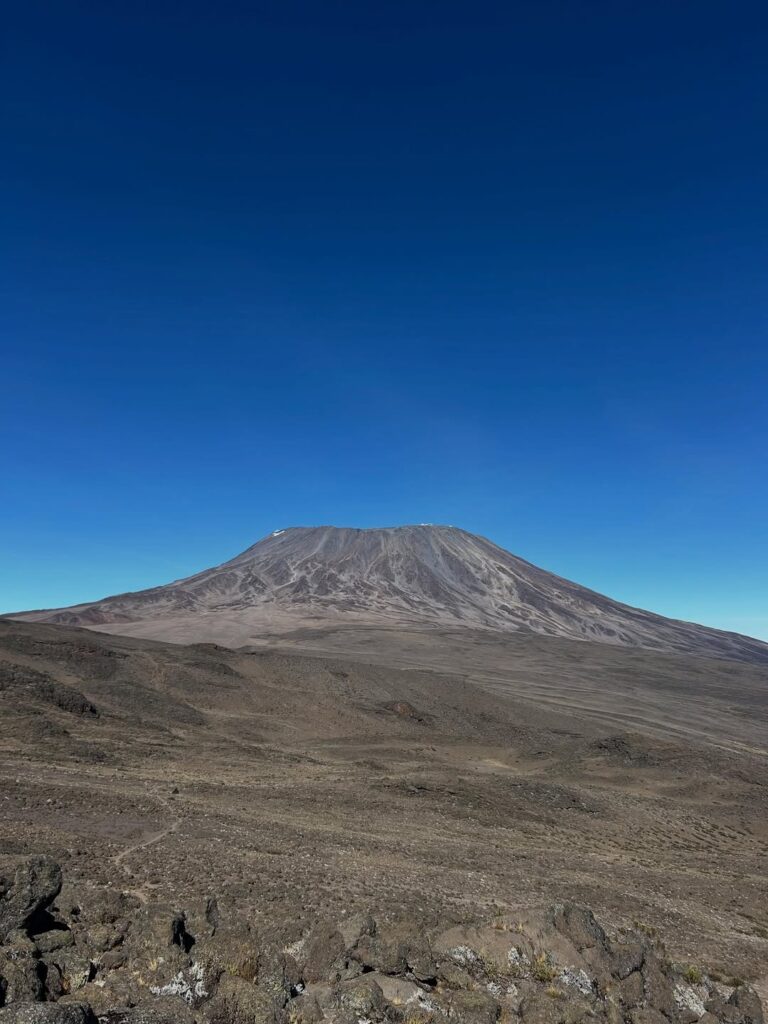
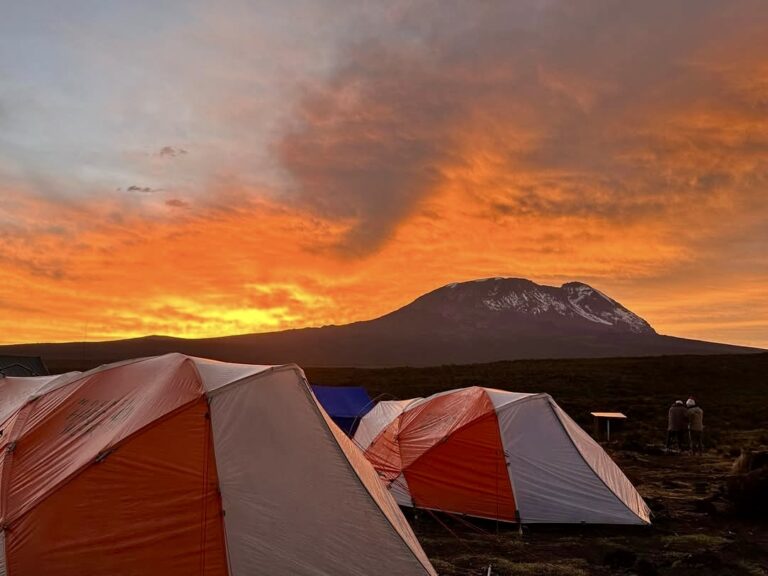
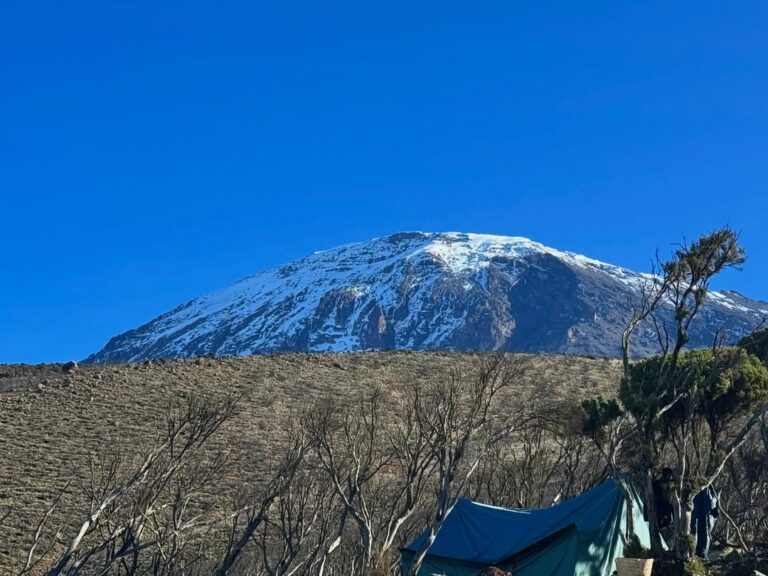
The literal translation most commonly given is “Mountain of Whiteness” or “Shining Mountain” — referring to the snow and ice on the summit that’s visible from hundreds of kilometres away.
There’s a puzzle in this, though. “Kilima” in Swahili means a small mountain, not a great one. If early Swahili speakers were naming the tallest mountain in Africa, you’d expect them to use “mlima” (mountain) rather than “kilima” (hill). Some linguists think the diminutive is deliberate — an affectionate or respectful form — while others think the “kilima” piece comes from a different language family entirely and that the similarity to Swahili is coincidental.
The Chagga Perspective
The Chagga people, who have farmed the southern and eastern slopes of Kilimanjaro for centuries, have their own names for the mountain — and interestingly, “Kilimanjaro” isn’t really one of them.
In Chagga, the mountain is often referred to as Kibo (the name that’s now applied specifically to the summit cone) or by descriptive phrases. The Chagga distinguish between the three cones, give individual features specific names, and relate the mountain to creation stories and local cosmology in ways that resist a single simple translation.
One Chagga interpretation of “njaro” is that it refers to a powerful spirit or demon believed to inhabit the summit. In this telling, “Kilimanjaro” is “the mountain of Njaro” — named for the presence believed to live there rather than for a physical feature. Whether this tradition predates European contact or emerged from colonial-era reinterpretation is disputed.
Our About page covers our roots in Moshi, which is in the heart of Chagga country, and our team includes Chagga guides who carry these stories with them on the trail.
The Maasai Perspective
The Maasai, whose traditional territory runs north and west of the mountain on the Kenyan side and into the plains of Tanzania, have a different name entirely: Ol Doinyo Oibor — “The White Mountain” — or, more poetically, Ngáje Ngài — “House of God.”
The “House of God” name captures something about how the mountain is perceived locally. Visible from hundreds of kilometres across otherwise flat savannah, Kilimanjaro’s snow-capped summit rising alone above the plains is genuinely otherworldly. It’s easy to see how cultures that lived with this view for millennia would place divine significance on it.
You may recognise the “Ngáje Ngài” name from Ernest Hemingway’s short story “The Snows of Kilimanjaro” (1936), which opens with the Maasai name and a reference to a frozen leopard found near the summit — a real story that has become part of the mountain’s legend.
The German Colonial Record
Kilimanjaro came into widespread Western awareness in the late 19th century during the German colonisation of what was then German East Africa. The first successful documented summit was by Hans Meyer and Ludwig Purtscheller in October 1889. Meyer originally named the highest point Kaiser-Wilhelm-Spitze (“Kaiser Wilhelm Peak”) after the German emperor — a name that persisted on European maps until Tanzania’s independence.
When Tanganyika gained independence from Britain in 1961 (later merging with Zanzibar to form Tanzania in 1964), the highest point was renamed Uhuru Peak — “Freedom Peak” in Swahili — to mark the independence of the country. That’s the name that stands today and the name that appears on your summit certificate if you make it to the top.
What “Uhuru” Means
Uhuru is a Swahili word meaning “freedom”. It’s a word that carries weight in East Africa — a rallying cry of the independence movements, a name for streets and squares in cities across the region, and now the name of the highest point on the continent’s tallest mountain.
Renaming the summit Uhuru Peak in 1964 was not just a geographical adjustment. It was a statement that this mountain, which had been named for a German emperor and mapped by European explorers, now belonged in name to the people who had always lived beneath it.
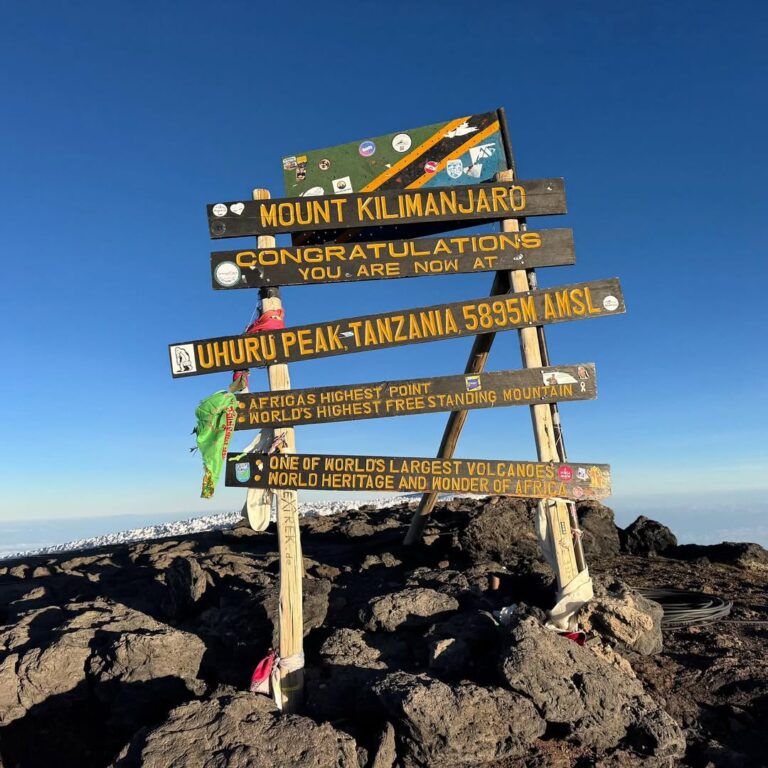
When you summit Kilimanjaro, the wooden sign at Uhuru Peak reads:
CONGRATULATIONS
YOU ARE NOW AT UHURU PEAK, TANZANIA.
5,895M AMSL
AFRICA’S HIGHEST POINT
WORLD’S HIGHEST FREE-STANDING MOUNTAIN
Every climber we’ve taken to Uhuru remembers that sign. Most have a photograph with it. The word “freedom” at 5,895 metres, after days of climbing, in the thin cold air at sunrise — it hits differently than it reads on a page.
The Other Named Summits
Kilimanjaro has several named summits and subsidiary points. The names are worth knowing:
- Uhuru Peak (5,895m/19,340 ft) — the highest point, on the Kibo cone’s outer crater rim
- Stella Point (5,756m/18,884 ft) — a named point on the southern side of Kibo’s crater rim, reached by Machame, Lemosho, and Shira routes before the final traverse to Uhuru. Named for Stella Latham, the wife of Kenneth Latham, who summited in 1925
- Gilman’s Point (5,681m/18,638 ft) — a named point on the eastern side of Kibo’s crater rim, reached by Marangu and Rongai routes. Named for Clement Gilman, a British geographer who mapped the summit in the 1920s
- Mawenzi Peak (5,149m/16,893 ft) — the second highest cone, technical and not part of standard trekking routes
- Shira Plateau (3,800–4,000m/12,467-13,123 ft) — the collapsed caldera of the oldest cone, named in Chagga tradition
The names of Stella and Gilman are colonial-era legacies that have persisted alongside Uhuru. If you summit via the Machame or Lemosho routes, Stella Point is where you first reach the crater rim before the final push to Uhuru. Our routes overview walks through each approach and which named points you reach on the way.
Why Meaning Matters
Why spend time on this? Because how you name a mountain tells you how you relate to it. “Kaiser Wilhelm Peak” and “Uhuru Peak” are the same 5,895 metres of rock and ice. They are not the same place.
The same is true for the mountain as a whole. “Kilimanjaro — Mountain of Whiteness” tells one story, rooted in the visible snow. “Ngáje Ngài — House of God” tells another, rooted in reverence. The Chagga naming practice, which distinguishes between the cones and attaches different significance to different features, tells a third.
For most climbers, the name “Kilimanjaro” will always be the default. But knowing that the mountain has other names, in other languages, that carry other meanings, is part of what makes climbing here different from climbing a peak that was named and mapped in a single cultural frame. You’re on a mountain that has been looked at, lived beneath, and spoken about in many different ways for a very long time.
If you’d like more context on the region’s history and people, our post on interesting Kilimanjaro facts and our guide to where Kilimanjaro is are good places to continue reading. When you’re ready to plan your own trip to Uhuru Peak, get in touch.