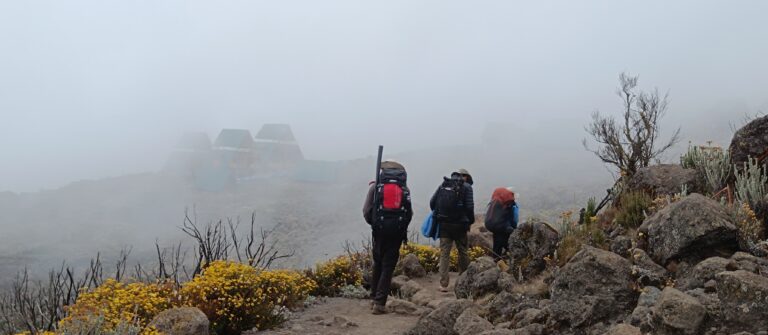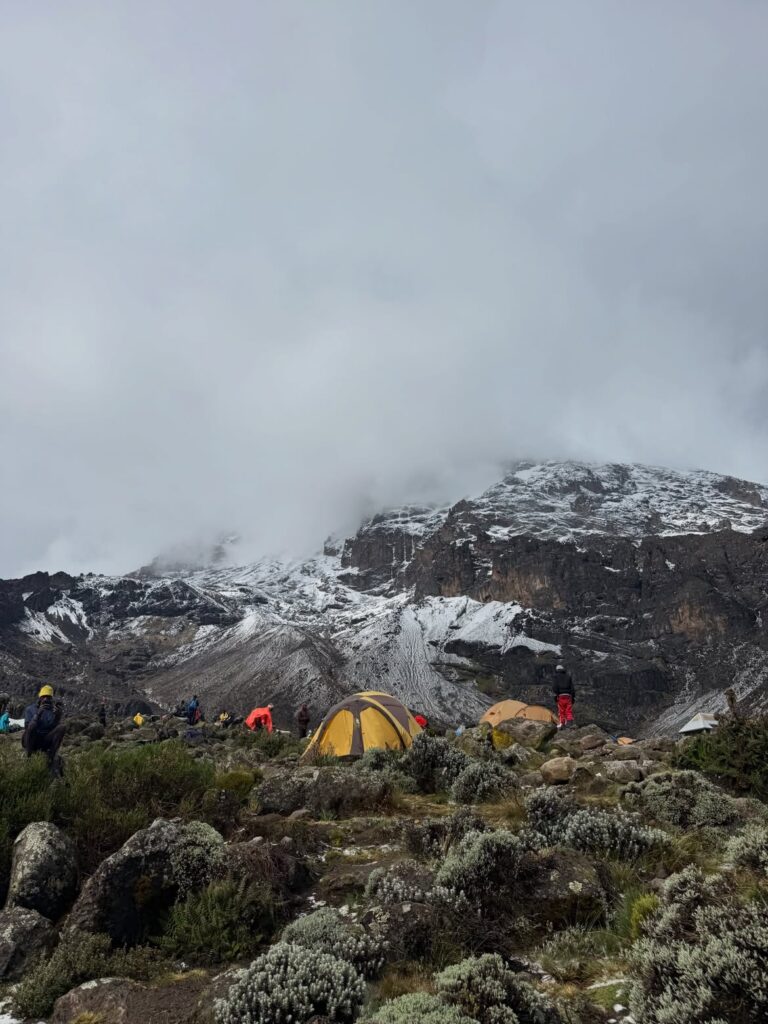
There are more Kilimanjaro climbing companies than most people realise. Some are global booking platforms that subcontract operations to local handlers. Some are international operators with offices in London or New York and guides sourced in Tanzania. Some are locally owned Moshi-based companies whose teams live at the base of the mountain and have spent decades on its slopes.
From the outside, their websites often look similar. Summit photos. Five-star reviews. Lists of routes. The phrase “safety first” appearing somewhere in the first paragraph. None of this tells you what happens when a climber’s oxygen levels drop at 4,800 metres at 2am and the group is six hours from the nearest road.
The best Kilimanjaro climbing company is not necessarily the biggest, the most marketed, or the one with the most reviews. It’s the one with the clearest answer to the questions that matter — and the operational specifics to back those answers up.
Start With How They Handle Medical Emergencies
This is the most important question, and most climbers don’t ask it directly enough.
Ask any climbing company: walk me through exactly what happens if a client develops symptoms of acute mountain sickness on summit night. The answer should be immediate and specific.
Responsible operators will describe a sequence: the guide monitors SpO2 (blood oxygen saturation) throughout the night. At Kilimanjaro Sky, readings below 75% — or drops of more than 5% from a prior measurement — trigger immediate reassessment and increased monitoring. If a climber develops symptoms of severe AMS (confusion, persistent cough, breathlessness at rest), descent is mandatory. Not optional, not subject to group consensus — mandatory, and the guide has full authority to enforce it regardless of how close the climber is to the summit.
From there, the company should be able to describe a clear evacuation sequence: oxygen and stabilisation at altitude, assisted descent with stretcher capability if the client cannot walk, vehicle evacuation coordinated with TANAPA from lower camps to KCMC Hospital in Moshi, and helicopter evacuation available for critical emergencies where ground evacuation is too slow. We’ve used helicopter evacuation before. It requires valid altitude insurance covering 6,000m+, which we strongly recommend to every client before departure.
For the complete protocol, see our safety page.
If a climbing company’s answer to this question is vague — if they say “we have experienced guides” or “safety is our priority” without tracing the actual procedure — that’s the most important signal you’ll receive.
What Qualifications Do the Guides Actually Hold?
Tanzania National Parks licenses Kilimanjaro guides through TANAPA — that’s the minimum requirement. Ask what your guides hold above that baseline.
Wilderness First Aid certification should be standard across all guides on any serious operation, not just lead guides. At Kilimanjaro Sky, all guides hold TANAPA licensing and Wilderness First Aid certification. Some hold additional qualifications: Emergency Medical Assistant of Tanzania certification, Wilderness First Responder training, and in some cases Bachelor’s degrees in Wildlife Management with mountaineering specialisation.
Ask also whether those qualifications are current. Medical training that hasn’t been refreshed in five years isn’t the same as active certification. An operator who can tell you when their guides last trained is an operator who treats qualifications as working tools rather than marketing materials.
The guide ratio matters alongside qualifications. Kilimanjaro Sky maintains one lead guide and one assistant guide for every two to three climbers. That’s not a client ratio that shifts when the group gets smaller or larger — it’s the structure for every departure. It means continuous monitoring, genuine one-on-one attention on hard sections, and a guide who actually knows how you’re moving by day three.
How the Company Treats Its Porters
Porter welfare is where you learn the most about a climbing company’s actual values — because porters have almost no visibility to clients, and cutting costs on porter treatment is financially tempting and largely undetectable unless you know what to look for.
The standards established by KPAP (Kilimanjaro Porters Assistance Project) are the industry benchmark: fair daily wages paid directly to each porter, a maximum carry weight of 20kg enforced at the park entrance, sleeping bags and weatherproof bags provided, proper food and accommodation throughout the climb. Ask any company you’re considering whether they meet these standards — and ask for specifics, not assurances.
At Kilimanjaro Sky, porters earn $10–12 USD per day. Payment is made directly to each porter by name, in cash, immediately after descent — not pooled, not routed through a supervisor. Carry weights are capped at 20kg, weighed at the TANAPA gate at the start of each climb. Every porter is provided a sleeping bag and waterproof kitbag. Three meals per day. Proper sleeping tents. And throughout the trek, the lead guide checks on porter health alongside client health — because the people carrying your gear are equally part of the team.
Kilimanjaro Sky is not a formal KPAP member, but our practices align with their standards and some of our team previously worked directly under KPAP. We’d rather show you the practices in detail than point to a logo — because what you can verify is more meaningful than what you have to take on faith.
Local Roots vs. International Infrastructure
One of the most significant differences between Kilimanjaro climbing companies is not widely discussed: where is the operation actually based, and who owns it?
An international booking platform based in London or New York typically subcontracts the actual climb to a local ground handler. That handler may be excellent. It may also be different for your trip than for the last client’s, with no direct accountability from the company you paid. The international entity has little visibility into what actually happens on the mountain.
A locally owned, Moshi-based direct operator is a different arrangement entirely. When the company’s entire operation is run from the base of the mountain — when the guides are permanent employees, not trip-by-trip contractors — consistency and accountability operate differently. The operator’s reputation is built in Moshi, among the people whose community this mountain belongs to.
Kilimanjaro Sky is locally owned and Moshi-based. Our guides, porters, and cooks are our team. We handle every logistics decision, every safety protocol, every post-climb porter payment directly — there is no middleman between our office and the mountain. That’s not just an operational structure; it reflects what we think a Kilimanjaro company should be. Read more about how we work.
Group Size and the Quality of the Experience
The best climbing companies understand that group size directly affects both safety and experience quality.
Large groups — 15 to 20 people moving together — create monitoring problems. A guide cannot simultaneously observe the pace, breathing, and demeanour of 18 individuals. People fall to the back and go unwatched. Summit nights with large groups become crowd-management exercises rather than personal guided ascents.
At Kilimanjaro Sky, groups typically run 4 to 10 clients, and we can accommodate larger groups by splitting them into sub-groups with dedicated guide teams — never simply adding clients to an already-formed group without adding guides proportionally. Small groups also create a very different climb experience: your guides learn your pace, know your habits, and notice when something changes. That relationship takes several days to build, and it can’t be built across 20 people.
What’s Actually Included: Reading the Details
Every Kilimanjaro climbing company has a page describing what’s included in their packages. Read it carefully, because the differences are significant.
The non-negotiables on any responsible operator’s list should include: TANAPA park fees, all camping equipment, all meals on the mountain, guide wages and crew wages, oxygen cylinders and medical kit, pulse oximetry monitoring, and airport transfers. If any of those are described as “available as an add-on,” that tells you the base package is cutting something consequential.
At Kilimanjaro Sky, we offer two tiers — Standard and Luxury — and both include the full guide team, all safety equipment, and every meal. The difference between tiers is comfort (tent quality, meal variety, private portable toilet facilities), not safety. The guide-to-client ratio and medical protocols are identical across both. See our full packages breakdown for detail on what each tier includes.
Comparing Routes and Matching Them to the Operator
The route you choose should be one the operator knows well. An operator who guides mainly on Machame and Lemosho — and has done so for 20 years — understands those routes at a granular level. The pace that works at each camp elevation, the places where altitude tends to bite first, the specific camp configurations and their microclimates.
Kilimanjaro Sky operates on seven routes: Machame, Lemosho, Marangu, Rongai, Northern Circuit, Shira, and Umbwe. If you’re still deciding which route is right for your timeline and fitness level, our route comparison guide walks through each one honestly.
The Conversation Before You Book
The best climbing companies have a substantive conversation with you before you book. Not a sales call — a genuine conversation about your fitness, experience, health history, medication, and expectations.
This matters because a good operator uses that information to advise you on route choice, trip duration, acclimatisation strategy, and whether there are any personal factors to plan around. An operator who takes your payment without asking these questions will also be an operator whose guides don’t know what they’re walking into.
At Kilimanjaro Sky, we want to know who we’re guiding before the trip begins. That preparation is part of the reason our summit success rate runs between 95 and 98% depending on route — not because we push people to the summit at any cost, but because we prepare them well and make sound decisions along the way.
Further reading: How to choose the best tour operator · What does Kilimanjaro cost? · Understanding altitude sickness
External sources: KPAP — Kilimanjaro Porters Assistance Project · TANAPA — Tanzania National Parks