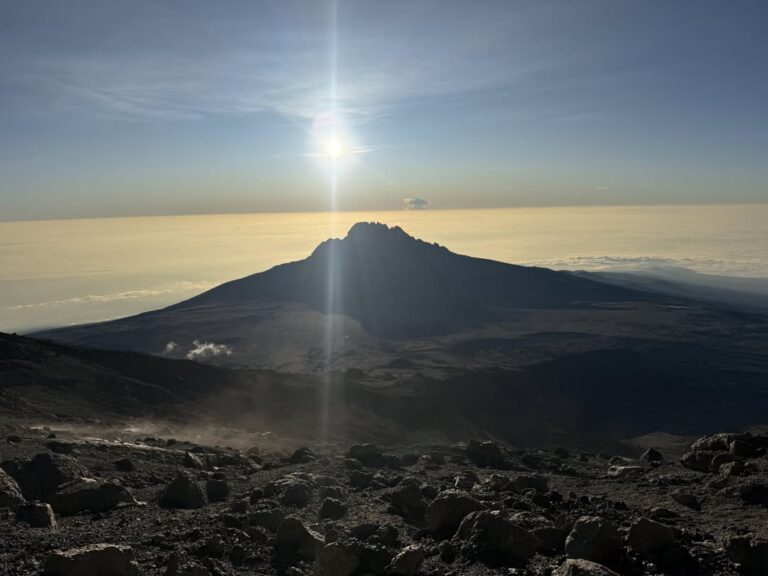
“Will my phone work on Kilimanjaro?” is one of the three most common pre-climb questions we get. Parents want to know their adult children can check in. Adult children want to know they can reach their parents. Partners want a daily word.
The honest answer: yes, more than most people expect. Kilimanjaro is not a signal black hole. Coverage across the mountain is genuinely decent at lower and mid camps, unreliable at higher camps, and unusable in the last 12 hours before the summit. Here’s the detail — by camp, by network, and with some practical advice about batteries and what to actually do.
The Short Version
- Lower camps (under 3,000m/9,842 ft): Usually strong 3G or 4G signal. Phone calls, WhatsApp, email, basic browsing all work.
- Mid camps (3,000–4,000m/9,842-13,123 ft): Signal exists but is patchy. Messaging typically works. Video calls usually don’t.
- High camps (4,000–4,700m/13,123-15,419 ft): Brief signal windows only — typically a hillside above the camp, facing a specific direction. Messaging sometimes works. Don’t rely on it.
- Summit night and summit itself (4,700–5,895m/15,419-19,340 ft): No coverage for practical purposes. Occasional brief signal at Stella Point has been reported; not reliable.
- Descent camps (below 3,500m/11,482 ft): Signal returns quickly as you descend.
This matches what our guides see on climbs week to week. Individual network performance varies, and weather affects it.
Which Tanzanian SIM Card to Buy
Your home SIM will probably roam on the mountain but at punishing rates. The sensible move is to buy a local SIM at Kilimanjaro International Airport (JRO) or in Moshi before the climb. We’ll help arrange this if you ask in advance.
The two networks with the best Kilimanjaro coverage are:
Vodacom Tanzania. Broadest national coverage and, in our experience, the most consistent signal at Kilimanjaro’s mid camps (Shira 2, Barranco, Karanga). Data packages are inexpensive — $5–10 buys you plenty of data for a week of light messaging and occasional browsing.
Airtel Tanzania. Competitive coverage. Sometimes gets signal in spots Vodacom doesn’t, particularly on the north side of the mountain (relevant for the Rongai Route).
Halotel and TTCL. Lower coverage on the mountain. Less recommended for climbers.
To buy a SIM you’ll need your passport — Tanzanian SIMs require passport registration. The process takes 5–10 minutes at any mobile shop in Moshi or at JRO arrivals. Top up with a data bundle at the same shop. Our team can handle the full walk-through at your pre-climb briefing; it’s simpler than it sounds.
Signal by Camp — Camping Routes
Coverage specifics by route and camp. These are approximate and based on repeated observation, not guaranteed — signal on a mountain is a function of weather, terrain, and network-side performance that we don’t control.
Machame / Lemosho (Southern Approaches)
- Londorossi / Machame Gate: Full 4G. Upload your airport photos now.
- Machame Camp (3,000m/9,842 ft): Reliable 3G/4G. Calls and messaging work well.
- Shira Camps (3,500–3,900m/11,482-12,795 ft): Mostly reliable 3G. WhatsApp good. Video calls unreliable.
- Barranco (3,960m/12,992 ft): Patchy. Signal from a hillside above the camp, better early morning when the valley clears.
- Karanga (4,035m/13,238 ft): Similar to Barranco. Patchy signal on a specific side of the camp — your guide knows where.
- Barafu (4,640m/15,223 ft): Very limited. Messaging sometimes works from a small area on the approach trail above camp. Don’t count on it.
- Mweka (descent camp, 3,100m/10,170 ft): Signal returns strongly.
Rongai (Northern Approach)
- Rongai Gate: Full 4G.
- Simba Camp (2,625m/8,612 ft): Reliable 3G/4G.
- Second Cave / Third Cave (3,450–3,950m/11,381-12,959 ft): Variable. Airtel often outperforms Vodacom here.
- School Hut (4,750m/15,583 ft): Very limited.
- Summit: No practical coverage.
- Mweka descent camps: Signal returns.
Marangu
- Marangu Gate: Full 4G.
- Mandara Hut (2,720m/8,923): Strong signal.
- Horombo Hut (3,720m/12,204 ft): Reliable 3G. One of the more connected higher camps on the mountain.
- Kibo Hut (4,720m/15,485 ft): Very limited.
Northern Circuit
The Northern Circuit spends more time in the less-trafficked north side of the mountain. Signal is comparable to Lemosho at shared camps, and sparser on the dedicated north-side camps (Moir, Pofu). Airtel tends to edge Vodacom here.
How to Keep Your Phone Alive
Batteries die fast on Kilimanjaro. Cold is the reason. Lithium-ion battery chemistry slows at low temperatures — a fully charged iPhone 15 sitting outside in -5°C overnight can lose 40–60% of its charge before morning, even with the phone switched off. Take it into your sleeping bag or inner pocket and this largely doesn’t happen.
Rules we repeat to every client:
- Airplane mode when you don’t need signal. Constantly searching for signal drains batteries faster than any other phone activity.
- Sleep with your phone in your sleeping bag. At the foot of the bag, inside an inner pocket, or in your base-layer pocket. Not in the tent vestibule, not in your day pack. Warm = alive.
- Bring a 10,000–20,000 mAh power bank. One per climber. This charges a modern smartphone 3–4 times. Keep it warm too — a cold power bank holds less charge and delivers less.
- USB-C or Lightning cable, short length. Less to freeze, less to tangle.
- Daytime: phone in an inner jacket pocket, not an outer pocket. Body heat preserves battery substantially.
If you’re shooting photos and video — which most clients are — bring a second power bank or plan for your phone to be largely dead by the descent. Photos and GoPros at altitude eat through charge faster than you expect.
Can You Charge in Camp?
Not directly. There is no mains electricity at any camp on Kilimanjaro. Some operators advertise “solar charging stations” — these are real on a few climbs but inconsistent, often small, slow, and prone to overcast-day underperformance. Don’t plan around them.
The workable plan is: charge at your hotel the night before the climb, bring two power banks per person fully charged, use airplane mode, sleep with devices in your bag. Do this and you’ll have a functional phone throughout. Don’t do this, and you’ll likely lose phone and GoPro by day four.
What to Actually Do With Phone Coverage
On climbs, clients generally do three things with phone signal:
Morning and evening check-in with family. A WhatsApp message of “at camp, feeling good, on schedule” takes 30 seconds and matters to people at home more than most climbers realise until they’re standing with signal and the phone in their hand. One sentence a day is enough.
Photos and video off-loading. Where signal allows, backing up photos to iCloud or Google Photos means an accidentally dropped phone doesn’t cost you the climb memories. Back up at lower camps on descent if you haven’t been able to on the ascent.
Reading, not scrolling. Downloaded books, podcasts, or music before the climb. Keep the phone on airplane mode all day, use it for 30 minutes in the tent in the evening, and the battery will last.
What we quietly encourage clients against: constant connectivity. The climb is short, the signal windows are unreliable, and most of the clients who disappear into their phones in the evenings report afterwards that they wish they hadn’t. This is not a rule — we’re not going to take your phone — it’s a gentle observation from 1,700+ summits of watching climbers’ experiences of the mountain.
Emergency Communication
In a genuine emergency, phone signal is not your primary tool. Your guides carry radios and — above a certain altitude — satellite communication devices. The four-tier evacuation protocol does not rely on client phone signal. If you’re injured or seriously ill, your guide reaches the rescue services. You don’t need to.
What this means practically: if you’ve lost phone signal for 12 hours, don’t worry that you’ve lost access to emergency care. You haven’t. The guides have the tools.
What you might want for peace of mind if you prefer redundancy: a Garmin inReach Mini or similar small satellite messenger, which provides global two-way messaging independent of mobile networks. Optional, and not required by us — but some clients who travel solo or have specific family circumstances (young children, elderly parents with health issues) bring one and report it worth the cost.
Before You Leave Moshi
Before the climb, the evening we meet at your hotel in Moshi for the pre-climb briefing, you’ll have full 4G signal. Good time to:
- Send the “heading onto the mountain tomorrow, messaging will be patchy, summit day will be radio-silence for at least 24 hours, back in Moshi on descent day” message.
- Back up your phone.
- Top up your SIM data bundle if needed.
- Charge everything — power banks, phone, camera, GoPro.
- Send the flight details and return plans to one person at home.
A single well-planned message before the climb saves a lot of low-signal scrambling on the mountain.
Closing Note
Most climbers arrive with anxiety about disconnection and end the climb glad for what connection they had, and glad for the hours they didn’t have it. Kilimanjaro rewards presence. The phone coverage is there when you need it — a daily check-in, a summit photo message, a safe-down text. The rest of the time, the mountain asks you to be in the mountain. That’s usually a gift, even when it doesn’t feel like one on day three.
If you have specific questions about phone coverage on your chosen route, or want us to help set up a local SIM at arrival, let us know at booking. Our FAQs and about page have more on how we handle the logistics side of a climb. For the wider connectivity picture, our internet on Kilimanjaro guide covers data, Wi-Fi, and realistic expectations for your digital life during the week.