The route you choose for Kilimanjaro gets a lot of attention — and the choice matters. But the guide team that leads you up that route matters more. A good guide on a hard route is safer than a mediocre guide on an easy one. The difference between a summit and a forced descent, between a well-managed case of altitude sickness and a life-threatening emergency, often comes down to the person walking beside you.
This is what guides actually do on Kilimanjaro, the certifications that matter, how the team hierarchy works, and the specific questions worth asking any operator before you book.
What a Kilimanjaro Guide Actually Does
The job description sounds simple: lead a group up and down the mountain. In practice, the role covers a range that most people don’t fully appreciate until they’re at 4,800 metres (15,748 ft) with a splitting headache at 2am.
Navigation and pacing. Kilimanjaro’s routes are well-marked, but conditions change — weather, trail quality, group dynamics. A guide reads the mountain and the group simultaneously, adjusting pace, route, and rest stops accordingly. The Swahili phrase pole pole — slowly, slowly — is the most important piece of advice on Kilimanjaro, and applying it well is a skill, not a suggestion.
Medical monitoring. Every morning and evening, and whenever something changes, your guide checks your oxygen saturation with a pulse oximeter. SpO2 readings below 75%, or a drop greater than 5% from your prior reading, trigger reassessment. Symptoms including confusion, persistent cough, or breathlessness at rest override oxygen readings — if any of those appear, descent happens, regardless of how close the summit is.
Descent decisions. The guide has full authority to call a descent. No Kilimanjaro Sky guide will ever be pressured to push a client toward the summit against medical judgment. This sounds obvious. In practice, with clients who’ve saved for years and flown from across the world, it takes a guide with real authority and genuine confidence to say “not today.”
Logistics management. The lead guide coordinates the entire crew — porters, cook, assistant guides — across multiple campsites, manages camp setup and takedown, liaises with TANAPA rangers, and handles any equipment or personnel issues that arise during the climb.
Emergency management. In a medical emergency, the guide initiates the 4-tier evacuation protocol: stabilisation, assisted or stretcher descent, vehicle evacuation from lower camps to KCMC Hospital in Moshi, or helicopter evacuation if required. Guides carry oxygen cylinders, pulse oximeters, and full medical kits. They know how to use them.
The Certification Framework
Tanzania National Parks (TANAPA) licenses all Kilimanjaro guides. This is the baseline legal requirement — without it, no guide can legally operate on the mountain. TANAPA licensing covers route knowledge, basic first aid, and mountain regulations.
Beyond the TANAPA baseline, the certifications that matter most are:
Wilderness First Aid (WFA)
WFA is a focused medical training programme specifically designed for wilderness and remote environments where definitive medical care is hours or days away. It covers patient assessment, wound management, altitude illness, environmental emergencies (hypothermia, frostbite), and improvised evacuation. All Kilimanjaro Sky guides hold WFA certification.
Emergency Medical Assistant of Tanzania (EMAT)
EMAT is a Tanzania-specific certification for emergency medical response. It’s relevant to the specific medical landscape of working in Tanzania — the conditions, the hospitals, the evacuation infrastructure. Some of our guides hold EMAT certification in addition to WFA.
Wilderness First Responder (WFR)
WFR is a more advanced and comprehensive certification than WFA — typically 70–80 hours of training compared to WFA’s 16–20. It covers patient assessment systems, spinal injuries, extended patient care, and complex multi-system trauma. WFR is the gold standard for wilderness medical response. Several of our lead guides hold WFR certification.
Bachelor’s Degree in Wildlife Management with Mountaineering Specialisation
Several of our guides hold this degree from Tanzanian universities. It covers ecology, conservation, route management, high-altitude physiology, and mountaineering techniques. It’s a deep grounding in both the science and the practical reality of working on this mountain.
Why do certifications matter? Because altitude illness escalates fast. The difference between a WFA-certified guide who recognises early HAPE symptoms and a guide who doesn’t know what to look for can be the difference between a managed descent and a helicopter evacuation. Both may end with the same outcome, but one is controlled and the other is a crisis.
The Guide Team Structure
For every 2–3 clients, Kilimanjaro Sky deploys one lead guide and one assistant guide. This is not the industry standard — many operators run 1 guide for 5–6 or more clients. The 2:3 ratio costs more. It’s why our pricing reflects our costs, and it’s one of the clearest indicators of how an operator actually operates.
Lead guide: Responsible for the entire group. Makes all medical and route decisions. Carries the medical kit and oxygen. In communication with camp crew and TANAPA. Has full authority over all safety decisions, with no override from the operator.
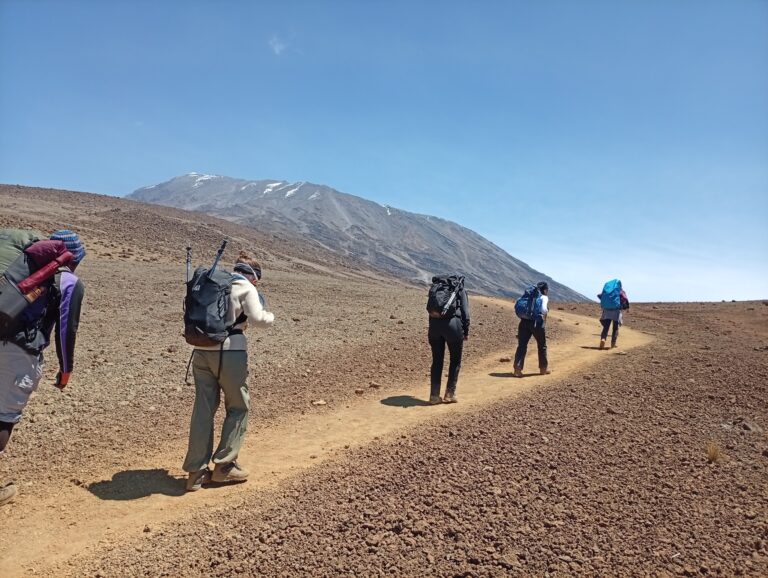
Assistant guide: Experienced mountain guide, typically positioned at the rear of the group. Monitors the group from behind, catches early signs of fatigue or distress, and supports the lead guide in medical assessments. On longer routes like Lemosho or the Northern Circuit, you may have more than one assistant guide.
Porters: Each client has 3–4 dedicated porters. They carry camping equipment, food, and client gear (within the 20kg TANAPA weight limit). Porters are not guides, but their wellbeing and working conditions reflect directly on the quality of the operation.
Cook: The mountain cook is underrated. Cooking at altitude requires significant skill — stoves behave differently, hydration needs are high, and appetite suppression above 4,000 metres means meals need to be appealing enough to actually eat.
How to Evaluate a Guide Team Before Booking
Most operators list their guide certifications on their website. Here’s how to go beyond the marketing to get actual answers.
Ask specifically: “What certifications do your lead guides hold?” The answer should include TANAPA licensing and at least Wilderness First Aid, with a note on which guides hold EMAT, WFR, or higher. If the answer is vague — “our guides are highly experienced and professionally trained” — that’s not an answer.
Ask about the guide-to-client ratio. 1:2–3 is strong. 1:4–5 is acceptable. 1:6 or more is a flag, especially on technically demanding routes or with less experienced groups.
Ask about medical equipment carried. Every team should carry: pulse oximeters, oxygen cylinders, a comprehensive medical kit, and communication devices. Ask specifically whether oxygen is carried on summit night.
Ask about descent authority. “Does the guide have full authority to call a descent, without operator approval?” should get a clear yes. If there’s any qualification — “we always try to reach the summit” or “we consult with the office” — that’s a problem.
Ask about the guide’s summit experience. How many times has the lead guide climbed? On which routes? An experienced guide on the Lemosho route, for example, will have deep knowledge of the Lava Tower acclimatisation section, the Western Breach, and the summit crater that a newer guide won’t have built up yet.
At Kilimanjaro Sky, you’ll meet your lead guide at a pre-climb briefing at the hotel the evening before your departure. This isn’t a formality — it’s your opportunity to ask these questions face to face, understand the plan, and begin the relationship that will define your climb.
Experience, Not Just Certification
Certifications matter. Experience matters more in the moment. The guide who has climbed Kilimanjaro 200 times has seen every variation of altitude response — the slow acclimatiser who turns it around on day 5, the fit marathon runner who crashes on summit night, the weather shift that changes the plan at 3am. That pattern recognition doesn’t come from a course. It comes from being on the mountain.
Our team has over 1,700 guided summits across all routes. Most of our lead guides have been climbing Kilimanjaro for over a decade. They know the camps, the weather windows, the pace adjustments that make the difference in the final hours.
You can read more about how we approach safety on the mountain, including the full evacuation protocol and the specific medical thresholds our guides use. The route pages give a sense of the terrain and acclimatisation profile for each option. And if you’re still in the planning stages, the beginners guide to climbing Kilimanjaro covers the whole picture from first steps to descent.
The Question Worth Asking Yourself
When you’re evaluating operators, this is the question that matters most: if I develop serious altitude illness at 4,800 metres in the middle of the night, am I confident that the guide beside me knows what to do, has the authority to do it, and has the equipment to do it well?
The answer should be an unambiguous yes. If it’s a maybe, keep looking.