The single most common gear mistake on Kilimanjaro isn’t bringing the wrong thing. It’s bringing too much of the right things and not enough of one critical thing: warmth for summit night.
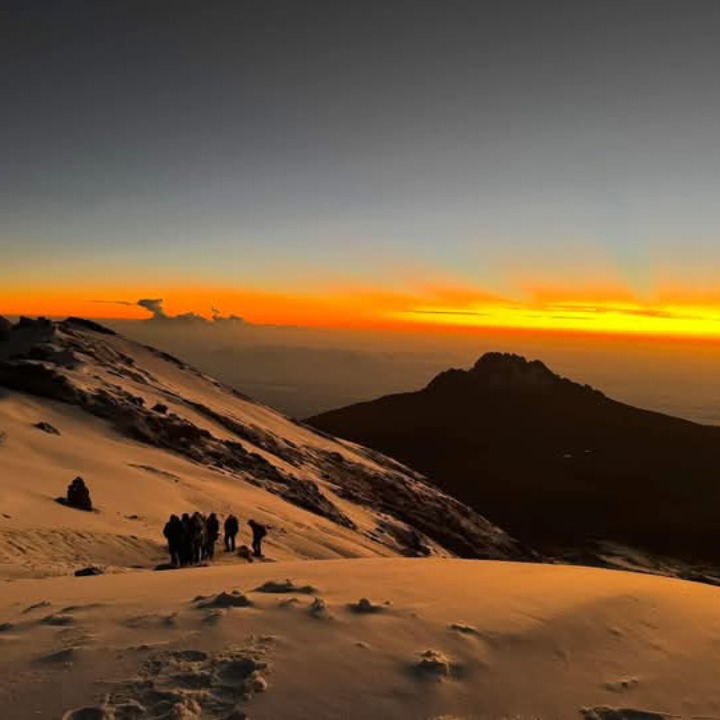
Climbers pack for a “mountain hike” and arrive with three pairs of trekking trousers and two rain jackets. Then they reach Barafu Camp at 4,673 metres at midnight, with temperatures around -15°C and wind cutting through every gap in their layers, and realize they packed for the wrong part of the mountain.
This list is built from what Kilimanjaro Sky guides have seen work — and not work — across more than 1,700 summits. It’s not exhaustive, and it’s not trying to be. It’s designed to help you pack smart.
The Core Principle: You’re Packing for Five Climates
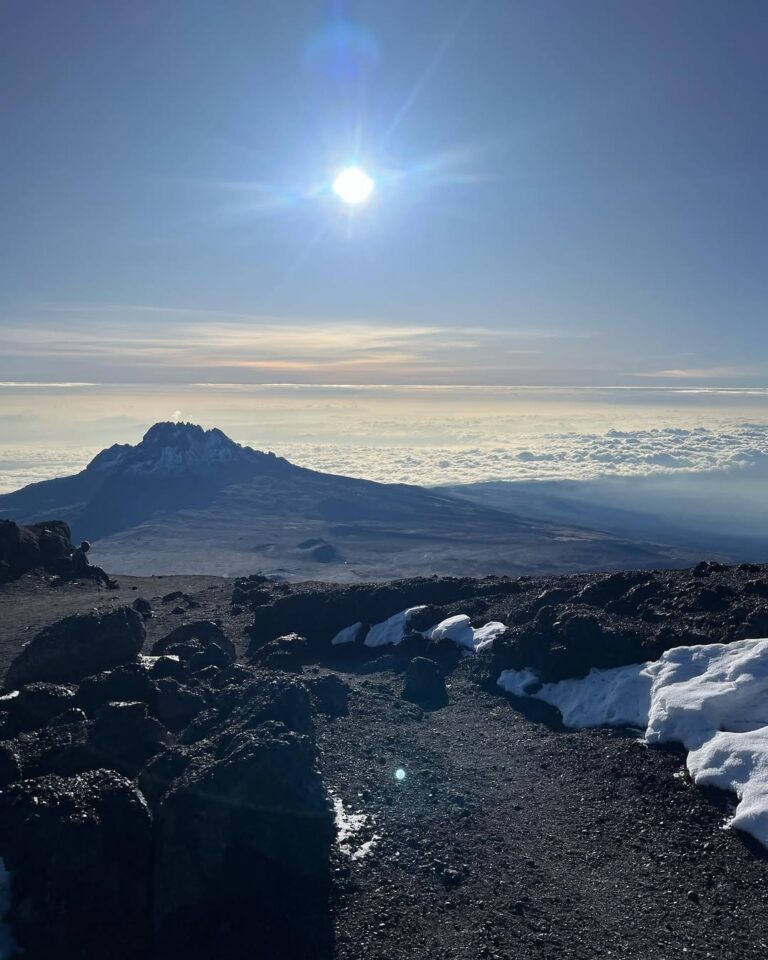
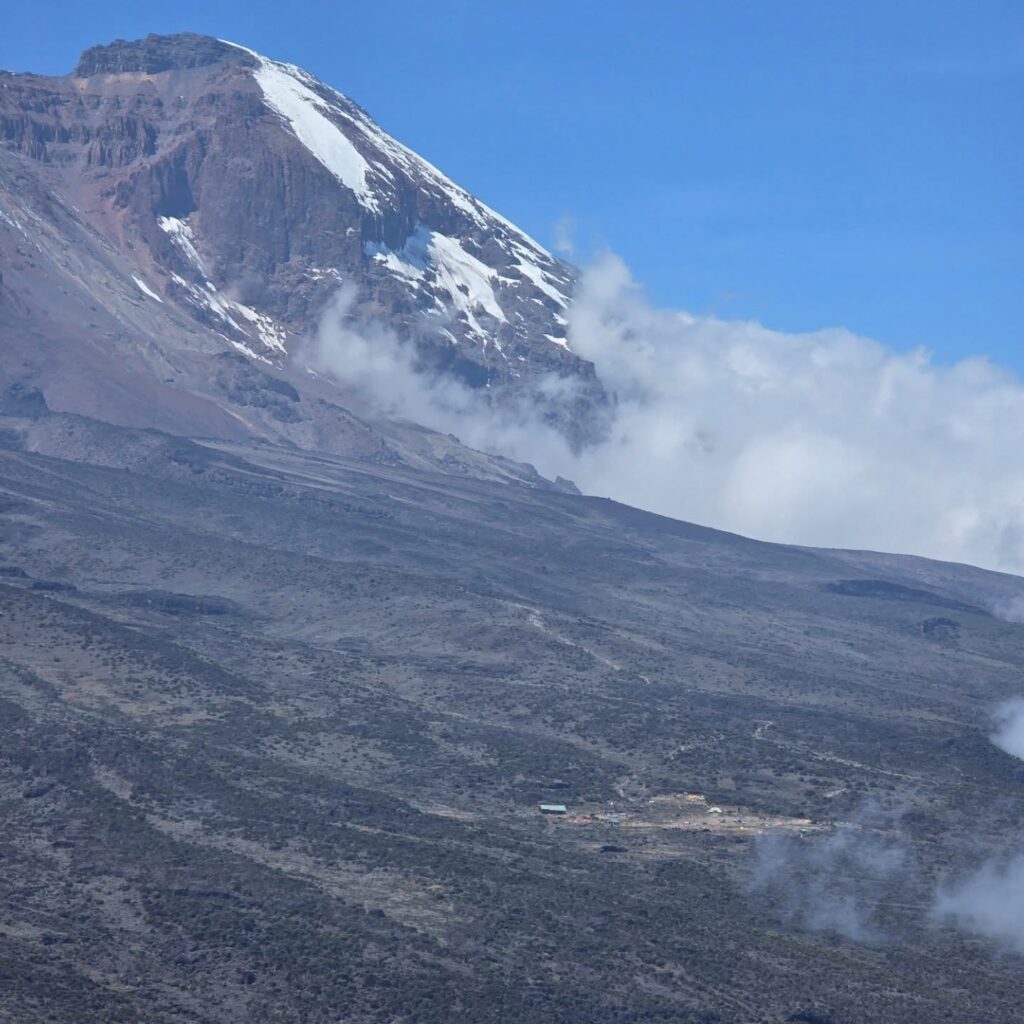
Kilimanjaro isn’t one climate. It’s five, stacked on top of each other, that you’ll move through in both directions. Starting at the gate (around 1,800 metres/5,905 ft, typically 25°C) and ending at Uhuru Peak (5,895 metres, -10°C to -20°C with wind chill), you’ll pass through rainforest, heath, moorland, alpine desert, and the arctic summit zone. Your gear needs to work across all of them.
The practical consequence: you need a real layering system, not just warm-weather hiking gear with a puffy jacket thrown in for the summit. The structure is three layers — base, mid, outer — that each serve a specific function and work together.
Base layer: Moisture-wicking material next to your skin. Its job is to pull sweat away from your body so you don’t get wet. Cotton fails at this immediately. When cotton gets wet, it loses insulating properties and stays wet. Above 3,000 metres, wet cotton creates a genuine cold problem. Merino wool or synthetic (polyester-based) base layers work. Nothing else does.
Mid layer: Insulation. A fleece for evenings at camp on the lower and mid-mountain. A serious down jacket for higher camps and summit night. The down jacket is not the item to economise on — more on this below.
Outer shell: Waterproof, windproof jacket with a hood. Its job is to keep weather out. Breathability matters because you’re moving and generating heat, and a non-breathable shell will soak you from the inside in sweat. Gore-Tex or equivalent is the appropriate standard. The rain jacket you use for a day hike at home is probably not enough for sustained wind at 5,800 metres (19,028 ft).
Get this system right and everything else is refinement.
Clothing: The Complete List
Upper body
- Moisture-wicking base layer tops (×2) — merino wool preferred; synthetic acceptable
- Mid-weight fleece jacket — for evenings at camp on the lower and mid-mountain
- Down jacket (serious weight, rated to at least -10°C) — the most important item on this list. Do not buy a thin fashion puffer and hope for the best. This is the layer between you and a very cold summit night.
- Waterproof/windproof hard shell jacket — with a good hood. Breathable. Full zip.
- Light trekking shirt (×1) — for warm days on the lower slopes
Lower body
- Moisture-wicking base layer bottoms / long johns (×2) — essential for summit night layering
- Trekking trousers (×2) — convertible zip-offs are practical; the ability to switch from full-length to shorts in the forest zones is useful
- Waterproof over-trousers / shell trousers — for summit night. These go over your base and mid layers and block wind and weather at altitude.
- Insulated trousers or down trousers (optional but recommended) — many climbers wish they had them by the time summit night arrives. Not strictly required; genuinely useful.
Extremities
- Warm hat that covers ears — wool or fleece. Summit night requires this; don’t rely on a hood alone.
- Balaclava or buff — the wind above 5,000 metres (16,404 ft) is cutting. Something that covers your face and neck is not optional at those temperatures.
- Liner gloves — thin, touchscreen-compatible if possible (you’ll want your phone accessible for photos near the summit)
- Insulated waterproof outer gloves — over the liner gloves. Mittens are warmer than fingered gloves for summit night if you run cold.
- Gaiters — useful above the Barafu zone, particularly on scree descent
Footwear
- Trekking boots — waterproof, ankle-supporting, broken in before you arrive. This is the single item most worth buying rather than renting, and the single item most often under-prepared.
- Wool or synthetic hiking socks (×4–5 pairs)
- Liner socks (×2 pairs) — reduce friction and blisters
- Camp shoes or sandals — your feet need a rest at the end of a hiking day. Lightweight, easy to slip on.
A Note on the Down Jacket
It deserves its own paragraph because it causes the most problems.
People frequently arrive with down jackets that aren’t adequate for summit conditions. “Rated to 0°C” is not enough. “Rated to -5°C” is marginal. You need a jacket rated to at least -10°C — and because temperature ratings are typically survival ratings rather than comfort ratings, -15°C is a more honest target for warmth.
This jacket will be bulky to pack and expensive to buy well. Both of those things are correct, and neither changes the situation. Summit night on Kilimanjaro is cold in a way that requires serious insulation. The North Face, Patagonia, Arc’teryx, and Mountain Hardwear all make appropriate options at various price points. Buy the right version.
Sleeping
Sleeping mat: Kilimanjaro Sky provides a sleeping mat at all camps. You don’t need to bring one.
Sleeping bag: You do need to bring one (or rent one). The temperature rating needs to be taken seriously.
For a six-to-eight-day route, your sleeping bag should be rated to at least -10°C to be genuinely comfortable through the cold nights at mid-mountain (3,800–4,200 metres/12,467-13,779 ft). A -5°C bag will have you cold and awake at Karanga or Barafu Camp. A -15°C bag is comfortable across the full range.
If you don’t own a suitable bag, quality sleeping bag rentals are available in Moshi. Ask specifically what temperature rating the bag has — not all rental bags are rated appropriately. Confirm before you arrive that you’re getting one that matches the mountain’s conditions, not just a bag that looks warm.
Equipment and Gear
Trekking poles (×2): Not optional in any practical sense. Trekking poles reduce knee strain on the descent — which can be 10–12 hours from summit to gate on routes like Machame — and provide stability on rocky, uneven terrain. Many people who arrive without them wish they’d brought them by day two. Most guide teams will source poles for clients who didn’t bring them, but quality varies; bring your own if you can.
Daypack (25–35 litres): What you carry yourself during hiking hours. Hydration system or water bottles, snacks, extra layers, camera, medical kit. The weight you’re carrying on your back for six to eight hours matters; don’t overload it.
Large duffel bag or dry bag (70–80 litres): Everything else — the majority of your gear — goes into this for porters to carry between camps. Must be soft-sided (not a hard frame case) and the total weight including the bag must stay under 20kg. Tanzania National Parks weighs loads at the entrance gate; Kilimanjaro Sky enforces this limit before the gate. The bag’s own weight counts.
Headlamp with spare batteries: Summit night begins around midnight and ends after sunrise — you’ll be moving in darkness for three to five hours total. Bring spare batteries; cold kills battery life at altitude and your primary set may drain faster than expected.
Water bottles or hydration reservoir (minimum 3 litres total capacity): Dehydration accelerates altitude sickness and is one of the most common preventable problems on the mountain. Hydration bladders can freeze at high altitude; some climbers prefer wide-mouth bottles that are harder to freeze. Bring insulating covers for any bladder hose you use above 4,500 metres (14,763 ft).
Sunglasses (UV-rated, wrap-around): UV radiation at altitude is intense even on overcast days — significantly more so than at sea level. Wrap-around or glacier-style lenses with UV400 rating are appropriate. Standard fashion lenses are inadequate above 4,500 metres (14,763 ft).
Health and Comfort
- Sunscreen SPF 50+ — reapply constantly above 3,000 metres (9,842 ft). The UV intensity at altitude surprises people.
- Lip balm with SPF — lips chap and crack in high-altitude dry air; bring a good balm and use it proactively
- Hand sanitizer
- Wet wipes — there are no showers above the gate. A pack of wet wipes per day is a reasonable allowance.
- Blister kit — Compeed (hydrocolloid plasters), medical tape, and the knowledge of how to use them before a blister worsens
- Personal medications including all prescriptions — ensure you have a full supply
- Acetazolamide (Diamox) if your doctor has prescribed it — discuss with a travel medicine doctor before departure. See our altitude sickness guide for context on how it works and what it does.
- Ibuprofen and paracetamol — headaches are common; having both gives you options
- Rehydration sachets — particularly useful if you develop GI issues at altitude
- Small personal first aid items — plasters, antiseptic wipes, medical tape
Your guide team carries a full medical kit, oxygen cylinders, and pulse oximetry equipment on every Kilimanjaro Sky climb. Your personal kit covers day-to-day minor issues, not emergencies.
What to Leave Behind
Cotton anything. T-shirts, jeans, cotton underwear, cotton socks. All of it stays in Moshi. Cotton fails at altitude — it gets wet and stays wet and cold.
A hard-case or wheeled luggage for the mountain. Porters carry soft bags and duffels. Rigid suitcases can’t be strapped, weighed, or carried efficiently. Leave hard cases at your Moshi accommodation.
Your entire wardrobe. Every extra kilogram in your daypack is a kilogram you carry for six to eight hours. On summit night, when every step above 5,000 metres requires deliberate effort, you will be grateful for every gram you left behind. Pack the minimum that covers the system.
Excessive electronics. Your phone is your camera. Cold destroys battery life at altitude — above 4,500 metres, a fully charged phone can drain to zero in a couple of hours in an outside pocket. Keep it close to your body (inner jacket pocket) to slow the drain. A small portable battery pack is useful. A laptop stays in Moshi.
Alcohol. Not a packing item, but worth stating: alcohol at altitude compounds altitude sickness, disrupts sleep quality, and accelerates dehydration. It’s not permitted in camps anyway; leave it for the celebration beer in Moshi after descent.
On Boots: Buy Them, Don’t Rent Them
If there is one item worth buying rather than renting for Kilimanjaro, it’s boots. And if there is one item most likely to ruin your climb through under-preparation, it’s also boots.
Trekking boots for Kilimanjaro need to be: waterproof, ankle-supporting, and broken in before you arrive. The “broken in” part is non-negotiable. Boots need 10–15 hours of actual wear across multiple walks before a seven-day climb. New boots on day one produce blisters that worsen every day and can become genuinely debilitating by day four or five.
The right category is mid-to-high cut waterproof trekking boots. Not trail runners (insufficient ankle support and insulation), not lightweight day hikers (not built for the cold and wet of higher camps), not mountaineering boots (overkill — Kilimanjaro requires no crampons on the standard routes). Think: Salomon, Scarpa, La Sportiva, Merrell, or Lowa in the waterproof trekking boot category.
If you’re not certain what you have is appropriate for Kilimanjaro, contact us before your trip. We’d rather answer a boot question in advance than watch you slow down on day five because your feet are in trouble.
The Gear That Makes the Most Difference
If you’re overwhelmed by the full list, focus on these:
- Down jacket rated to -10°C or below — the difference between a painful summit night and a manageable one
- Broken-in waterproof trekking boots — the most common source of preventable discomfort
- Trekking poles — knee and stability insurance for the descent
- Sleeping bag rated to -10°C or below — a cold night at 4,000 metres (13,123 ft) means you arrive at the summit push already tired
Everything else is important, but these four items are where most problems originate.
For any questions about specific gear or whether what you own is appropriate, reach out before your trip. The guide team is happy to advise — it’s a much simpler conversation at home than at the Kilimanjaro gate.
Further reading: How hard is it to climb Kilimanjaro? · Kilimanjaro altitude sickness: signs and prevention · Best time to climb Kilimanjaro
External sources: The North Face · Patagonia · Salomon · Scarpa · La Sportiva — referenced gear brands for boots and insulation layers