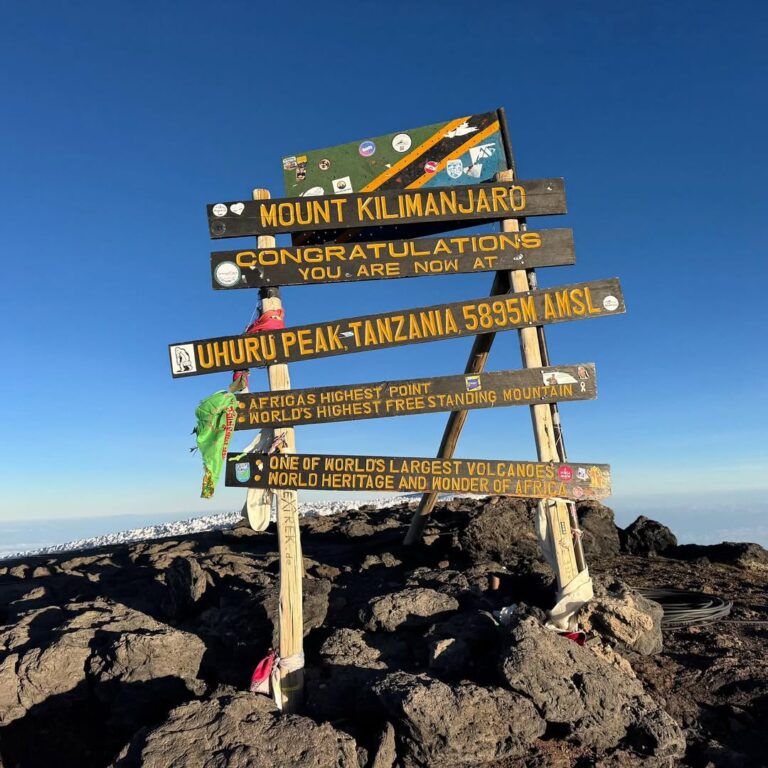
Most people who don’t reach Uhuru Peak are stopped not by fitness, but by altitude. Acute Mountain Sickness — AMS — is the body’s response to reduced oxygen at high elevation, and it’s the primary variable between climbers who stand at 5,895m (19,341 feet) and those who turn around before it.
Understanding how altitude sickness works, and what a responsible guide team does about it, is not about preparing yourself for failure. It’s about walking into the mountain with a clear picture of what you’re actually dealing with — and what the right response looks like if your body struggles.
This is practical information, not a disclaimer.
What Actually Happens at Altitude
At sea level, every breath delivers approximately 21% oxygen. That percentage doesn’t change at altitude — the proportion of oxygen in the air stays the same. What changes is air pressure. At 5,895m(19,341 ft.), air pressure is roughly half what it is at sea level, which means each breath delivers fewer oxygen molecules. Your blood oxygen saturation (SpO2) drops as a result.
Your body can adapt to this if given time. Acclimatisation is the process by which your cardiovascular system compensates — increasing red blood cell production, adjusting breathing patterns, redistributing blood flow. The critical word is time. Acclimatisation happens over days, not hours. It cannot be rushed, and no amount of fitness accelerates it.
When a climber ascends faster than their body can adapt, AMS develops.
This is why route duration matters so much — more than any single piece of gear, more than fitness level, more than the time of year you climb. An eight-day Lemosho gives your body significantly more adaptation time than a five-day Marangu, and that difference shows up in summit success rates. For a full comparison of how each route’s acclimatisation profile stacks up, see our route comparison guide.
Recognising Altitude Sickness
Acute Mountain Sickness (AMS)
AMS presents as a cluster of symptoms: headache, nausea, fatigue, dizziness, and disturbed sleep. Headache is typically the first sign and the most reliable early indicator.
One important distinction: almost every climber above 4,000m (13,123 ft.) experiences some fatigue, breathlessness on uphills, and disrupted sleep. Normal acclimatisation discomfort is not AMS. The difference is clinical — AMS involves a specific symptom cluster that signals your body is not adapting adequately, not just finding the altitude tiring.
Your guide team’s job is to make that distinction clearly and early. A good guide isn’t waiting for you to say something is wrong. They’re watching how you move, how you breathe, how quickly you’re speaking, whether you seem different than you did an hour ago.
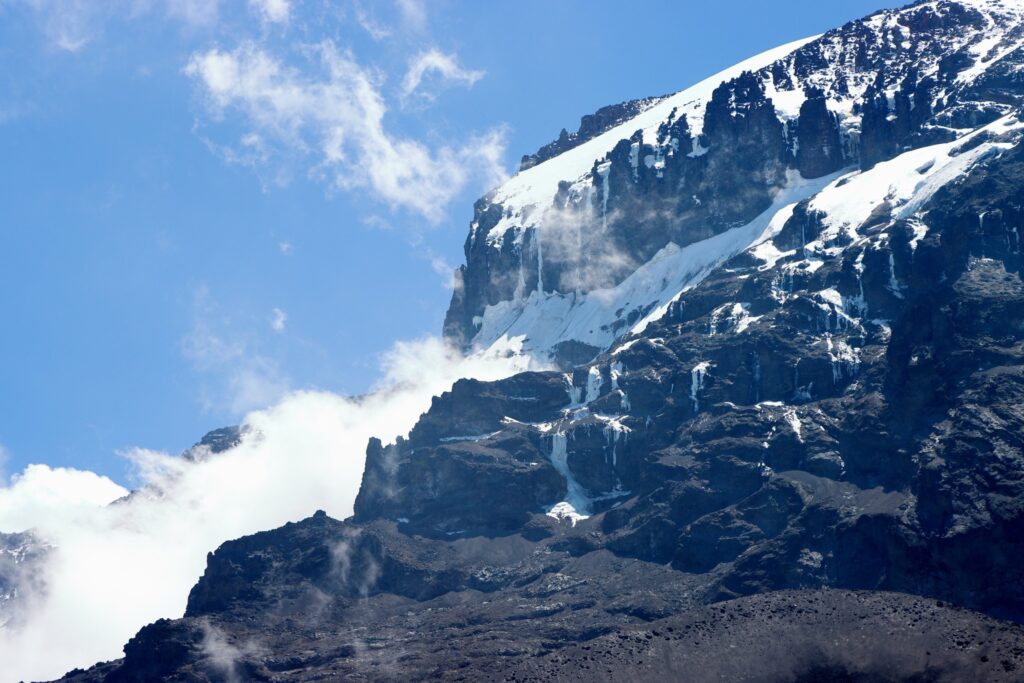
Kilimanjaro Sky
High Altitude Pulmonary Edema (HAPE)
HAPE is a more serious condition in which fluid accumulates in the lungs. It presents with breathlessness at rest, a persistent cough (sometimes with frothy or pink-tinged sputum), reduced exercise tolerance even compared to the prior day, and a crackling sensation when breathing. HAPE requires immediate descent — it is life-threatening if not addressed.
High Altitude Cerebral Edema (HACE)
HACE involves fluid accumulation in the brain. Symptoms include severe headache unresponsive to medication, confusion, loss of coordination (stumbling gait), and extreme fatigue. HACE is rare but potentially fatal. Immediate descent is mandatory.
The Key Point About Fitness
Altitude sickness is not a function of fitness. Elite athletes get AMS. Sedentary people don’t. There is no reliable predictor from physical condition. The most meaningful indicator is prior high-altitude experience — if you’ve been above 4,000m(13,123 feet) before without difficulty, that’s useful information. If you haven’t, there’s genuine uncertainty about how your body will respond.
This is one of several reasons why guide qualifications, monitoring protocols, and guide-to-client ratios matter as much as they do. A well-trained guide with proper equipment catches developing problems early, when the response options are still straightforward. A guide who’s watching ten clients from a distance with no oximeter catches problems late, when they’re harder to manage.
How Kilimanjaro Sky Monitors Your Altitude Response
Pulse Oximetry
Pulse oximetry — measuring blood oxygen saturation through a clip on your fingertip — is the primary tool for objective altitude assessment. It gives an immediate, objective reading that neither guides nor clients can second-guess.
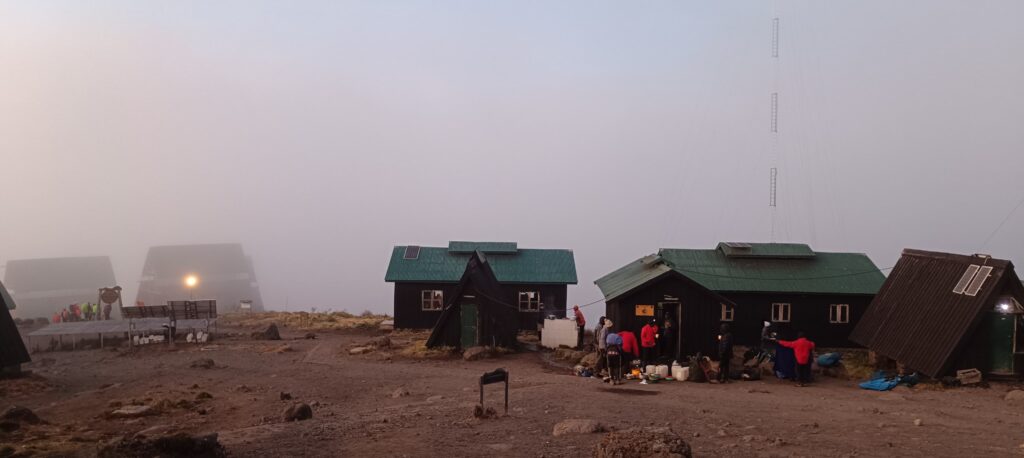
At Kilimanjaro Sky, your SpO2 levels are checked at minimum twice daily: morning and evening. Additional checks happen whenever a guide observes a change in how you’re moving, breathing, or presenting. This is continuous, attentive monitoring — not a daily checkbox.
The threshold for intervention is specific: an SpO2 reading below 75%, or a drop of more than 5% from your prior reading, triggers immediate reassessment and increased monitoring frequency. These numbers are the operating standard, not rough guidelines.
The Four-Tier Evacuation Protocol
When a serious altitude emergency develops, a pre-planned response is faster and better organised than an improvised one. At Kilimanjaro Sky, the response protocol has four tiers:
Tier 1 — Assessment and stabilisation at altitude. Pulse oximetry, clinical assessment, supplemental oxygen as needed. Addresses symptoms that respond to rest and oxygen without requiring immediate movement. If the client improves, increased monitoring continues.
Tier 2 — Assisted descent. If the client can walk with support, descent begins immediately — the most effective treatment for altitude sickness is always going lower. If the client cannot walk, the team carries stretcher capability for manual evacuation.
Tier 3 — Vehicle evacuation. Tanzania National Parks coordinates vehicle access from lower camps. Mweka Gate and Marangu Gate are the primary lower pickup points. From there, transport is arranged to KCMC Hospital (Kilimanjaro Christian Medical Centre) in Moshi, which handles altitude-related emergencies regularly and has specific experience with Kilimanjaro cases.
Tier 4 — Helicopter evacuation. This option has been used. Helicopter evacuation is available for critical emergencies where ground evacuation is too slow. It requires valid altitude insurance covering at least 6,000m (19,685ft.), or direct client funding. This is why Kilimanjaro Sky requires altitude insurance as a pre-condition for climbing — not as a formality, but because the ability to use this tier when needed is part of the safety infrastructure.
If a climbing company you’re evaluating can’t describe a specific evacuation sequence, that company hasn’t fully thought through its responsibility to you. Full details on our protocols are on our safety page.
Acclimatisation: The Most Effective Prevention
The most effective thing you can do to prevent severe altitude sickness is choose a longer route. Not a harder route — a longer one.
The additional days on an eight-day Lemosho versus a five-day Marangu aren’t extra hiking days. They’re additional acclimatisation cycles at progressively higher altitudes, each one giving your cardiovascular system more time to adjust before the next gain. That physiological adaptation is what drives the difference in summit success rates between routes.
The “climb high, sleep low” principle — built into the design of routes like Machame and Lemosho — reinforces this. On these routes, you gain significant altitude during the day (passing the Lava Tower at 4,630m (15,190ft.), for example) and then descend slightly to camp. That up-down pattern triggers additional acclimatisation response compared to a simple linear ascent.
Pace is the other variable your guides control. Pole pole — slowly, slowly — is the phrase you’ll hear most often on a Kilimanjaro climb. It’s not a cultural phrase or a tourism cliché. It’s a physiological protocol. Moving at a pace that keeps your heart rate in a sustainable zone means your body isn’t accumulating oxygen debt faster than it can recover. A guide who lets clients race up the lower trail is trading acclimatisation response for false confidence.
Diamox (Acetazolamide): Discuss It With Your Doctor
Acetazolamide is a prescription medication that accelerates acclimatisation by stimulating more frequent, deeper breathing — which raises blood oxygen saturation. The evidence for its effectiveness in reducing AMS symptoms is solid. It’s widely used by climbers on high-altitude routes.
Important caveats:
It is not a substitute for adequate route duration. Diamox can support acclimatisation; it cannot replace acclimatisation time. A climber on Diamox doing a five-day Marangu is not equivalent to a climber without Diamox doing eight days on Lemosho.
It has side effects. The most common are tingling in the fingers, toes, and lips; increased urination; and a mild metallic taste with carbonated drinks. These are uncomfortable but not harmful.
It requires a prescription. Your guides will not advise you on whether to take it or in what dose. That’s a conversation for a travel medicine doctor at home before your trip — ideally at least six weeks before departure to allow time for consultation and prescription. For a clinical overview of acetazolamide use at altitude, the Wilderness Medical Society’s altitude illness guidelines and CDC travel health guidance for Tanzania are both useful starting points for that conversation with your doctor. UK-based climbers can find equivalent guidance at NHS Travel Health Pro.
If you’ve had previous AMS at altitude, or if you’re climbing a shorter route, it’s worth raising with your doctor specifically.
Hydration and Its Effect on Altitude Response
Dehydration compounds altitude sickness in a direct physiological way: it reduces blood volume and thickens blood, which makes oxygen transport less efficient — exactly what you don’t want when you’re already fighting for oxygen at altitude.
At elevation, your body loses fluid faster than it does at sea level. Increased respiration rates and the dry air above 4,000m(13,123ft.) both accelerate water loss. Your sense of thirst is also a less reliable indicator at altitude than at sea level — you can be dehydrating without feeling particularly thirsty.
Three to four litres of water daily on the mountain is a reasonable baseline. Your guides will prompt you throughout the day, particularly on summit-approach days. Carry at least 3 litres of water capacity in your pack.
Alcohol impairs sleep quality and accelerates dehydration. A single beer at altitude has a disproportionate effect compared to at sea level — it’s not a good trade-off during the climb itself.
What Clients Often Ask Before the Climb
“If I get altitude sickness, does that mean I don’t summit?”
Not necessarily. Mild AMS — a headache, some nausea — is common above 4,000m(13,123ft) and often resolves with rest, hydration, and acclimatisation time. The question is how severe the symptoms are and whether your body recovers with rest at the same altitude. Your guide team makes that assessment; it’s not a binary you decide by yourself.
“Can I tell in advance if I’ll get altitude sickness?”
Prior high-altitude experience is the most useful predictor. If you’ve been at 4,000+ metres-13,123 feet+ before without difficulty, you have relevant information. If you haven’t, there’s genuine uncertainty. Altitude sickness is not correlated with age, sex, or fitness level in any reliable way — it’s genuinely individual.
“What if my guide wants me to descend and I don’t want to?”
Your guide’s assessment takes precedence. This is non-negotiable on a Kilimanjaro Sky climb. Guides have full authority to enforce descent based on their clinical assessment, and they exercise it. The summit will be there; the risk of pushing a serious altitude emergency is not worth taking.
The Bottom Line
Altitude sickness is manageable with the right support, the right route duration, and the right monitoring. Most climbers who approach Kilimanjaro properly — on a longer route, with experienced guides, with their body’s signals treated seriously — reach the summit.
The guide team at Kilimanjaro Sky has led more than 1,700 summits across more than 20 years of combined experience on this mountain. They have seen altitude affect people at every point on the trail, in every condition, at every fitness level. They know what normal acclimatisation looks like, and they know what a developing problem looks like before it becomes a crisis.
Trust what they observe. Tell them early when something feels off. Move pole pole.
That’s the protocol, and it works.
Further reading: Kilimanjaro routes compared — acclimatisation profiles · How hard is it to climb Kilimanjaro? · Best time to climb Kilimanjaro
External sources: Wilderness Medical Society altitude illness guidelines · CDC Tanzania travel health · NHS Travel Health Pro — Tanzania · KCMC Hospital, Moshi