There’s a persistent misunderstanding about oxygen on Kilimanjaro that’s worth addressing clearly: supplemental oxygen is a medical emergency resource, not a performance enhancement, not a summit shortcut, and not a standard feature of the ascent. It is carried on every Kilimanjaro Sky climb because emergencies happen — and when they do, having oxygen immediately available can change the outcome significantly.
Understanding what oxygen is for on Kilimanjaro, when guides administer it, and why it can’t replace proper acclimatisation will help you approach the mountain with realistic expectations.
Why Supplemental Oxygen Exists on Kilimanjaro
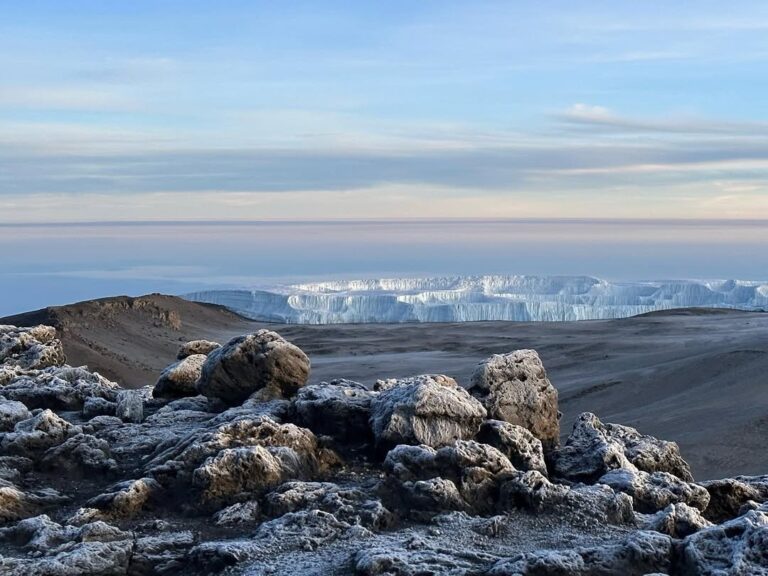
At 5,895 metres (19,340 ft), the atmospheric oxygen concentration is roughly 49% of what you breathe at sea level. Your body acclimatises to this reduction over days — producing more red blood cells, adjusting blood chemistry, increasing breathing rate. The acclimatisation process is why longer routes like Lemosho (8 days) and the Northern Circuit (9–10 days) have higher success rates than shorter ones like Marangu (5 days). Time on the mountain, not fitness, drives acclimatisation.
When acclimatisation fails — when acute mountain sickness progresses to high-altitude pulmonary oedema (HAPE) or high-altitude cerebral oedema (HACE) — supplemental oxygen is the most immediate clinical intervention. It raises blood oxygen saturation, buys time, and supports the patient while the critical intervention — descent — is organised.
On Kilimanjaro, where helicopter evacuation can take hours depending on weather and aircraft availability, the oxygen in your guide’s pack is what bridges the gap between identifying a medical emergency and resolving it through descent.
How Kilimanjaro Sky Carries Oxygen
Every Kilimanjaro Sky lead guide carries oxygen cylinders as part of the standard medical kit. This is not optional equipment — it’s part of the kit that goes up the mountain regardless of weather, route, or group size.
The medical kit also includes: pulse oximeters, a full first aid kit, communication devices, and a portable stretcher capability for assisted evacuation. The oxygen cylinder is a D-size or E-size portable medical oxygen unit with a regulator and mask. Flow rate is typically set at 2–4 litres per minute for standard emergency use, which provides significant elevation equivalent improvement in blood oxygen saturation within minutes of administration.
Our guides are trained in oxygen administration as part of their Wilderness First Aid and Emergency Medical Assistant of Tanzania certifications. They know when to use it and how to use it correctly. Oxygen administered to someone who doesn’t need it is harmless. Oxygen not administered to someone who does need it is a problem. The protocols lean toward early administration when AMS has progressed to the point of concern.
When Oxygen Is Administered: The Clinical Triggers
Supplemental oxygen on Kilimanjaro is administered in response to specific clinical indicators, not in response to a client’s preference or discomfort.
The primary triggers:
SpO2 readings below 75%, or a drop greater than 5% from the previous reading, prompt reassessment and increased monitoring. A reading below 70% in combination with symptoms is a strong indicator for oxygen administration and preparation for descent.
Symptoms of serious altitude illness: confusion or altered mental status (a key HACE indicator), persistent cough producing pink or frothy sputum (a HACE indicator), breathlessness at rest (HAPE indicator), severe headache unresponsive to ibuprofen and hydration, loss of coordination. Any of these override pulse oximetry numbers — symptoms determine the response, not measurements alone.
Combined clinical picture: A client with mild HAPE symptoms and a SpO2 of 78% who is deteriorating over two hours represents a different emergency than the same numbers in a stable, improving client. Guides assess the trend, not just the number.
When oxygen is administered, it typically accompanies the initiation of the four-tier evacuation protocol — the clinical intervention of oxygen buys time while the logistics of descent and evacuation are organised. Oxygen is not a treatment for altitude illness. It’s support while the actual treatment — lower altitude — is achieved.
What Oxygen Cannot Do
It cannot replace acclimatisation. The acclimatisation process is physiological — your body adapts to reduced oxygen by producing more red blood cells and adjusting blood chemistry. This takes days and cannot be shortcut. Breathing supplemental oxygen doesn’t trigger acclimatisation. It provides temporary support.
It is not a summit performance tool. On 8,000-metre (26,246 ft) peaks in the Himalayas, supplemental oxygen is routinely used by climbers during the ascent because the altitude is genuinely beyond the human body’s long-term adaptability range. Kilimanjaro’s summit, at 5,895 metres (19,340 ft), is achievable without supplemental oxygen for the vast majority of climbers — it’s within the range where acclimatisation can adequately prepare your body. We don’t offer “summit oxygen” as a service because it isn’t appropriate or necessary on this mountain.
It cannot reverse serious HAPE or HACE without descent. Once high-altitude pulmonary oedema has progressed significantly, supplemental oxygen reduces symptoms but doesn’t cure the condition. The fluid in the lungs doesn’t clear while you’re still at altitude. Oxygen keeps the patient stable while you get them lower. It is not a holding pattern — it’s a bridge.
It cannot substitute for proper route choice and timing. Choosing a longer, better-acclimatised route is more effective than carrying oxygen. The 8-day Lemosho route or the 9-day Northern Circuit give your body the time to adapt that a 5-day Marangu route doesn’t. No amount of oxygen addresses the physiological deficit from rushing.
The Difference Between Oxygen and Helicopter Evacuation
These two things address different moments in the emergency management sequence and are not interchangeable.
Oxygen is immediate — it’s in the guide’s pack, administered at altitude within minutes of the decision to use it. It manages the acute situation while the next steps are organised.
Helicopter evacuation resolves the altitude exposure itself — it gets the patient to lower altitude (and to hospital if needed) far faster than assisted descent. A helicopter that lifts from Barafu Camp (4,600m) to KCMC Hospital in Moshi (800m) achieves a 3,800-metre (12,467 ft) altitude drop in 20–30 minutes. Assisted or stretcher descent on foot takes 3–8 hours for the same distance.
The relationship between the two is sequential, not either/or. In a serious case: oxygen is administered, descent is initiated, and helicopter evacuation is requested if the severity warrants it. Our guide to helicopter rescue on Kilimanjaro covers the full process and cost in detail.
A Note on Diamox (Acetazolamide)
Diamox is a prescription medication commonly used to prevent and reduce altitude sickness symptoms. It works by acidifying the blood, stimulating faster breathing and thus faster acclimatisation. It’s not an oxygen supplement — it doesn’t increase oxygen in your blood. It helps your body process the oxygen available more efficiently.
Diamox is a separate subject from supplemental oxygen, but they’re often conflated. Diamox is a preventative medication taken before and during a climb. Supplemental oxygen is an emergency intervention administered in response to acute illness. They address different things at different points.
If you’re considering Diamox, speak to your doctor before the climb. It’s not appropriate for everyone, has side effects (tingling in the fingers and toes, increased urination), and interacts with some medications. But for climbers with a history of altitude sensitivity, or those choosing shorter routes, it’s worth discussing. Our guides can answer questions about it from an operational perspective, but the prescription decision belongs to your doctor.
What to Know Before Your Climb
When you climb with us, oxygen is in the medical kit and your guide knows exactly when and how to use it. You don’t need to think about it as logistics. What you do need to understand is this: the mountain requires acclimatisation. The correct route length, the right pace, and adequate rest days are the foundation of a successful, safe ascent.
Oxygen supports you if acclimatisation isn’t enough. It doesn’t substitute for it.
Our safety page goes into the full medical protocol in detail, including SpO2 thresholds, the evacuation framework, and guide certification requirements. The altitude sickness guide covers AMS prevention and recognition. And if you’re in the early stages of deciding which route to take — a decision that affects your acclimatisation profile more than almost anything else — the routes overview is the right starting point.
The mountain is manageable. Preparation is the best insurance you have — and oxygen in the guide’s kit is there for the edge cases, not the standard ones. Choose a long enough route, follow your guide’s pace, and let the acclimatisation process do what it’s designed to do. That’s the system that gets people to Uhuru Peak safely, day after day.