There’s a lot of generic Kilimanjaro advice online. Some of it is useful, some of it is recycled from twenty years ago, and some of it is just wrong. This post is the opposite — it’s the specific advice our guides give every client in the pre-climb briefing in Moshi, distilled down to what actually changes outcomes on the mountain.
We’ve organised it by what matters most. Start at the top.
1. Go Slower Than You Think
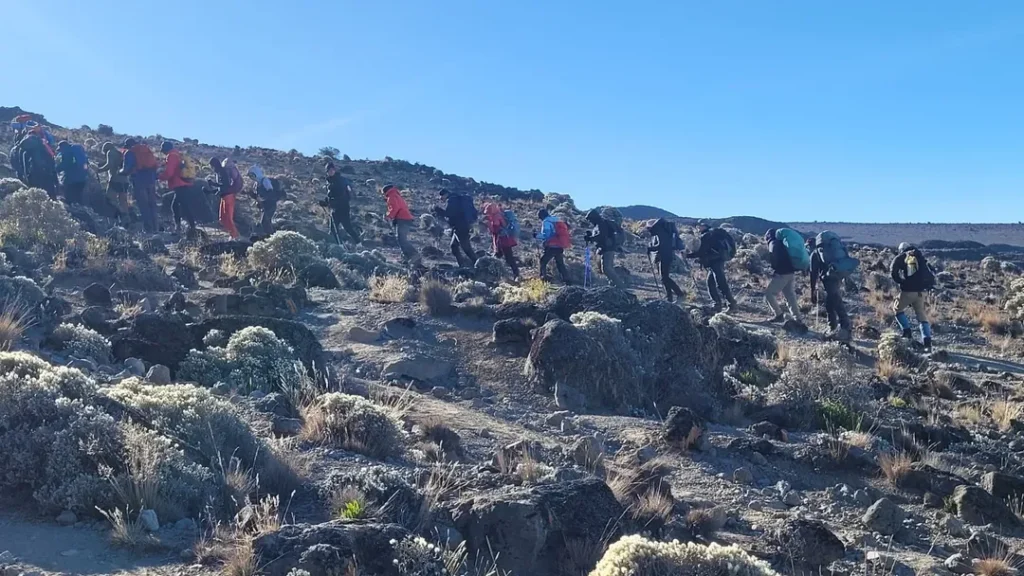
Pole pole. Slowly, slowly. You’ll hear it from every guide on every route, and it’s not a catchphrase — it’s the single most important physical skill on Kilimanjaro.
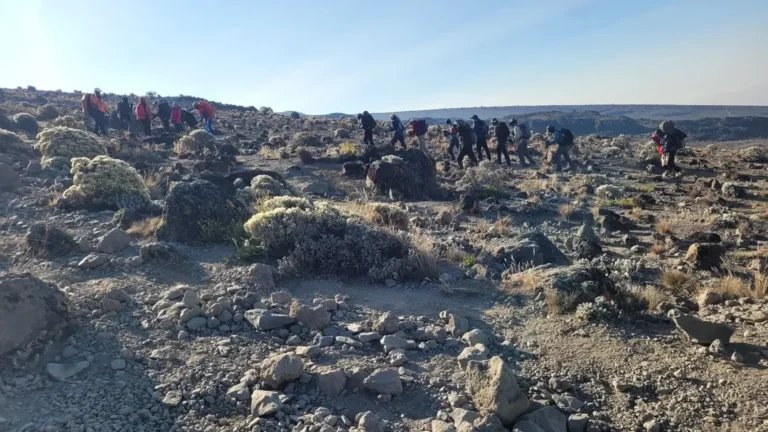
Most new climbers walk too fast for the first three days. The pace feels easy at sea level, and the trail in the forest zone is gentle enough that you can push it. Don’t. The climbers who summit are the ones who walk slowly from day one, not the ones who start strong and crash at 4,500 metres.
Practical rule: if you can hold a full conversation while walking, you’re at the right pace. If you’re short of breath, slow down. If your guide tells you pole pole, you’re already too fast.
This is counterintuitive for fit climbers especially. Strong cardiovascular fitness tempts you to walk at a pace that’s unsustainable at altitude. The mountain doesn’t care how fit you are — it cares how slowly you’re willing to move.
2. Drink More Water Than Feels Reasonable
Four litres a day minimum. More if you can. This is not a round number — it’s what the physiology requires at altitude, and it directly affects your acclimatization.
Dehydration mimics altitude sickness almost perfectly. Headaches, nausea, fatigue, poor sleep — all the early AMS symptoms. Most climbers who feel awful on day three are not acclimatising badly. They’re dehydrated.
Practical rules:
- Start hydrating two days before the climb.
- Carry three litres in your daypack (bladder and/or insulated bottles). Refill at every camp.
- Add electrolytes — hydration tablets are cheap, effective, and make a real difference.
- Pee frequently. If your urine is dark, drink more. If you haven’t peed in four hours, drink more.
- On summit night, keep your water in an insulated carrier. Frozen water is useless water.
Our drinking water on Kilimanjaro post covers the specifics of how your water is boiled, treated, and provided along the route.
3. Eat Even When You Don’t Want To
Altitude suppresses appetite. By day three or four, the meals in front of you will look unappealing and your stomach will feel off. Eat anyway.
Your body is working harder than usual just to function at altitude. Caloric deficit compounds fatigue, slows acclimatization, and makes summit night meaningfully harder. Small portions, often, are better than skipping meals.
Practical rules:
- Have porridge or eggs for breakfast even when you don’t feel like it.
- Keep your snacks in your daypack: nuts, trail bars, dried fruit, chocolate. Eat something every 60–90 minutes on the trail.
- If your stomach is unsettled, ask the cook for ginger tea or uji (a smooth porridge). Both help.
- On summit night, force yourself to eat something small every couple of hours — a square of chocolate, a half bar, anything.
Our food on Kilimanjaro post walks through what’s actually served on the mountain.
4. Choose a Longer Route
The single biggest factor in summit success, outside of the operator’s safety and guide quality, is how many days you spend on the mountain. More days means better acclimatization. Better acclimatization means more energy, less altitude sickness, higher chance of summit.
The route math:
- 5-day Marangu: around 65–70% summit success industry-wide.
- 6-day Machame: 75–80%.
- 7-day Machame: 85–90%.
- 8-day Lemosho: 90–95%.
- 9–10 day Northern Circuit: highest success rates, often 95%+.
If budget allows, the 8-day Lemosho route is the sweet spot for most first-time climbers — strong acclimatization profile, quieter opening days, high success rate. If you want the quietest route and the most complete acclimatization, the Northern Circuit is the choice.
The false economy is climbing the 5-day Marangu to save money. A failed summit bid costs you the whole investment.
5. Test Your Gear Before You Fly
Never put a piece of gear on the mountain for the first time. Boots especially.
New boots cause blisters. New packs rub. New jackets turn out to have a zipper that catches. Finding this out on day one of the climb is miserable and often avoidable.
Practical rules:
- Break in your boots with at least 50 km of actual hiking before the climb, including some with elevation gain and a loaded daypack.
- Wear your full summit-night layering system on a training hike in cold conditions. Check the layers work together.
- Test your daypack with realistic weight (3–4 kg) on a multi-hour walk.
- Test your hydration system. Bladders leak. Bite valves freeze. Bottles break.
- Try your headlamp on a dark night, with the actual batteries you’ll bring.
Our Kilimanjaro packing list covers every gear category in detail.
6. Train Properly, Not Just Enough
The common fitness advice — “if you can walk for six hours, you’re fine” — undersells what Kilimanjaro requires. Summit night is 12–16 hours on your feet, at altitude, in the cold, with minimal sleep. That needs actual training.
Practical training minimums:
- Aerobic: run or brisk-walk 10 km in under an hour, three times a week, for at least three months before the climb.
- Long hikes: every 1–2 weeks, do a 4–6 hour hike with 20–30 kg on your back, preferably with elevation gain.
- Leg strength: squats, lunges, step-ups. Your quads and glutes take the load on the scree and descent.
- Back-to-back days: do two or three consecutive days of training once a month to simulate the cumulative fatigue of the trek.
More detail in our how fit do you need to be to climb Kilimanjaro guide.
7. Layer for Summit Night Specifically
Summit night is the coldest you’ll ever be on Kilimanjaro — possibly the coldest you’ll ever be, period. Temperatures between Barafu and Uhuru Peak run from -10°C to -20°C with wind chill. The climbers who suffer most are almost always under-layered.
The summit-night layering system our guides recommend:
- Merino wool or synthetic base layer (top and bottom).
- Mid-layer: insulated fleece or a mid-weight synthetic.
- Heavy fleece or lightweight down jacket.
- Shell jacket and shell pants.
- Expedition-weight down jacket (over everything else).
- Warm hat, balaclava, and buff.
- Inner glove liner plus a heavy insulated glove.
- Two pairs of wool socks.
- Gaiters.
- Double-insulated water container or bladder with tube kept warm.
You’ll be shedding the outer down jacket during the climb as you warm up, then pulling it back on as the wind hits at Stella Point. Plan for the shedding and re-layering — don’t bury any layer.
Our Kilimanjaro summit night post covers the full experience in detail.
8. Know the Early Signs of Altitude Sickness
Every climber will feel some altitude. Mild symptoms — headache, fatigue, reduced appetite, slight shortness of breath — are normal above 3,000 m. These aren’t the danger signs.
The warning signs, in order of escalation:
- Persistent headache that doesn’t respond to water and paracetamol
- Nausea or vomiting
- Sleep disturbance with vivid dreams
- Severe fatigue beyond what the day’s effort justifies
- Shortness of breath at rest (not just on the uphill)
- Persistent dry cough
- Confusion, disorientation, or loss of coordination
The last three — shortness of breath at rest, persistent cough, and confusion — are the mandatory-descent signs. Our guides run pulse oximetry checks morning and evening, but what matters most is honesty from the climber. If you’re feeling worse than you’re saying, say so.
Our Kilimanjaro altitude sickness post covers this in depth, and our safety page explains our evacuation protocol.
9. Talk to Your Guide Honestly
Kilimanjaro guides are skilled at reading climbers, but we’re not telepathic. The climber who says “I’m fine” while not actually being fine gives us less to work with than the one who says “I’m feeling rough, my head is pounding, and I’m worried.”
Say what you’re feeling:
- Sleep quality the night before
- Appetite
- Headaches — where, how severe, how persistent
- Breathing at rest
- Energy level compared to yesterday
This information changes how your guide paces the day, when they insist on an extra rest, whether to start summit night earlier or later, and whether a concerning symptom is trending up or down. Guides are there to make calls — but they need real data to make them.
10. Decide Before the Climb That You’ll Listen to Your Guide
Every year, a handful of climbers push past the point where their guide has advised them to descend. It almost never ends well. The climbers who insist on continuing against guide advice have higher rates of serious altitude illness, emergency evacuation, and — rarely but real — worse outcomes.
Our guides have full authority to call a descent, and we train them to use that authority. What we need from climbers is the pre-commitment: if my guide says descend, I descend. Make that decision before you ever set foot on the trail. It takes the pressure off you in the moment.
11. Take the Tanzania Part Seriously
Kilimanjaro isn’t just a climb. It’s Tanzania. Most climbers who have the most memorable trips are the ones who gave themselves a day or two in Moshi before the climb and added a safari or cultural experience after.
- Spend a day in Moshi: the markets, the coffee, the view of Kilimanjaro from town.
- Add the Ekanubi Underground experience — a cultural visit with the Chagga community about the mountain’s lower slopes.
- Consider a coffee tour in the Kilimanjaro foothills.
- Add 3–5 days of safari in the Serengeti or Ngorongoro Crater.
Our packages page outlines combined options. The climb is the main event; the rest of the trip is what makes it a trip.
12. Tip Your Crew Directly and Fairly
Porters and guides on Kilimanjaro depend on fair tipping. Tanzania National Parks set guidance figures, but the practical rule is that tips should reflect what the crew has actually done — carried 20 kg of your gear, made your meals, pitched and struck your camp, kept you safe for a week.
Our Kilimanjaro tipping guide covers the specifics — who gets what, how to distribute the tips, and how we structure the tipping ceremony on the final morning. Tipping matters. It’s how the mountain economy works.
13. Take the Descent Seriously
Most injuries on Kilimanjaro happen on the descent, not the ascent. Climbers have just summited, they’re exhausted, and they’re walking down steep scree with shot legs. Ankles roll, knees give out, people fall.
Practical rules:
- Use trekking poles. Both of them.
- Walk slowly, especially on the scree sections.
- Keep eating and drinking even on descent day.
- Don’t rush — you’ve got hours ahead of you, and there’s no prize for finishing early.
14. Talk to Yourself Well on Summit Night
The last tip is the most intangible. Between Barafu and Stella Point, around 3 a.m., somewhere above 5,000 metres, most climbers hit a mental low. You’re cold, tired, breathing is hard, and the summit feels impossibly far away.
This is not a fitness problem. It’s not an altitude problem. It’s a point where most people’s inner voice turns against them.
The climbers who summit are not the ones who feel strongest at this moment — they’re the ones who’ve decided, in advance, how they’ll talk to themselves when it gets hard. Break the climb into pieces. “Just to that rock.” “Just to the next guide check.” Count your steps between breaks. Let the negative voice talk but don’t follow its instructions.
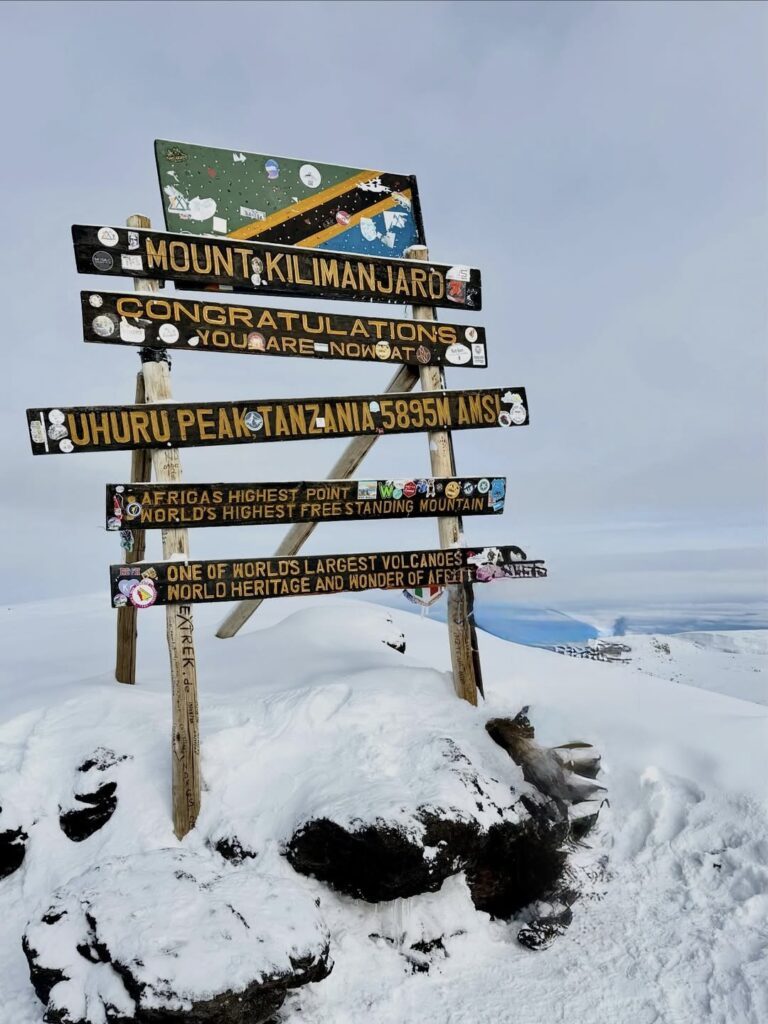
This is what our guides are watching for on summit night, too — the climber who goes quiet and stops responding is the one who needs a check-in. Say what you’re feeling, keep moving, and trust that the sunrise from Uhuru Peak is worth it. Ask anyone who’s been there.
Our Honest Take
Most of the climbers who summit Kilimanjaro do so not because they were the fittest, the most experienced, or the best equipped. They summit because they paced correctly, hydrated, listened to their guides, and took the small decisions seriously throughout the week. The big moments — the summit push, the final hundred metres to Uhuru — matter, but the climb is made on the boring, repeating choices of the preceding six days.
If you prepare well and climb with an operator who takes safety and pacing seriously, Kilimanjaro is reachable. If you want to talk through specifics for your climb — route, fitness, timing, what to expect — get in touch with our team in Moshi. We’d rather have the conversation before you book than after you’re in trouble at Karanga Camp.