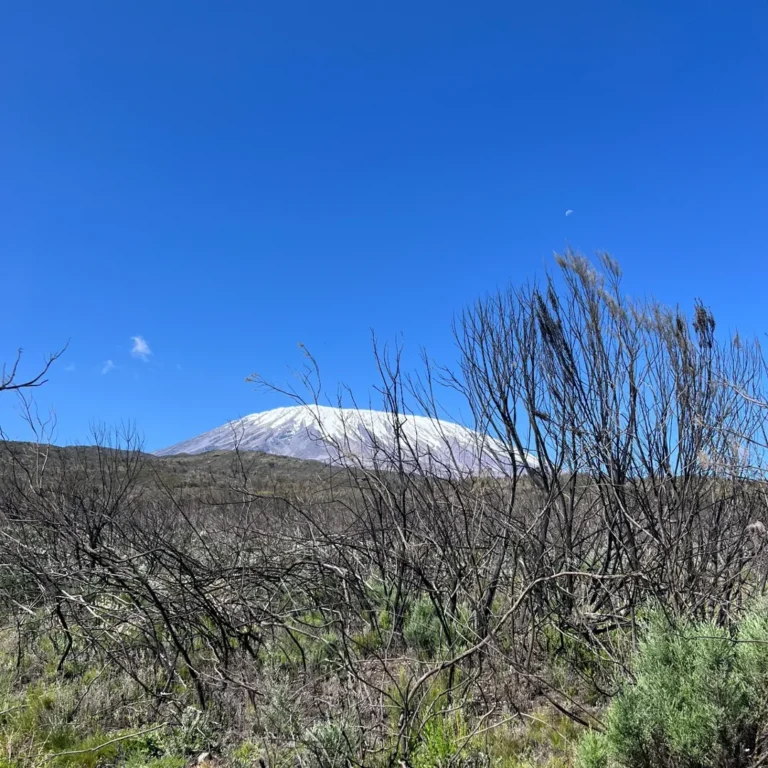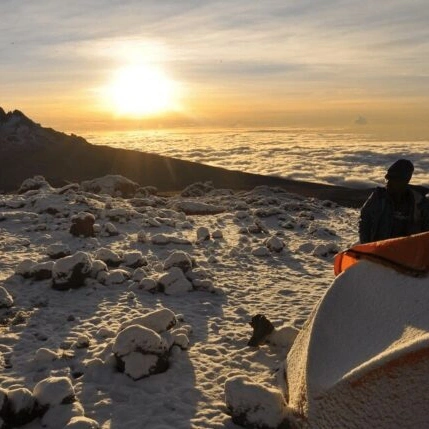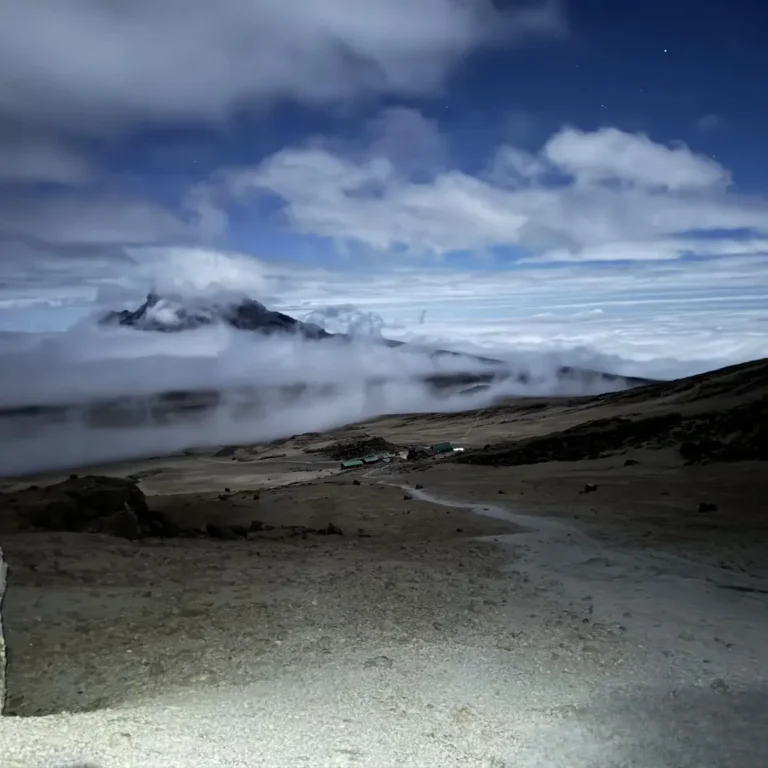
Kilimanjaro doesn’t just sit in Tanzania — it sits inside Kilimanjaro National Park, a 1,688-square-kilometre protected area administered by Tanzania National Parks (TANAPA). Every climb on the mountain happens within the boundaries of this park, which means every climber interacts with its rules, its gates, its permitting system, and the small army of rangers, guides, and porters licensed to operate within it.
This guide covers what Kilimanjaro National Park is, when it was established, what it protects, what the entry gates are, the rules that apply to climbers, and the practical logistics of visiting. If you’re planning a climb, this is the institutional context you’ll operate inside for 6 to 9 days.
The Basics
- Name: Kilimanjaro National Park
- Country: Tanzania
- Established: 1973 (designated a UNESCO World Heritage Site in 1987)
- Size: 1,688 km² (652 sq mi)
- Administrator: Tanzania National Parks (TANAPA)
- Location: Kilimanjaro Region, northeastern Tanzania
- Nearest major town: Moshi (approximately 45 minutes from Machame Gate)
The park encompasses the entirety of the mountain above 1,800 metres (5905 ft) — essentially, everything above the cultivated zone. The lower slopes, where Chagga farmers grow coffee and bananas, are outside the park boundary. The Kilimanjaro Forest Reserve, a separate protected area managed by the Tanzania Forest Services Agency, covers part of the buffer zone between the park and the cultivated slopes.
If you’re curious about the precise location, our where is Kilimanjaro post covers the geography in more detail.
A Brief History
Kilimanjaro was first formally protected in 1921, when the British colonial administration declared it a game reserve. The mountain had been under German administration until the end of the First World War, when the Treaty of Versailles transferred German East Africa to Britain as the mandate of Tanganyika.
In 1973, twelve years after Tanzanian independence, the mountain was upgraded from a reserve to a full national park, bringing it under the same administrative framework that protects Serengeti, Ngorongoro, and the rest of Tanzania’s park system.
In 1987, Kilimanjaro was designated a UNESCO World Heritage Site, recognising its outstanding natural significance — as a freestanding volcano, as a glacier-capped mountain at the equator, as a cradle of unique flora (the giant groundsels and lobelias found nowhere else on Earth), and as a place of profound cultural significance to the Chagga, Maasai, and other peoples who have lived around it.
What the Park Protects
The mountain itself
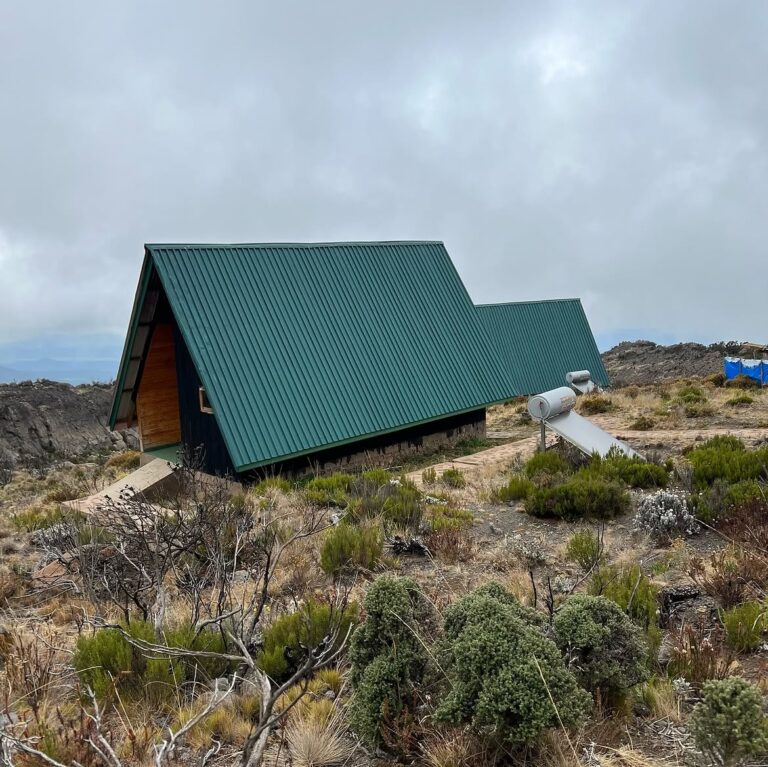
Every route, every camp, every gate, and every summit point sits within the park. TANAPA is responsible for trail maintenance, camp infrastructure (such as the huts on the Marangu Route), emergency response coordination, and the licensing of guides and operators.
Five climate zones
Kilimanjaro’s climate zones — cultivated (partially outside the park boundary), montane rainforest, heath and moorland, alpine desert, and arctic summit — are all contained within the park’s upper reaches. Our climate zones guide covers each in depth.
Wildlife
While Kilimanjaro isn’t primarily a wildlife-viewing destination — it’s a climbing mountain, not a Serengeti-style safari park — the lower forests contain meaningful wildlife populations:
- Primates: Blue monkeys and black-and-white colobus monkeys are the most commonly seen, particularly on the Machame, Lemosho, and Umbwe routes
- Larger mammals: Elephant, buffalo, leopard, bushbuck, duiker, suni (a small antelope) — present but usually elusive; elephants occasionally cross the Lemosho and Shira trails
- Birds: Turacos, hornbills, sunbirds, alpine chat, lammergeier (bearded vulture), bronze sunbirds, Hartlaub’s turaco
- Small mammals: Four-striped grass rats, tree hyraxes (heard far more than seen — their calls at night are distinctive)
Wildlife encounters are a bonus on Kilimanjaro, not the main event. If safari is a priority, a post-climb extension to Serengeti, Ngorongoro Crater, Tarangire, or Lake Manyara is the standard add-on. We can arrange these directly — get in touch to discuss.
Unique flora
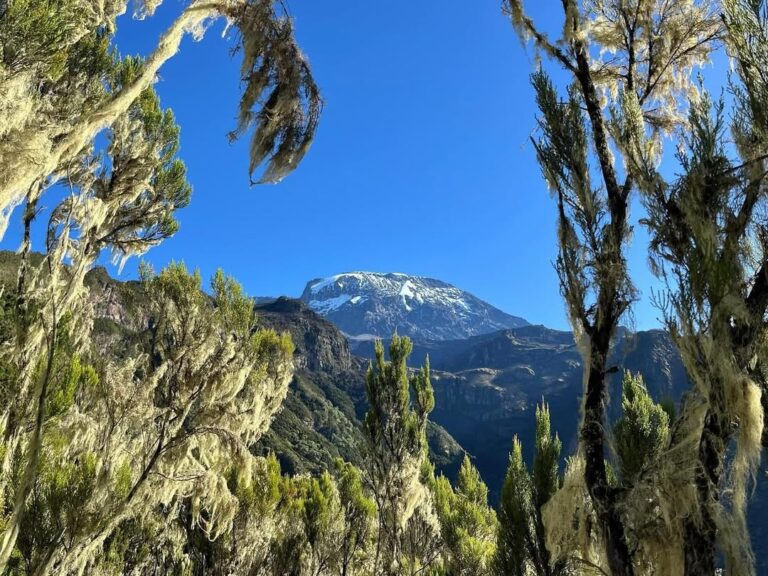
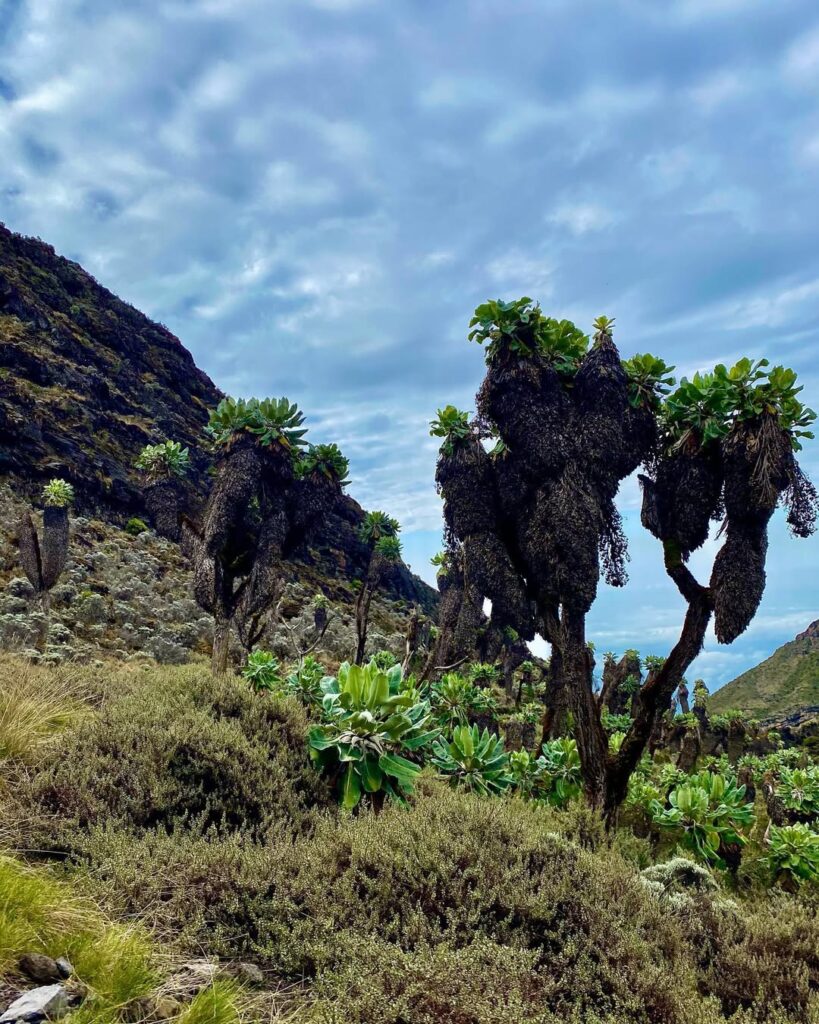
Kilimanjaro’s afro-alpine flora is genuinely unusual. Giant groundsels (Dendrosenecio kilimanjari) grow three to six metres tall and can live over a century. Giant lobelias (Lobelia deckenii) form silvery rosettes that close at night to survive freezing temperatures. Both are found only on a handful of East African mountains — Kilimanjaro, Mount Kenya, the Rwenzoris, and the Virungas — and are among the most distinctive plants in Africa.
The glaciers
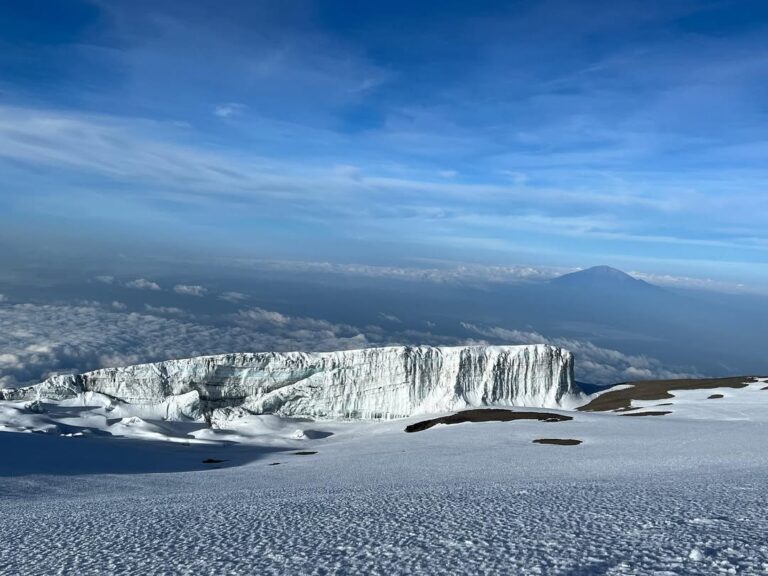
The mountain’s summit glaciers are part of what the park protects, though “protect” is difficult when the glaciers are retreating for climatic reasons beyond any park authority’s control. The Northern Icefield, Southern Icefield, Furtwängler Glacier, and Rebmann Glacier are all within the park boundaries.
The Gates of Kilimanjaro National Park
The park has several registered entry gates. Each one serves one or more climbing routes:
| Gate | Route(s) | Drive from Moshi |
|---|---|---|
| Machame Gate | Machame Route | 45 minutes |
| Marangu Gate | Marangu Route | 45 minutes |
| Londorossi Gate | Lemosho, Shira, Northern Circuit | 2.5–3 hours |
| Rongai Gate (Nalemoru) | Rongai Route | 3–4 hours |
| Umbwe Gate | Umbwe Route | 1 hour |
| Mweka Gate | Descent only (used by Machame, Lemosho, Umbwe, Northern Circuit) | 1 hour |
On the first day of your climb, your team drives from Moshi to the gate for your chosen route. At the gate:
- Climber registration — each climber’s details are logged with TANAPA rangers
- Porter load weighing — every porter’s pack is weighed to ensure compliance with the 20kg limit
- Permit and fee verification — park fees must be paid and permits issued before climbers can enter
- Briefing — a final briefing from your lead guide before setting off
The process typically takes 45 minutes to an hour. On descent day, you exit the park at a different gate (Mweka on the Machame, Lemosho, Umbwe, and Northern Circuit routes; Marangu on the Marangu Route; Rongai or Marangu on the Rongai Route) and receive your summit certificate if you reached either the crater rim (Gilman’s or Stella Point) or Uhuru Peak itself.
Park Fees
Entering Kilimanjaro National Park is not free. TANAPA charges a conservation fee, camping fee, rescue fee, and — on the Marangu Route — a hut fee, plus VAT. For most climbs, park fees account for roughly 30–40% of the total cost of the trip. This is one of the reasons climbing Kilimanjaro costs what it does, and one of the reasons any operator offering a climb significantly below the market rate is almost certainly cutting corners somewhere.
Our dedicated post on Kilimanjaro National Park fees walks through the current rates for each category, and our cost of climbing Kilimanjaro post covers how those fees fit into the broader climb budget.
Rules and Regulations
The park operates under a set of TANAPA regulations that every climber and operator must follow:
- Licensed operators only. All climbs must be conducted through a TANAPA-licensed company. Independent, unguided climbs are not permitted.
- Licensed guides required. Every climbing party must have a TANAPA-licensed lead guide. Our guides are all licensed, with Wilderness First Aid certification as a minimum standard.
- Camping permits. All campsites are designated; climbers cannot camp outside marked areas.
- Waste carry-out. All non-biodegradable waste must be carried off the mountain.
- No open fires. Cooking is done on gas stoves only; open fires are prohibited.
- Porter weight limits. Porters carry a maximum of 20kg, enforced at gate weighing.
- Minimum age. Climbers must be at least 10 years old. Special exemptions have been granted in rare cases.
- Conservation fees. All park fees must be paid before entry.
Our operation complies fully with these regulations as a baseline. Beyond them, we add practices that affect porter welfare — direct payment at descent, provision of sleeping bags and waterproof kitbags, three meals a day, and health monitoring by the lead guide. Our post on Kilimanjaro porters covers this in detail.
Practical Logistics for Park Visitors
Hours and seasons
The park is open year-round. Climbers can start their climb any day, depending on operator availability. The main climbing seasons run January to March (warmer, clearer) and June to October (cooler, drier). March to May is the long rains season; November is the short rains. Our post on the best time to climb Kilimanjaro covers seasonal choice in depth.
How long you stay
Depending on route, climbers spend 5 to 10 days inside the park. Day trips into the park (to the Shira Plateau or the rainforest zone for hiking, rather than a summit attempt) are possible but rarely requested.
Where to stay
Accommodation inside the park is either camping (on all routes except Marangu) or hut-based (on Marangu). We provide all camping equipment, meals, and porter support. On the Marangu Route, bunk huts with basic facilities are used instead.
Safety infrastructure
TANAPA maintains ranger stations along the main routes and coordinates with operators on evacuation protocols. Our safety page covers our 4-tier evacuation protocol — ranging from stabilisation at altitude, to assisted descent with stretcher, to vehicle evacuation (coordinated with TANAPA from the Mweka or Marangu Gate to KCMC Hospital in Moshi), to helicopter evacuation if required and funded.
What the Park Funds
Park fees don’t disappear into a general budget. TANAPA uses conservation fees to maintain:
- Trails and trail infrastructure
- Ranger stations and patrols
- Gate facilities
- Anti-poaching operations (less critical on Kilimanjaro than in wildlife parks, but present)
- Scientific monitoring of glaciers, climate, and flora
- Environmental restoration projects
The fee structure is genuinely expensive, but the money pays for the infrastructure that makes the park possible to visit. This is part of why Kilimanjaro’s trails, camps, and rescue capabilities are as developed as they are compared to many other high mountains in the developing world.
The Takeaway
Kilimanjaro National Park is more than a boundary line around a mountain. It’s the institutional framework that makes climbing the mountain possible — permits, rangers, rescue coordination, regulated operators, and the protection of an ecosystem that includes some of the most distinctive plants and climate zones on the planet.
When you book a climb, you’re not just booking with us — you’re buying into a system that keeps the mountain accessible, relatively safe, and intact for the next generation of climbers. The fees are real. The rules are enforced. And the result is a mountain that’s still worth climbing more than 50 years after the park was established.
Ready to climb inside Kilimanjaro National Park? Browse our routes and packages, or reach out to start planning.