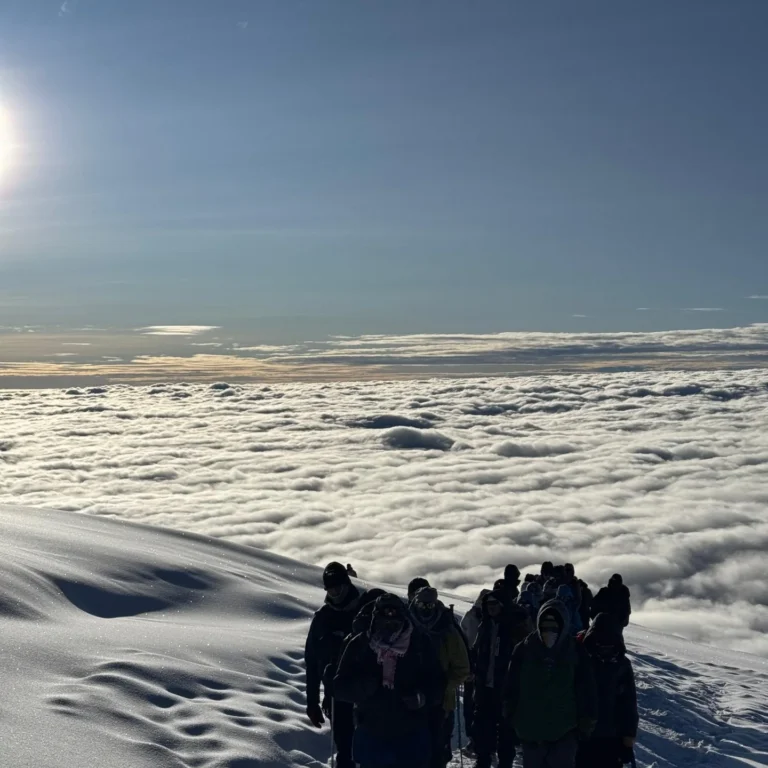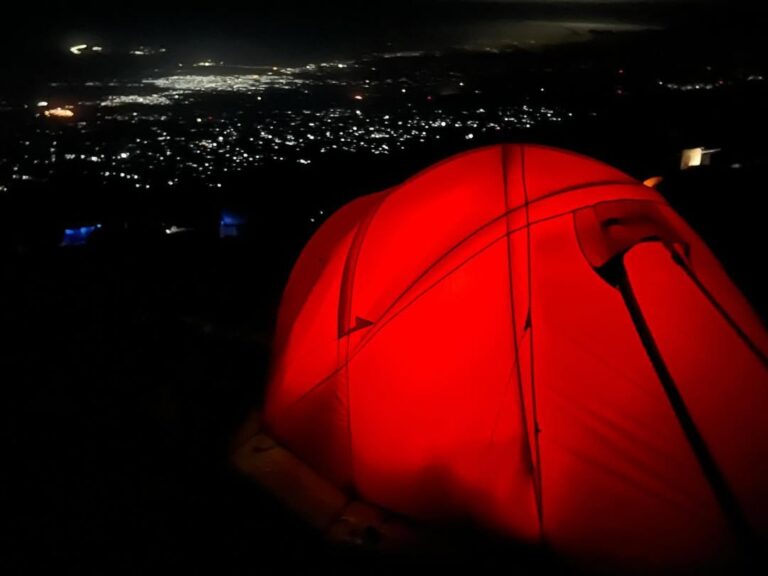
Nobody tells you quite how strange summit night is until you’re already in it. You’ve spent five or six days walking up a mountain, adjusting to altitude, eating well, sleeping (not sleeping), and building toward this moment. Then at around midnight, your guide wakes you up, you layer everything you own, and you step out into a darkness so complete it feels solid.
This is the part that separates Kilimanjaro from most other high-altitude challenges. Not because of the physical demand alone — though that’s real — but because of the combination: extreme cold, thin air, deep darkness, and the particular way your own mind starts talking to you when your body is working harder than it ever has.
Here’s what it actually looks like.
Why You Start at Midnight
The timing isn’t arbitrary. There are a few reasons summit night begins in the early hours of the morning rather than at dawn.
The most important one is temperature. Kilimanjaro’s upper section — the Barafu zone above 4,500m (14,763 ft) on the Machame and Lemosho routes, or Kibo above 4,700m (15,419 ft) on Rongai and Marangu — is covered in glaciers and snowfields. In the afternoon, the sun softens the snow and scree, making the trail loose and difficult to navigate. In the hours before dawn, the surface is firm and your footing is far more secure.
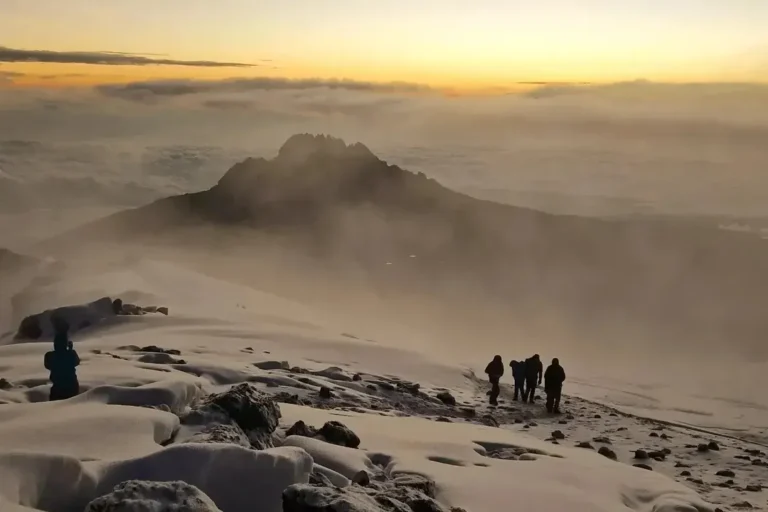
The second reason is timing the summit itself. You want to reach Uhuru Peak (5,895m/19,340 ft) around sunrise — between 6am and 7am on most days. This gives you the best chance of clear skies before the mountain builds its own cloud layer, which typically happens by mid-morning. Summit at 5am in darkness, and you’re descending in gloom with tired legs. Summit at dawn, and you’re rewarded with the full scale of what you’ve done — the curve of the earth, the ice fields glowing, the shadow of the mountain stretching west.
Working backwards from a 6am target summit, and assuming 5–7 hours of climbing (depending on your pace, the route, and the conditions), a midnight or 12:30am departure makes sense.
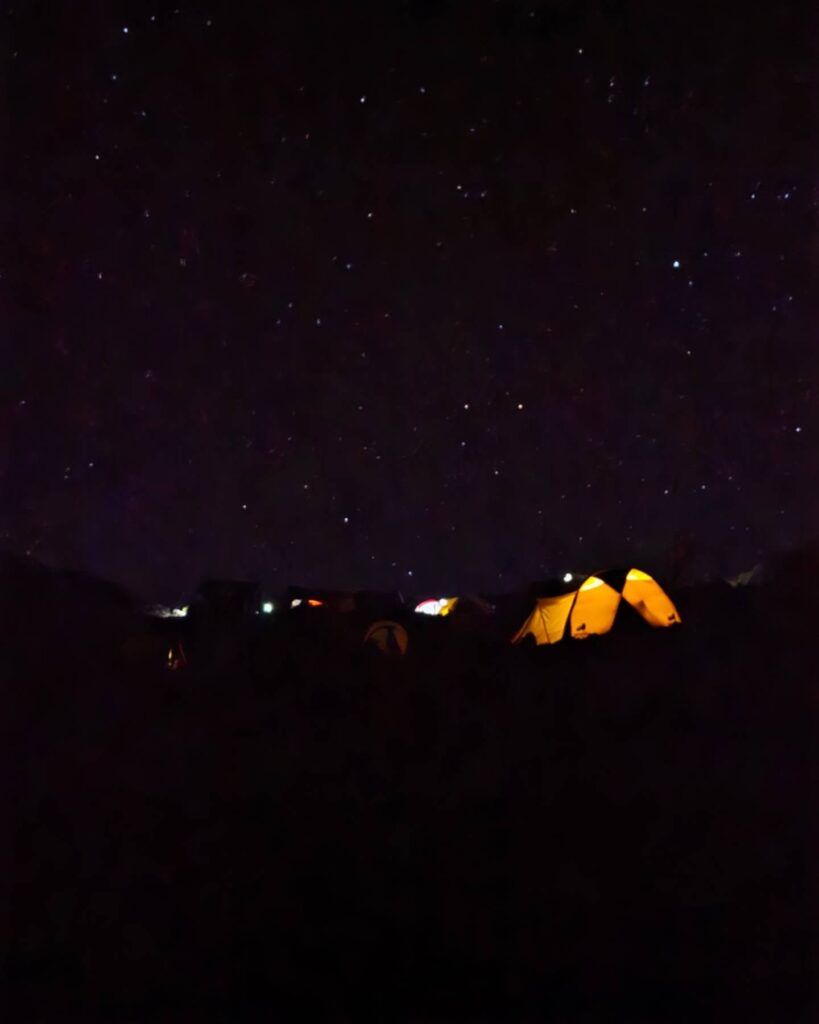
What It Feels Like to Leave Camp
At Barafu Camp — the staging point for most summit attempts on Machame and Lemosho — you’re already at 4,673m (15,331 ft). The air is noticeably thin. You’ve felt it since you arrived. Some people have headaches. Most people have a low-level heaviness that’s not quite fatigue and not quite illness. Everything just takes a little more effort than it should.
The lead guide checks in with everyone before departure. On our climbs, this includes a pulse oximetry check — we’re looking at SpO2 readings and comparing them against the pattern over the past several days. A reading that has been stable through the climb is reassuring. A reading that has dropped more than 5 percentage points from the prior evening’s baseline gets a careful conversation before we move. This isn’t bureaucracy. It’s the guide making a genuine call about whether your body is ready for what comes next.
Then you walk out of the tent and hit the cold.
Summit night temperatures at Barafu typically sit between -5°C and -15°C (23°F to 5°F) — but wind chill can push the felt temperature significantly lower. At the crater rim at 5,756m (Stella Point), wind is common. By the time you reach Uhuru Peak, you can be looking at a felt temperature below -20°C depending on conditions. This is why the layering system you planned at home, six months ago, in your warm living room, is the thing between you and real suffering on that ridge.
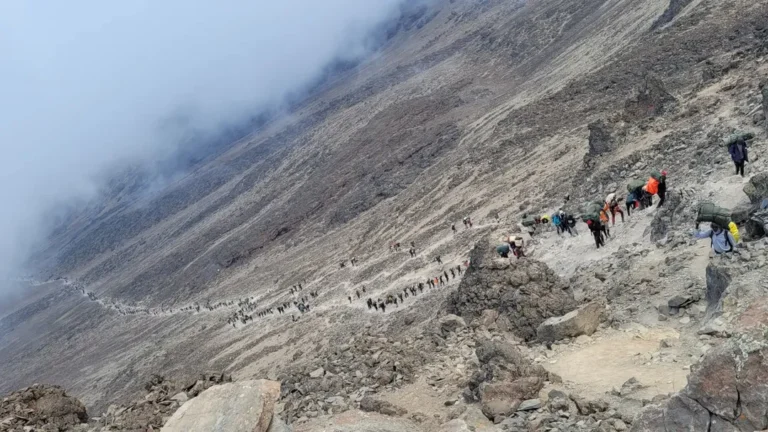
Your head torch cuts a narrow cone of light. You can see the boots of the person in front of you, maybe ten feet of path, and very little else. This is both limiting and clarifying. You stop thinking about the view. You stop thinking about how far you have to go. You think about the next step.
The Pace: Pole Pole at Its Most Literal
Pole pole — Swahili for “slowly, slowly” — is the operating principle of any responsible Kilimanjaro ascent. But on summit night, it becomes a precision tool rather than a general philosophy.
Your guide sets a pace that feels, at first, absurdly slow. Slower than your normal walking pace. Slower than you’d walk to the shops. You’ll want to walk faster. Your body will feel like it can. Don’t.
Here’s what’s happening physiologically: at 4,500m (14,763 ft) and above, your body is taking in significantly less oxygen per breath than at sea level — roughly half the oxygen available at sea level. Your heart is working harder. Your blood is carrying less oxygen per circuit. Your muscles are still generating effort, but the recovery between steps is compromised.
The slow pace is not for the people who feel fine. It’s the pace that protects the people who feel fine from becoming the people who don’t feel fine at 5,500m (18,044 ft), where the margin for error shrinks dramatically.
Our guides walk at the front and set the rhythm. The assistant guide walks at the rear — watching, listening, checking on the person at the back who tends to fall slightly behind, noting who is breathing heavily, who has gone quiet, who is stumbling on the scree.
Rest breaks are short — three to five minutes — because stopping for longer allows your body temperature to drop, and cold muscles recover worse than warm ones. You stop, you breathe, you take a sip of water (insulated bottle — it will freeze in an uninsulated one), and you move again.
The Psychological Reality
The physical challenge of summit night is real. But most people who don’t make it, or who later say the experience was harder than expected, are talking about the psychological dimension as much as the physical one.
There is a period — usually between 5,000m (16,404 ft) and 5,500m (18,044 ft) — that climbers often describe as the hardest part. You’ve been walking for three or four hours. You’re tired. Your head may be hurting. The summit is somewhere above you in the dark, and you genuinely cannot tell how far. The guide says “not far” and your brain processes this as encouraging but unverifiable. You might feel nauseous. Your hands are cold despite your gloves. Someone in the group has started breathing louder.
This is the moment when the decision to continue or stop is most likely to come up — not because you’ve hit a wall, but because the rational part of your brain starts doing the math and the math feels uncertain.
What good guides do in this period is worth describing, because it’s not what people expect. It’s not motivational speeches. It’s not cheerleading. It’s calibrated presence: a hand on the shoulder, a check-in, a brief read of your face, and a clear honest assessment of whether continuing makes sense. “You’re doing well” from a guide who has been watching your oxygen levels and your gait for five days means something different from the same words delivered by someone who doesn’t know you.
Our lead guides have full authority to recommend descent at any point. No override from us, no pressure to push on. A guide who is genuinely watching for your wellbeing — not for their own summit count — will tell you when it’s time to go down. That conversation is rare, but it happens, and when it does, it’s the right call.
Stella Point to Uhuru Peak
When you reach Stella Point (5,756m/18,884 ft) on the crater rim, you are technically on the summit of Kilimanjaro in the sense that matters to TANAPA certification. But Uhuru Peak is still roughly 45 minutes to an hour of walking along the crater rim.
The path from Stella to Uhuru is relatively flat — a traversing path across the glaciated rim — but at this altitude, “relatively flat” still requires significant effort. This section catches some climbers off guard. They’ve been focused on reaching the rim. The rim is not the top.
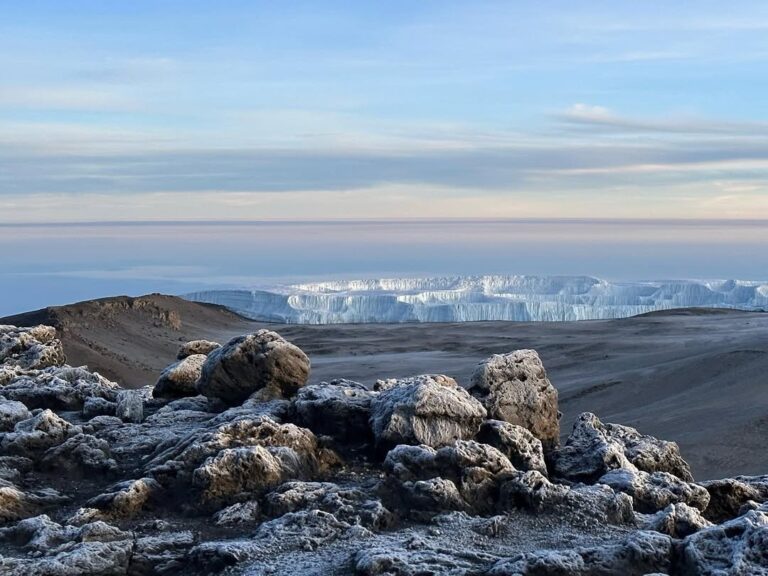
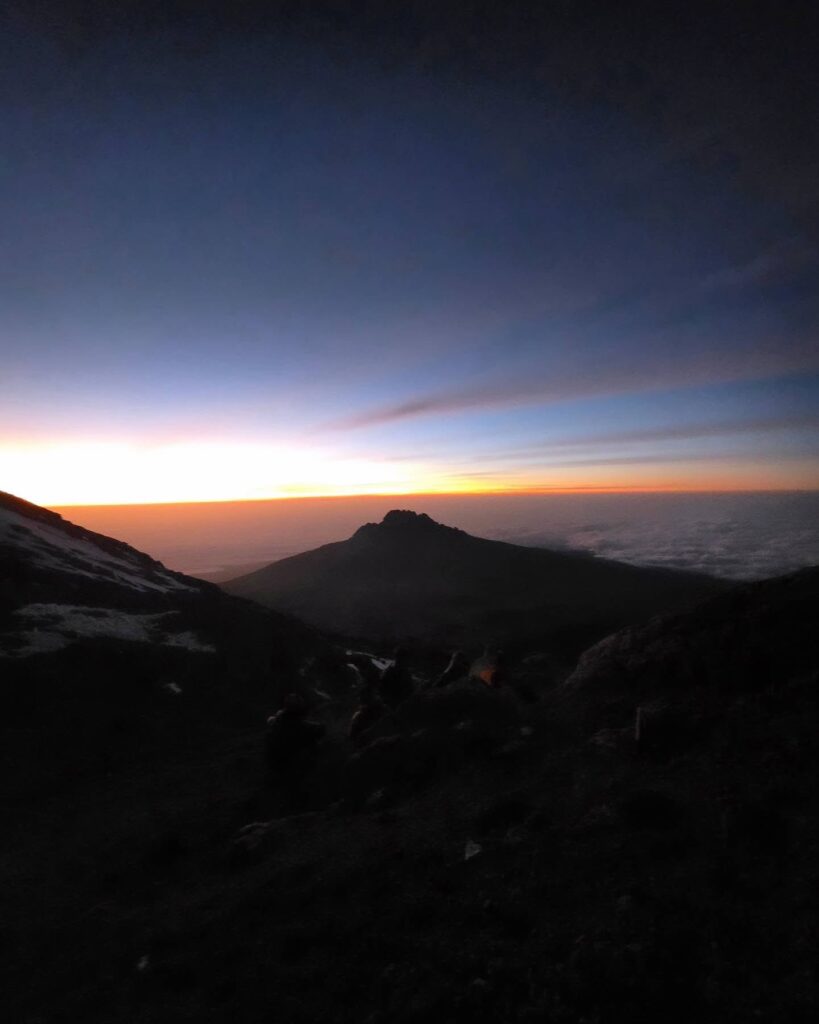
The first light often starts appearing in the east around this section, depending on time of year. The ice walls of the Furtwängler Glacier catch the light before anything else. It’s a genuinely dramatic landscape — not because of the altitude, but because of the scale and strangeness of it.
When you reach the summit sign at Uhuru Peak, the moment tends to be quieter than people expect. Some people cry. Some people laugh. Most people take a few minutes to look around before the cold pushes them toward getting a photo and starting the descent. There is very little ego at 5,895m (19,340 ft). You’re too tired, too cold, and too present.
The Descent
The descent is physically harder on the body than the ascent for many climbers, even though it’s faster. The scree slope below Barafu — a 45-degree angle of loose volcanic rock — is descended by plunging your boot into the surface with each step, using the mountain’s pitch against itself. It’s fast and strangely fun when your legs are cooperating. When they’re not, it’s a long shuffle.
Descending from the summit to Barafu typically takes 2–3 hours. After a rest at Barafu (some people can sleep; most just lie down), the descent continues to Mweka Camp or Millennium Camp for the final night.
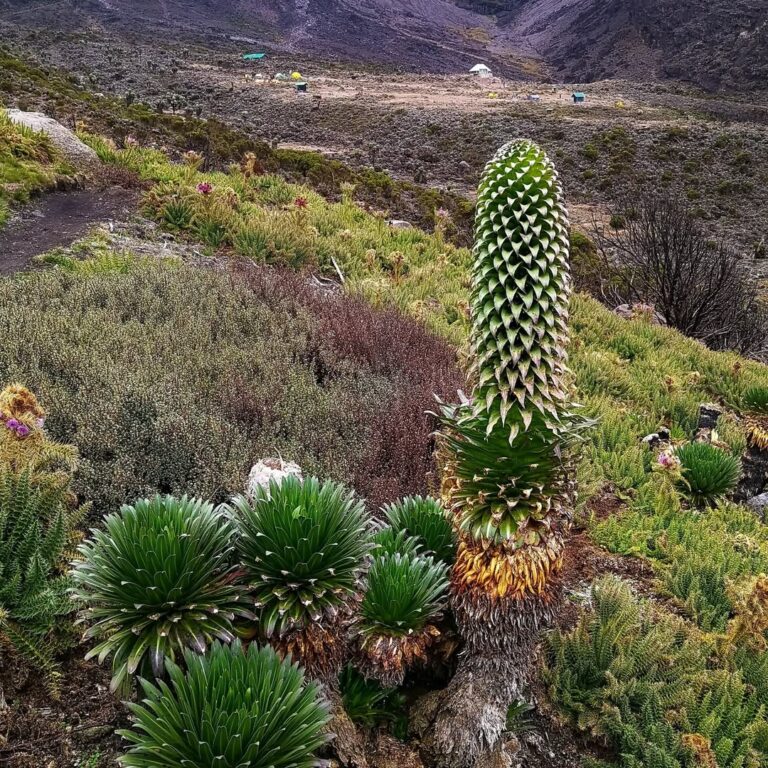
By the time you reach the lower camps, the temperature is rising, the forest is reappearing, and the strange inverted world of the night — cold, dark, thin, enormous — has given way to something that feels, improbably, like an ordinary afternoon.
How to Prepare for Summit Night
Train your legs for descent as much as ascent. Going up Kilimanjaro requires cardiovascular fitness. Going down requires leg strength — specifically eccentric loading of your quads. Stair descents, long downhill hikes, and step-downs in training all help.
Test your kit in the cold before you leave home. Don’t assume your -15°C sleeping bag rating and your layering system work together until you’ve worn the full kit in actual cold. Many UK climbers have never tested their high-altitude layers in genuinely cold conditions. A weekend in Scotland in February is useful preparation.
Practice drinking in the dark with gloves on. It sounds trivial. On summit night, managing a hydration bladder hose with liner gloves and thick outer gloves while wearing a head torch, at 5,000m (16,404 ft), is genuinely fiddly. Know your kit.
Eat at dinner even if you’re not hungry. Your body burns significant energy staying warm on summit night. The dinner at Barafu the night before your summit push is not optional — it’s fuel.
Tell your guide what you’re experiencing. Altitude sickness is managed by communication. If your head is pounding, say so. If your feet have gone numb, say so. Your guide has seen every variant of this and is not going to judge you for describing your symptoms. Guides who are fully informed make better decisions than guides who are guessing.
For more on altitude symptoms and how to manage them, read our detailed guide on altitude sickness on Kilimanjaro.
Which Routes Offer the Best Summit Night Experience?
The technical summit push is similar across routes — most converge on the same upper mountain pathways. But the approach, condition of the camps, and acclimatisation profile vary.
The Machame Route and Lemosho Route are our highest-rated for overall summit night preparation. The Lemosho in particular has the best acclimatisation profile of any route we run — the extra days at altitude before you reach Barafu make a material difference to how your body handles the final push.
The Marangu Route uses different facilities (huts rather than camps) and approaches through the Kibo Hut, but the summit night dynamics are similar. The shorter duration does mean less acclimatisation time.
If you’re still deciding which route fits your goals, our route comparison guide walks through the key differences. And our team is always available to help you match a route to your specific circumstances — fitness background, available days, priorities for the experience.
Summit night is hard. It’s also one of the clearest, most present experiences most people ever have. The combination is what makes it worth doing properly.