Stella Point sits at 5,756 metres (18,885 feet) on the southern rim of Kilimanjaro’s summit crater. It is not the top of the mountain. Uhuru Peak, the true summit, is another 139 metres (456 ft) higher and roughly 45 minutes along the crater rim to the west. But talk to climbers a year after their climb and you’ll hear a strange thing: many of them remember Stella Point more vividly than Uhuru.
There’s a reason. Stella is where the climb actually ends. Uhuru is where you walk after that.
This post explains what Stella Point is, which routes finish there, what the last push from Barafu feels like, and why the sign standing at 5,756m (18,884 ft) has become one of the most emotionally charged spots on the mountain.
Where Stella Point Sits on Kilimanjaro
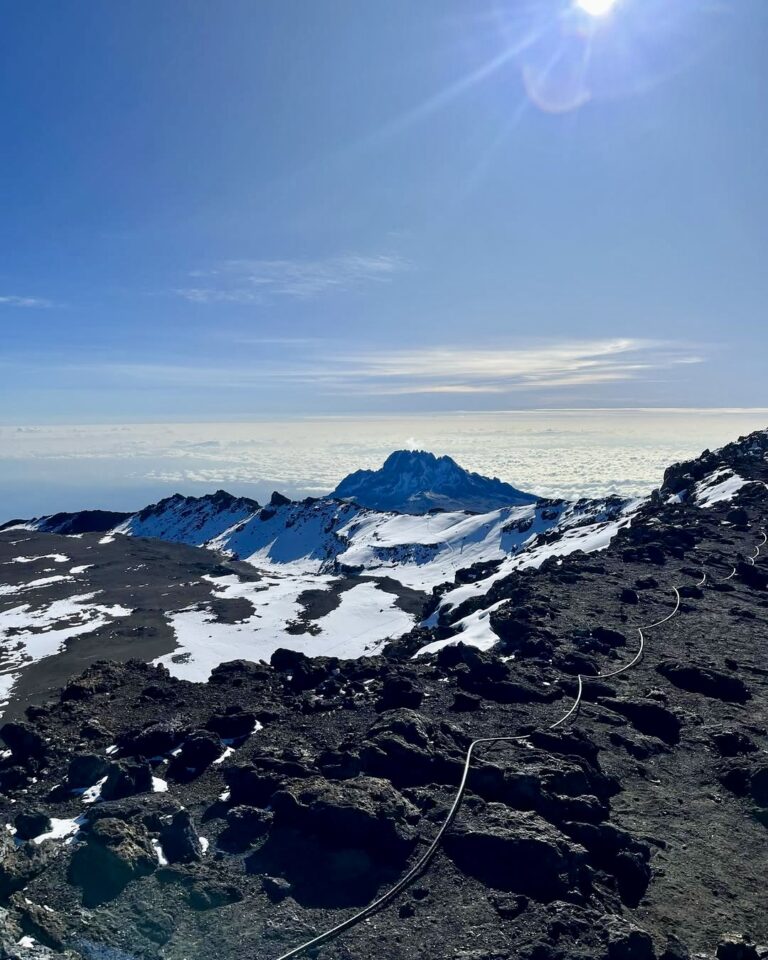
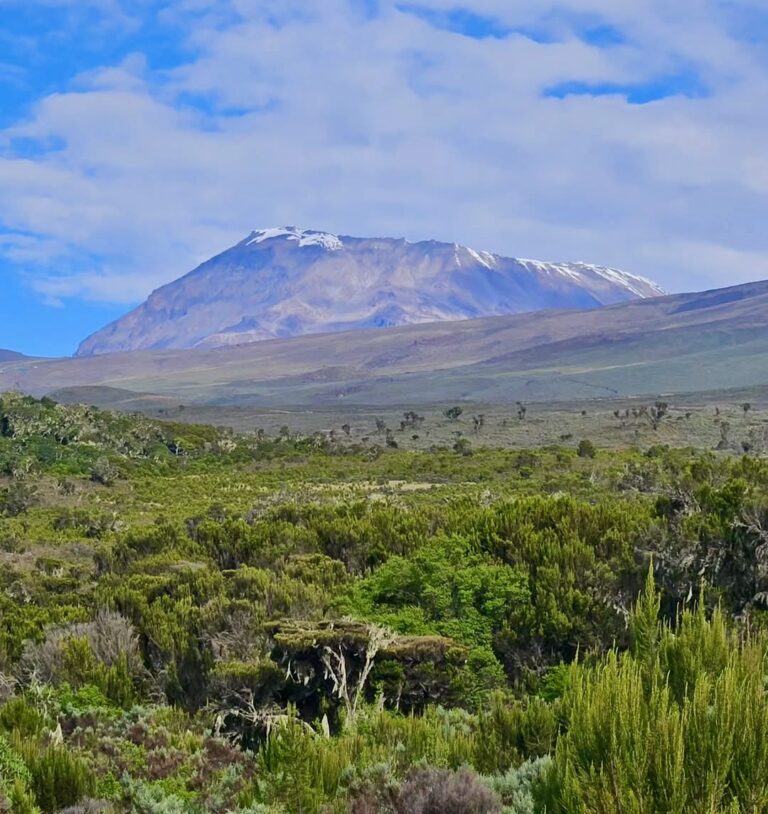
Kilimanjaro is a dormant volcano with three cones. The highest, Kibo, holds the summit crater and the glaciers that remain after the last century of melt. The crater rim is a rough, snow-dusted ring of rock running around the outside of the crater bowl, and it has several named points on it.
The two most important are Gilman’s Point at 5,681m on the eastern rim, and Stella Point at 5,756m (18,884 ft) on the southern rim. Uhuru Peak, at 5,895m, sits slightly west of Stella, a gently rising ridge walk along the rim. If you’ve heard climbers say “once you hit the rim, you’ve basically done it,” this is what they mean — the brutal climb up the scree is finished, and the remaining distance to the true summit is a slow, almost flat walk at extreme altitude.
Stella Point is marked by a wooden sign — simple, weather-beaten, green and yellow in most years — that reads “Congratulations — you are now at Stella Point, 5,756m (18,884 ft).” For climbers arriving at dawn from the scree slopes below, that sign is often the first thing they can physically focus on after four or five hours of climbing in the dark.
The point was named after Estella “Stella” Latham, who reached it in 1925 as part of an early expedition on the southern approaches.
Which Routes Finish at Stella Point
Five of Kilimanjaro’s seven established routes approach the summit via Stella Point:
- The Machame Route
- The Lemosho Route
- The Shira Route
- The Umbwe Route
- The Northern Circuit Route
What these routes share is that they all converge at Barafu Camp, the summit-night camp on the southern side of the mountain at 4,673m (15,331 ft). From Barafu, the summit route climbs roughly 1,100 vertical metres up a scree slope to Stella Point, then eases off along the rim to Uhuru.
The two routes that do not use Stella Point — Marangu and Rongai — approach the summit from the eastern side via Kibo Hut and arrive at the crater rim at Gilman’s Point instead. From Gilman’s, climbers still have about 1.5–2 hours of rim walking to reach Uhuru. It’s a longer and psychologically harder final push than the Stella route, which is one of the reasons Machame and Lemosho have higher summit success rates than Marangu.
What the Climb to Stella Point Actually Feels Like
Most climbers leave Barafu between 11pm and midnight. The walk from camp begins gently — a short, flat approach that lets everyone find their pace in the dark. Headlamps on, water bottles insulated so they don’t freeze, down jackets already on.
Then the scree begins. The path switches back and forth up a steep slope of loose volcanic gravel, about 800 vertical metres of it from the base of the climb to Stella Point. This is the part of Kilimanjaro everyone who’s done it talks about afterwards — and not in gentle terms.
A few things make it hard in a way that fitness alone doesn’t solve:
Altitude. By the time you’re halfway up the scree, you’re somewhere between 5,200 and 5,400 metres (17,060-17,761 ft). The air contains roughly half the oxygen of sea level. Even moderate effort feels disproportionate. Your legs work fine; your lungs do not keep up.
Cold. Leaving Barafu, ambient temperature is usually -5°C to -10°C. On the upper scree, it drops to -10°C to -20°C with wind chill. Your water freezes if it’s not insulated against your body. Fingers inside gloves go numb if you stop for too long. Summit temperatures on Kilimanjaro are a real factor, not a footnote.
Darkness. You can’t see how far you’ve come or how far you have to go. Your world reduces to the circle of light from your headlamp and the boots of the climber ahead.
Pace. Pole pole — slowly slowly — is the Swahili phrase every guide on this mountain repeats. On summit night it stops being a phrase and becomes a survival strategy. Your guides will slow you down more than you expect. Resist the urge to speed up. The climbers who summit are almost always the ones who moved at a sustainable crawl; the climbers who turn back are disproportionately the ones who went too fast in the first two hours.
The climb from Barafu to Stella Point typically takes 5–7 hours. Faster is not better. The goal is to arrive at the rim around sunrise, roughly 5:30–6:30am depending on season.
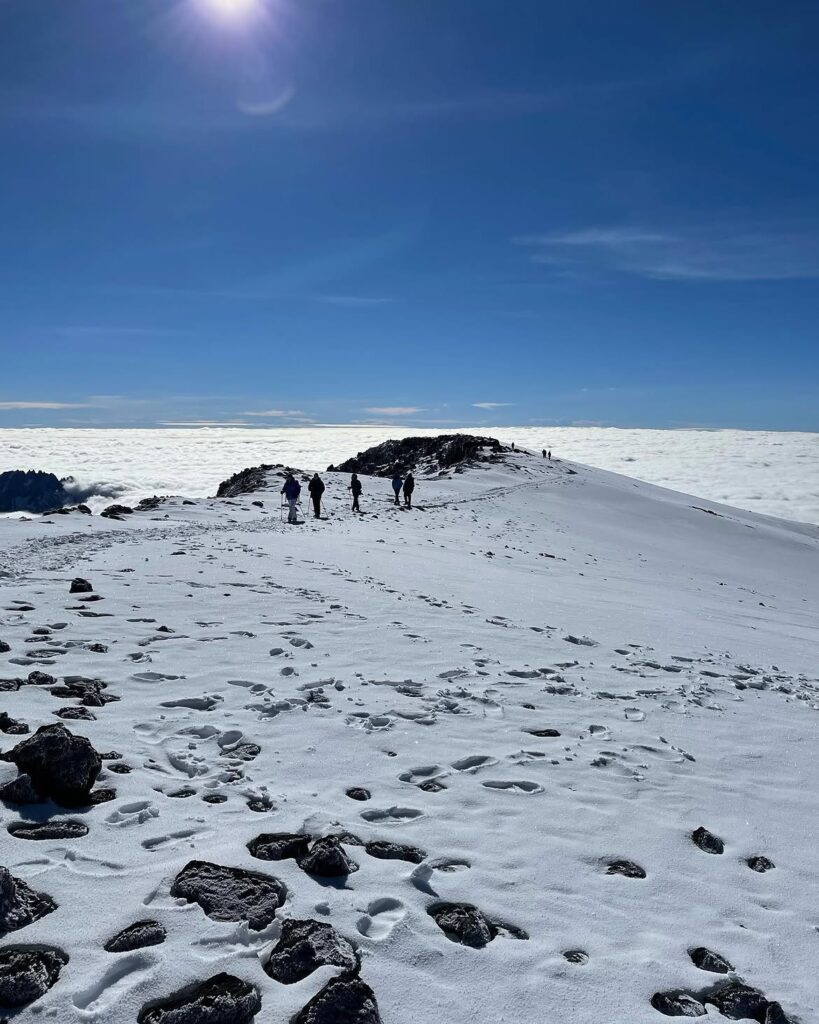
The Moment You Reach the Rim
What climbers describe almost universally is the same sequence. The scree eases. The path levels. And then — suddenly — the sky opens up to the east and you can see Mawenzi, Kilimanjaro’s jagged second peak, silhouetted against a red-orange pre-dawn.
You see the sign. You sit down next to it. Your guide takes your photograph.
It is often the moment climbers describe as the one that made them cry.
This is not drama. The physiological state at the rim is extreme: oxygen deprivation, hours of cold, muscular exhaustion, and a sudden release of the tension that has been sustaining you since midnight. Emotional response at Stella is less about achievement and more about what your body does when the load finally comes off.
Most climbers spend 10–15 minutes at Stella Point before continuing. Guides will check on you here — a pulse oximeter reading, a visual check, a conversation. The Kilimanjaro Sky safety protocols treat the rim as a decision point: if you’ve struggled up the scree but are stable, guides will usually continue to Uhuru. If symptoms are escalating — confusion, persistent breathlessness at rest, a sharp SpO2 drop — they have full authority to turn you back from Stella. Reaching Stella Point and not continuing is not a failure. It is a decision that keeps you alive.
Stella Point to Uhuru: 45 Minutes That Feel Longer
The rim walk from Stella to Uhuru is, on paper, easy. About 1 kilometre in horizontal distance. Roughly 139 metres of elevation gain. A path that’s sometimes snow, sometimes rock, sometimes gravel, but broadly gentle.
At sea level, it would be a 15-minute stroll.
At 5,800m (19,028 ft), it takes 45 minutes to an hour. You stop every 30 or 40 metres to breathe. Your guide walks ahead and waits. The sun rises somewhere in that hour, and the Rebmann and Furtwängler glaciers — what’s left of them — come into view on your left.
Then the path rounds a gentle crest, and you see the Uhuru Peak sign.
Most climbers spend 10–20 minutes at Uhuru. Photos, a short moment, and then the descent starts — because the longer you stay above 5,700m (18,800 ft), the harder the descent becomes. Summit day is 12–16 hours round trip, Barafu-to-Barafu-and-down-to-Mweka or High Camp.
Why Stella Matters More Than the Geography Suggests
The geography of Stella Point is simple: a signpost, a few flat rocks, the crater rim, a view east to Mawenzi. On a map, it’s a waypoint.
In practice, it’s where the climb ends for most climbers. The hours between midnight and Stella are the hardest part of the entire week on the mountain — harder than the Barranco Wall, harder than Lava Tower, harder than the long days on the approach. Everything in the summit push is designed to get you to that rim. Once you’re at Stella, the walk to Uhuru is a gift.
Which is why, a year later, it’s often Stella climbers remember. The sign, the first light, the sitting down after six hours of dark climbing. Uhuru gets the photograph. Stella gets the memory.
If You’re Planning for Stella Point
A few practical things to carry into your planning:
Choose a route with good acclimatization. The approach to Stella is the same regardless of which of the five southern-route options you pick, but your acclimatization going into summit night is not. Longer itineraries deliver higher summit success — 8-day Lemosho and 9–10 day Northern Circuit give your body meaningfully more time to adjust. Six-day Machame is the shortest viable itinerary, and summit success rates drop noticeably below it.
Train your legs for long descents, not just climbs. After Stella and Uhuru, you descend 2,800 vertical metres (9,186 ft) in a single day — back down the scree to Barafu, then another 1,500m (4,921 ft) to Mweka Camp or High Camp. This descent wrecks under-prepared knees. Squats, downhill running, and step-downs in the months before your climb matter more than most climbers realize.
Don’t optimize for speed. Nobody remembers how fast they reached Stella. They remember whether they reached it at all. Pace is the single biggest variable under your control.
Book with operators who don’t push. If a guide company talks about “making the summit” as the goal, be cautious. The goal is getting you up and down safely — and sometimes that means turning back at Stella. Kilimanjaro Sky’s guides are trained and authorized to make that call. You can read more in the Kilimanjaro Sky safety page and in our FAQs.
If you want to talk through which route gives you the best shot at Stella and Uhuru given your timeline and fitness, get in touch with our team in Moshi. We’re small on purpose, and we’ll be straight with you about what your climb is likely to look like.