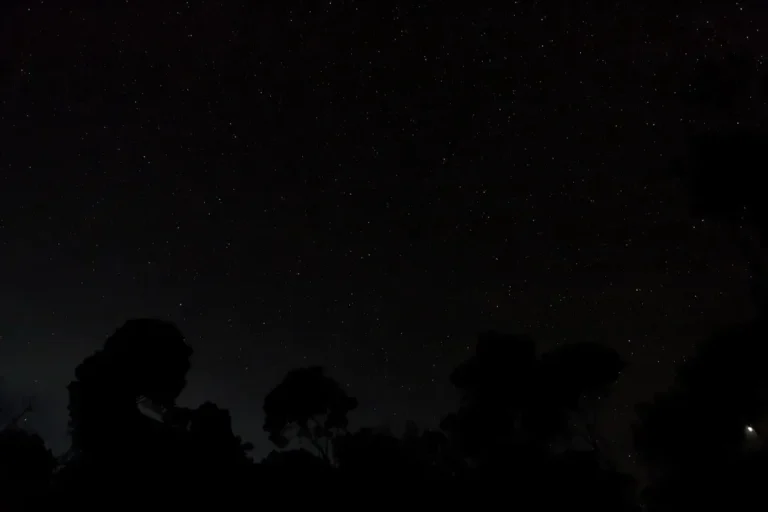
There’s a reason guides on Kilimanjaro time summit night the way we do — waking you at around 11pm, leaving Barafu at midnight, pushing through the cold dark for six or seven hours to land at Uhuru Peak right as the sun comes up. The reason isn’t tradition. It’s that the sunrise at 5,895m (19,340 ft), on the roof of Africa, looking east toward the Indian Ocean with the shadow of the mountain stretching behind you across Tanzania, is one of the moments climbers remember for the rest of their lives.
Most of our clients tell us afterwards that it was more than they’d pictured. Some say it was the most significant single moment of their adult life. We take that seriously — which is why summit-day logistics, pacing, and timing are as carefully built as they are.
Here’s what summit sunrise actually looks like, how guides time it, and what to know before you get there.
The Timing — Why Midnight Departure
On clear days at Uhuru Peak, first sunrise light hits the summit around 6:00–6:20am. Full sun-above-the-horizon is typically 6:15–6:40am, depending on season.
Working backwards from that target:
- Sunrise at the summit: 6:15am target
- Time from Stella Point to Uhuru: 45 minutes to 1 hour at altitude
- Time from Barafu to Stella Point: 5–6 hours for most climbers
- Departure from Barafu: midnight, with some groups leaving at 11pm or 1am depending on pace assessment
The reason this timing window matters, and why guides are disciplined about it:
Too early summit (pre-sunrise by more than 20 minutes) at -20°C with wind: you stand on the summit in darkness, cold, without the view, waiting — and the cold takes over fast. Clients who arrive too early sometimes end up descending before sunrise to stay warm, missing the moment entirely.
Too late summit (after 7:30am): you lose the clean view. Kilimanjaro’s summit regularly builds its own cloud layer by mid-morning. Views that were clear at dawn are often gone by 8:30am. You also descend in fuller sun on softer scree, which is slower and harder on knees.
The sweet spot is the 20-minute window between pre-dawn twilight and the first full sun. Our guides adjust pace on the mountain to hit this window. If a group is moving faster than expected, we’ll add a warming break at Stella Point. If slower, we adjust the final push.
What You Actually See
The summit of Kilimanjaro at sunrise is unusual among high-altitude views because of the geography. You are standing on the highest free-standing mountain in the world — meaning the next landmass this high is hundreds of kilometres away — with open visibility east across the Tsavo plains and, on exceptionally clear days, to the Indian Ocean roughly 300km away.
What clients typically describe:
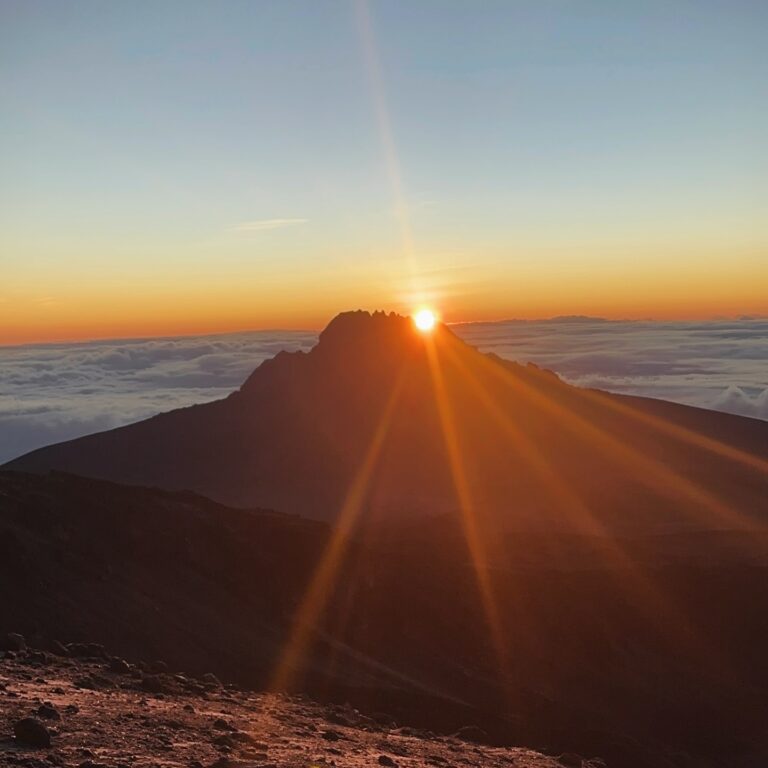
Before the sun: A deep indigo sky fading to orange along the eastern horizon. Mawenzi Peak — Kilimanjaro’s second summit, 5,149m — visible to the east as a dark, jagged silhouette against the warming sky. The curve of the earth, faintly, along the horizon line.
First light: A sharp orange line appears along the horizon. Within 2–3 minutes, the light begins striking the highest glacier ice on the summit plateau. The Furtwängler Glacier and the southern ice fields light up before the sun is visible at lower altitudes. This is the moment many clients describe as when the emotional weight of the summit lands — the combination of altitude, fatigue, and the physical beauty of the light hitting the ice.
Sun breach: The sun crests the horizon. The shadow of Kilimanjaro — a triangular silhouette of the mountain itself — appears behind you, cast westward across hundreds of kilometres of the Tanzanian landscape. This is one of the most recognisable images of the Kilimanjaro summit and one of the reasons the sunrise timing matters.
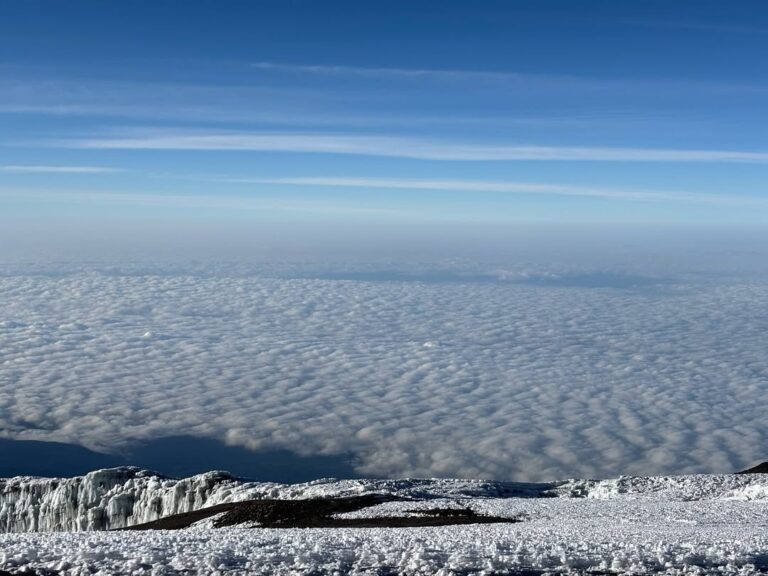
Post-sunrise: The full summit plateau is visible. Glaciers catch direct light and gleam white. The Meru massif 70km to the west becomes visible as a freestanding peak. Clouds below eye level fill the lower altitudes of the mountain, and you stand above the weather. Visibility ranges from 100km on an average clear day to 300+km on the rare perfect days.
How Long You Can Stay at Uhuru Peak
Short answer: 15–30 minutes of active summit time for most groups.
The limits are physiological, not sentimental:
Altitude. At 5,895m (19,340 ft), you’re at roughly 49% of sea-level oxygen. Your body is working hard just to stand still. Lingering longer than 20–30 minutes doesn’t let you experience the view more deeply — it lets the altitude tire you more, which makes the descent harder.
Cold. Summit ambient temperature at sunrise is -10°C to -20°C, warming slightly as the sun rises. Wind chill commonly takes apparent temperature to -25°C to -35°C. Layered correctly, this is manageable for 20–30 minutes. See our how cold is the summit of Kilimanjaro post for the full breakdown. Beyond 30 minutes, cold takes over.
Other groups. Peak-season mornings at Uhuru can have 6–10 groups arriving within an hour of each other. Sign space and summit photo space is shared, and a gentle queue forms. Our guides typically time our arrival to give space for a proper summit experience without the crowd.
Our standard approach: arrive at Uhuru 5–15 minutes before sunrise, take the group summit photos, let clients have individual photos, let clients have a genuine quiet moment to absorb the view, and begin the descent within 25 minutes of arrival.
The Emotional Reality
Most people who reach Uhuru Peak describe it as one of the best moments of their lives. We take that seriously.
There is no script for what the moment feels like. Some clients cry. Some are silent. Some are euphoric and want to high-five everyone. Some want to hug their guide — we hug back; we know what the last six hours have taken out of you.
The combination of factors that produces the moment:
- The physical challenge of summit night — the cold, the dark, the thin air, the hours
- The acclimatisation journey across the previous five or seven days
- The altitude itself, which amplifies emotional state in both directions
- The specific beauty of the sunrise and the view
- The cultural and personal significance of Uhuru Peak (uhuru means “freedom” in Swahili — named for Tanzania’s independence in 1961)
- The long personal arc — the training, the decision, the travel, the money, the hope
Most of these factors land at once when you read the signboard, and your guide says “hongera, mzungu” (congratulations), and the light hits the glacier. It’s allowed to be a lot.
What to Bring to the Summit (Beyond the Obvious)
Your standard summit-night kit (full layer system, water, snacks, headlamp) is covered in our what to wear on summit night guide. Some summit-specific additions that clients often wish they’d brought:
A small token or photo. Many clients carry a small personal item to the summit — a letter from a partner, a photo of someone who couldn’t be there, a memento of a parent or friend. If this is your climb, we encourage it. It turns the summit moment from a photo op into something more personal.
A small flag or banner. If you’re fundraising for a cause or climbing for an organisation, a small, packable banner for the summit photo is worth the extra 100g.
A waterproof pen and paper. If you want to journal briefly at the summit, a pencil or waterproof pen works in the cold when ballpoint pens don’t. Most climbers don’t do this. The few who do tell us they treasure the paragraph they wrote at 5,895m.
A fully charged camera and a spare battery kept warm. Phones work but struggle in the cold. If photography matters to you, a dedicated camera with a warm spare battery in an inner pocket is more reliable. See our mobile phones on Kilimanjaro guide for battery management in the cold.
Nothing else. The more you take, the more you manage. Most of what matters at the summit, you’re wearing or carrying already.
If the Weather Doesn’t Cooperate
Some mornings, the summit is cloud-socked. Some mornings, it’s snowing. Some mornings, the sunrise is a muted glow through a grey ceiling rather than the crystal view postcards show.
This happens on perhaps 10–15% of summit mornings in dry season and 25–35% in wet season. Our guides read the weather through the night and adjust — if a summit is considered unsafe due to weather, we turn back; if it’s viable but the view is likely to be limited, we push through anyway because most clients prefer the summit with a limited view over no summit.
What to know:
- Summiting in cloud is still the summit. The sign is still there. The altitude is still 5,895m. The achievement is the same.
- The light is different — softer, often more beautiful in a quiet way than the bright clear-sky version.
- The shadow of Kilimanjaro is not visible through cloud. The glacier view is often still visible, since the clouds typically sit below the summit plateau.
Our summit photos with clients from cloudy mornings are still beautiful photos. Most clients who summit in cloud tell us afterwards they’re glad they did.
For the broader weather picture by season, see our Kilimanjaro weather guide and our best time to climb Kilimanjaro guide.
The Descent After Summit
You stand at the summit for 15–30 minutes. Then you begin descending — first back along the crater rim to Stella Point (45 minutes to 1 hour), then down the scree slope to Barafu (2–3 hours), then, after a brief rest and pack-up, continuing down to Mweka Camp (3–4 more hours).
By the time you reach Mweka Camp late afternoon, you have been moving for roughly 14 hours. You will sleep extraordinarily well that night.
For the full summit night arc — pre-climb, climb, sunrise, descent — our Kilimanjaro summit night guide covers the experience hour by hour.
One Small Final Thing
We say this to clients during the pre-climb briefing, so we’ll say it here too: on the summit, at sunrise, take a breath and actually look. Not through a camera. Not while scrolling for signal. Just look.
The climb’s costs — financial, emotional, physical — are real, and most of our clients come from working lives that don’t often let them spend eight days on a mountain. Summit sunrise is 15 minutes. It happens once for most people. Being fully present for it is the best thing you can do for yourself.
The guide team will make sure you get the photos. You bring the attention.
If you have questions about summit timing on your specific route, or you want to talk through what summit morning looks like for the Machame versus Lemosho itineraries, our team in Moshi is happy to walk through it. Our packages explain the Standard versus Luxury differences on the ascent, and our about page is where you can reach us directly. We want the morning of your summit to be everything you’ve imagined — and a few things you haven’t.