If you’ve climbed Everest, Denali, or Aconcagua, the concept of “base camp” is familiar — the main staging camp where expeditions organise, acclimatize, and launch summit attempts. Kilimanjaro is different. There is no single “Kilimanjaro base camp.” Depending on which of the seven main routes you’re climbing, your summit launch camp will be one of four different sites, each at a different elevation, on a different side of the mountain, with different conditions and a different character.
This post covers all four — Barafu, Kibo Hut, School Hut, and Crater Camp — and explains which routes use which camp, what each one is actually like, and what that means for your summit night.
Why Kilimanjaro Has Multiple “Base Camps”
Kilimanjaro’s summit, Uhuru Peak at 5,895m (19,340 ft), sits on the crater rim of Kibo, the mountain’s central cone. Climbers approach Kibo from four different directions — south, southwest, east, and north — and each approach has its own established high camp from which summit night begins.
Unlike bigger mountains that have one logical base camp dictated by geography, Kilimanjaro’s gentler profile allows for multiple viable approach routes. This is one of the reasons Kilimanjaro is accessible to trekkers rather than only technical climbers. It’s also why choosing a route matters so much — the summit camp you’ll launch from, and the terrain between it and the crater rim, varies significantly.
Barafu Camp (4,673m/15,331 ft) — The Southern High Camp
Used on: Machame Route, Lemosho Route, Shira Route, Umbwe Route, and the Northern Circuit.
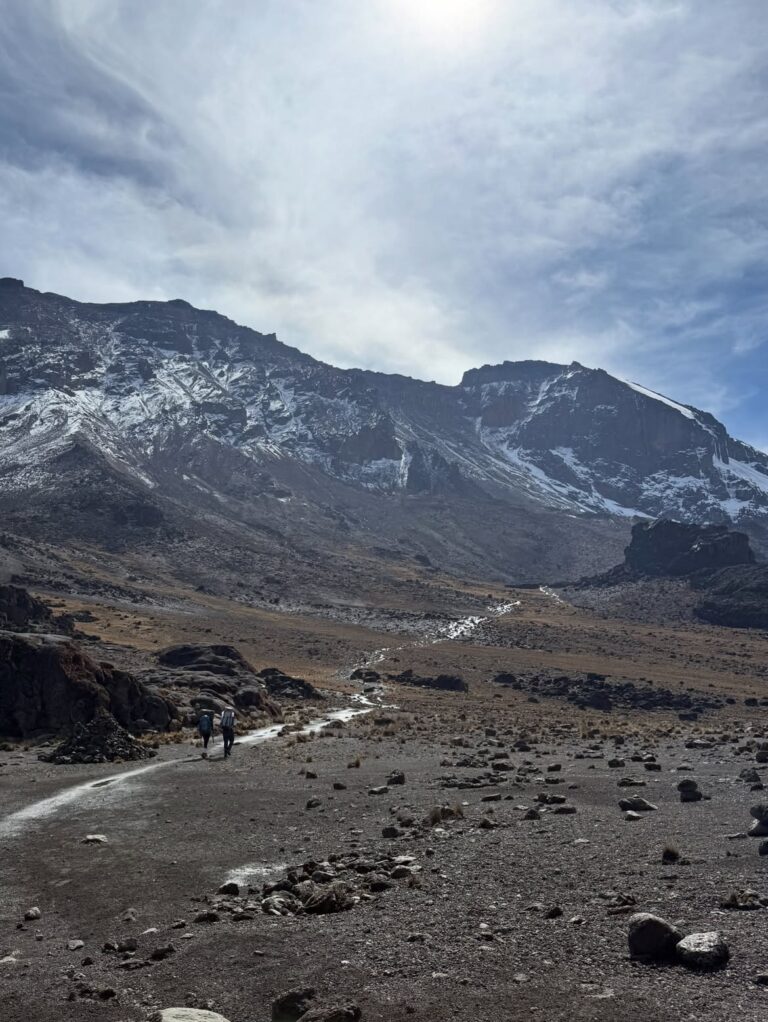
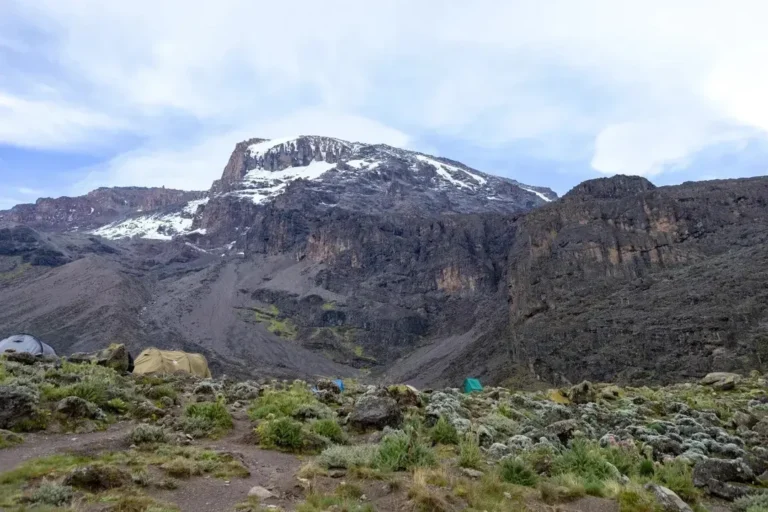
Barafu is the most heavily used high camp on the mountain, because the routes that use it are the most popular. “Barafu” is Swahili for ice, and the camp has earned the name — a narrow, exposed rocky ridge at 4,673m (15,331ft) on the southeastern side of Kibo, wind-scoured, perpetually cold, almost no vegetation.
Terrain: Loose volcanic rock and gravel. Tents pitched between boulders on uneven ground. Ridge location makes it exposed to wind from multiple directions.
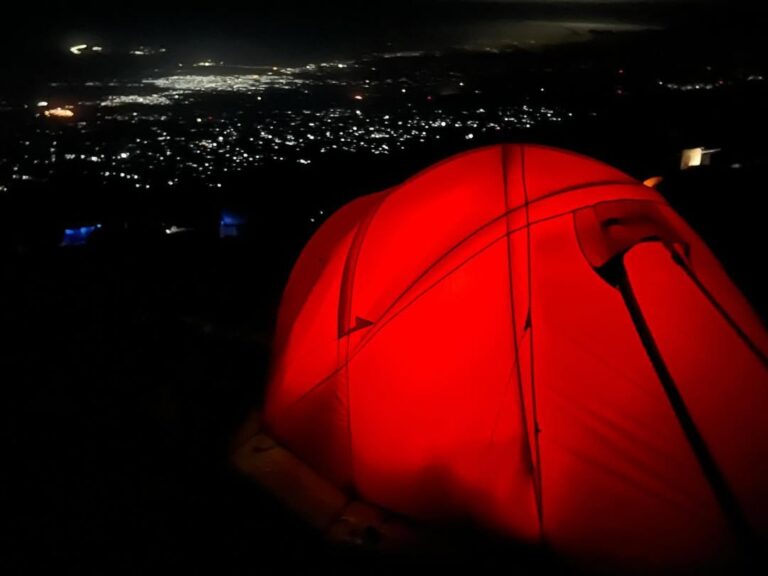
Conditions: Daytime temperatures 0°C to 5°C. Night-time -5°C to -10°C. Wind typically 10 to 40+ km/h. No shelter other than tents.
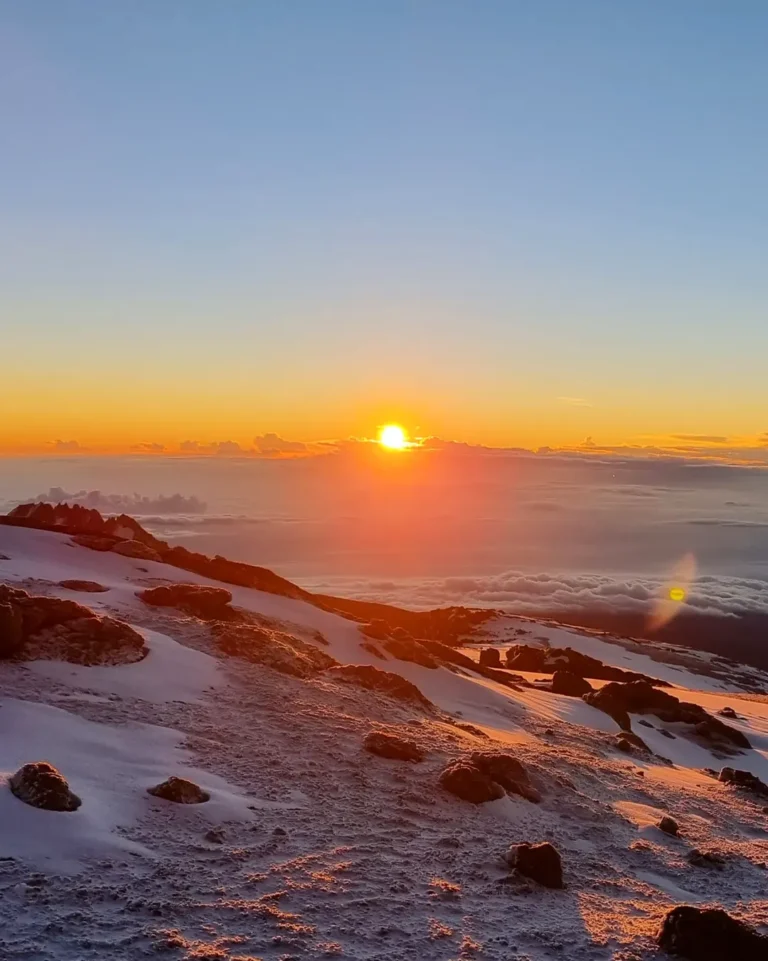
Summit path from Barafu: Climb roughly 1,080 vertical metres of switchback scree to Stella Point at 5,756m on the crater rim, then another 45 minutes along the rim to Uhuru Peak. Total summit night is 5–7 hours up, 4–6 hours down.
Rhythm of evening: Climbers arrive mid-afternoon. Early dinner at 5:30pm. Summit briefing at 6:30pm. Sleep attempt 7pm to 11pm. Wake-up call 11pm. Depart midnight.
Barafu is covered in detail in our Barafu Campsite post — worth reading if you’re climbing any of the southern or western routes.
Kibo Hut (4,703m/15,430 ft) — The Eastern High Camp
Used on: Marangu Route and Rongai Route.
Kibo Hut is the eastern equivalent of Barafu — the summit launch camp for routes approaching from the east side of the mountain. It sits at 4,703m (15,430ft), slightly higher than Barafu, and it’s the only summit camp on Kilimanjaro with built accommodation rather than tents.
Terrain: Volcanic gravel and rock, mostly flat. Several stone-and-metal huts clustered together with capacity for roughly 60 climbers across shared dormitory-style rooms. Separate mess hut for meals.
Conditions: Similar to Barafu — cold, exposed, alpine desert. The huts provide some wind shelter advantage over tent camps, though the dormitories are unheated and cold inside.
Summit path from Kibo Hut: Climb roughly 985 vertical metres of scree and rock scramble to Gilman’s Point at 5,685m on the eastern crater rim, then another 1.5 to 2 hours along the rim to Uhuru Peak. The walk from Gilman’s to Uhuru is longer and higher than from Stella to Uhuru — one of the reasons Marangu and Rongai summit success rates are lower than Machame and Lemosho.
Rhythm of evening: Similar to Barafu but earlier wake-up (often 11pm for midnight departure) and longer summit day due to the extended rim walk.
Who uses it: Marangu is the only Kilimanjaro route with hut accommodation throughout — many climbers book Marangu specifically because they prefer huts to tents. Rongai is a longer, more remote approach that joins the Marangu summit path at Kibo Hut.
School Hut (4,800m) — The Alternative Eastern Camp
Used on: Rongai Route (optional variant — some itineraries).
School Hut is a smaller, higher camp that sits slightly west of Kibo Hut at 4,800m (15,748ft). Some Rongai itineraries use School Hut as an alternative to Kibo Hut, particularly on longer and more gradual Rongai variants that include Mawenzi Tarn.
Terrain: Small designated camping area. Fewer climbers, less crowded than Kibo Hut. Tent camping — the “hut” in the name is one small structure, and climbers do not sleep inside it.
Conditions: Similar to Kibo Hut, at slightly higher elevation. Nights are colder and slightly more hypoxic, but most climbers acclimatize well given the slow Rongai approach.
Summit path from School Hut: Summit night climbs northwest and joins the main Kibo Hut-Gilman’s Point summit trail near the top of the scree slope, then continues to Gilman’s Point, then to Uhuru. Slightly shorter than the Kibo Hut summit distance because you’re starting 100m higher, but otherwise similar terrain.
Advantage over Kibo Hut: Less crowded, quieter, and pushes your sleep to a higher acclimatization altitude the night before summit. Some climbers summit more successfully from School Hut because the higher starting elevation shortens summit night and the camp itself is far less busy.
When it’s used: Usually on 7-day Rongai itineraries, sometimes on standard 6-day Rongai as a quiet alternative. Ask your operator specifically — some default to Kibo Hut, some default to School Hut.
Crater Camp (5,730m/18,800 ft) — The Highest Campsite
Used on: Lemosho and Northern Circuit extended itineraries. Occasionally on Shira or Umbwe for experienced trekkers.
Crater Camp is the highest campsite on Kilimanjaro — and one of the highest non-technical camps on any mountain in the world. At 5,730m (18,800ft), it sits inside the summit caldera of Kibo, 165m (541 ft) below Uhuru Peak itself.
Terrain: Volcanic rock and gravel on the caldera floor. Near-perpetual ice and snow in patches. No vegetation. No shelter.
Conditions: Night-time temperatures -10°C to -20°C. Wind can be intense. Water freezes solid if not kept close to body. Air has roughly 49% of sea-level oxygen.
Use pattern: Climbers on a Crater Camp itinerary summit Uhuru Peak on the afternoon of their “summit day,” then descend briefly into the crater to camp. They wake the next morning, walk back up to Uhuru for sunrise if desired, then begin the descent to Mweka Camp or Millennium Camp far below.
The trade-off: Crater Camp adds a day to the itinerary, moves the summit push to daylight rather than midnight, and gives climbers access to the inner crater, the Furtwängler Glacier, and the ash pit. It also requires climbers to sleep at an altitude where sleep is poor, headaches are common, and evacuation is slow if something goes wrong.
Who should and shouldn’t do it: Experienced altitude trekkers — people who have done Everest Base Camp, Aconcagua, or significant Himalayan trekking — are reasonable candidates. First-time high-altitude trekkers should not add Crater Camp. We cover the full decision framework in our Kilimanjaro Crater Camp post.
Base Camp Comparison Table
| Camp | Elevation | Routes | Summit Approach | Accommodation |
|---|---|---|---|---|
| Barafu | 4,673m (15,331 ft) | Machame, Lemosho, Shira, Umbwe, Northern Circuit | Stella Point (5,756m) | Tents |
| Kibo Hut | 4,703m (15,429 ft) | Marangu, Rongai (standard) | Gilman’s Point (5,685m) | Huts |
| School Hut | 4,800m (15,748 ft) | Rongai (variant) | Gilman’s Point (5,685m) | Tents |
| Crater Camp | 5,730m (18,800 ft) | Lemosho, Northern Circuit (extended) | Already at summit crater | Tents |
Choosing a Camp Is Choosing a Route
You don’t pick a base camp directly. You pick a route, and the route dictates the camp. But since the camp affects summit night — which is often the hardest part of the climb — it’s worth thinking about the camp as you choose your route.
Barafu and Stella Point give you the shortest summit-night distance and the best combination of altitude profile and rim walk. This is one of several reasons Machame and Lemosho have the highest summit success rates on the mountain.
Kibo Hut and Gilman’s Point give you a longer, harder rim walk to Uhuru after you hit the crater. Some climbers stop at Gilman’s and call it a summit. Officially, only Uhuru counts.
School Hut is a quieter alternative that pushes your last sleep higher — potentially helpful for acclimatization, potentially harder if your body struggles above 4,700m (15,419 ft).
Crater Camp is the alpine-style option for experienced trekkers who want the crater experience and can handle the physiological cost.
Why Camp Choice Matters for Summit Success
Your body at 4,700m (15,419 ft) is different from your body at sea level. Your body at 5,700m (18,800 ft) is very different. Small differences in camp elevation compound:
- Sleep quality. Deeper sleep at 4,600m (15,091 ft) than at 4,700m (15,419 ft) than at 4,800m (15,748 ft). The curve isn’t linear — it accelerates with altitude. A climber who sleeps well at Barafu may not sleep at all at Crater Camp.
- Hydration. Higher altitude means faster dehydration via respiration, which compounds altitude symptoms. Camps at 4,700m (15,419 ft) require aggressive hydration; camps at 5,700m (18.800 ft) require it even more.
- Appetite. Food intake drops sharply above 5,000m (16,404 ft). Climbers who can eat a full meal at Barafu may struggle with soup at Crater Camp.
- Distance to summit. The shorter the summit night, the more energy climbers arrive at Uhuru with — and descent from Uhuru is almost as physically demanding as the ascent.
This is why our safety protocols include structured SpO2 monitoring and morning-and-evening guide check-ins at every high camp, not just at Barafu. We want to catch altitude problems before they become summit problems.
What Kilimanjaro Sky Does at Every High Camp
Regardless of route or camp, our standard practice at every summit launch camp is the same:
- Pulse oximetry checks on arrival and before bed. Readings below 75% or drops of more than 5% from previous reading trigger reassessment.
- Oxygen and medical kit on site. Every climb carries supplemental oxygen. Not routinely used, but available.
- Clear descent protocol if symptoms escalate. Our guides have full authority to call descent. No pressure to push on. No bonuses tied to summit success.
- Summit briefing the evening before. Climbers walk through the full night ahead — layers, pace, breaks, what to carry, what to eat. If you’re nervous, the briefing is where to say so.
- 1 lead guide and 1 assistant guide per 2–3 climbers on summit night. This ratio matters when one climber is struggling and needs to descend while others continue.
The porters are paid directly after descent at a fair daily wage, with weight limits enforced by TANAPA at the park gate and gear (sleeping bags, waterproof kitbags) provided by us, not brought from home. We cover this in more detail on the about page and the packages page.
Planning Around Your Base Camp
If you’ve already chosen a route, the base camp is set — there’s no decision left to make. What you can control is which itinerary length you pick, which affects how well-acclimatized you arrive at that camp.
A 7-day Machame will arrive at Barafu better acclimatized than a 6-day Machame. An 8-day Lemosho arrives better acclimatized than a 7-day Lemosho. A 9-day Northern Circuit arrives better than both. If budget and time allow, more days = better acclimatization = higher summit success.
If you’d like to talk through which route and itinerary length fit your experience and fitness, start with our routes overview or reach out through our contact page. Every route on our site has its own dedicated page with full day-by-day itinerary, elevation profile, and included services. The FAQs cover the questions climbers ask most often before booking.