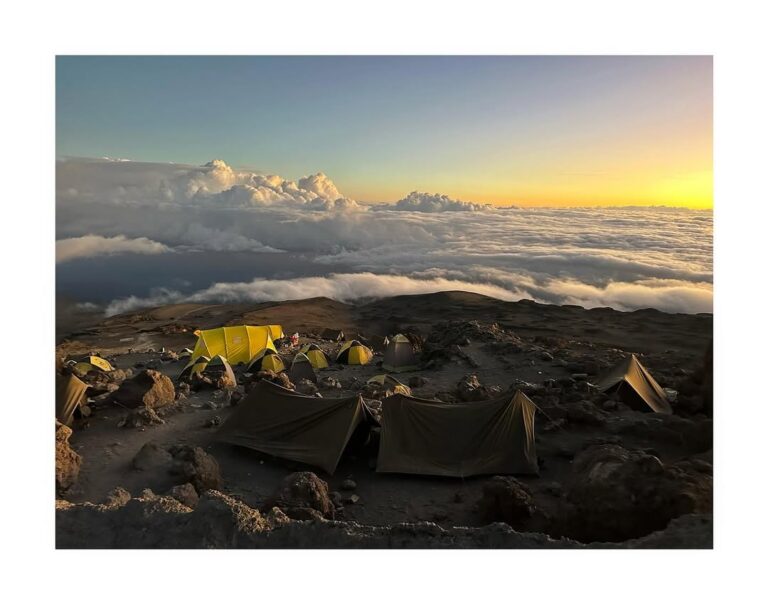
Barafu Camp sits at 4,673 metres (15,331 feet) on a narrow, exposed rocky ridge on the southeastern side of Kilimanjaro. “Barafu” is the Swahili word for ice, and the camp has earned the name — wind-scoured, perpetually cold, almost no vegetation, tents pitched between volcanic rocks on uneven ground. For climbers on the Machame, Lemosho, Shira, Umbwe, and Northern Circuit routes, Barafu is the final camp before the summit. It’s where you arrive in the afternoon, eat an early dinner, try to sleep, and then wake at 11pm to start the climb to Stella Point and Uhuru Peak.
This post covers what Barafu is actually like — the terrain, the conditions, the rhythm of an afternoon and evening there, and what climbers need to know to get through summit night from this camp.
Where Barafu Sits on the Mountain
Barafu is on the southeastern flank of Kibo, the highest of Kilimanjaro’s three volcanic cones. The camp is built along a rocky ridge at the intersection of several route descents and ascents. Depending on which direction you’re looking:
To the south, you can see the Mweka descent route disappearing into cloud below — this is where most climbers will come down after summit night.
To the west, above camp, you can see the dark scree slopes climbing toward Stella Point on the crater rim.
To the east, Mawenzi Peak — Kilimanjaro’s jagged second peak — rises in profile across the saddle between the two summits.
To the north, the vast upper slopes of Kibo climb steadily toward the summit.
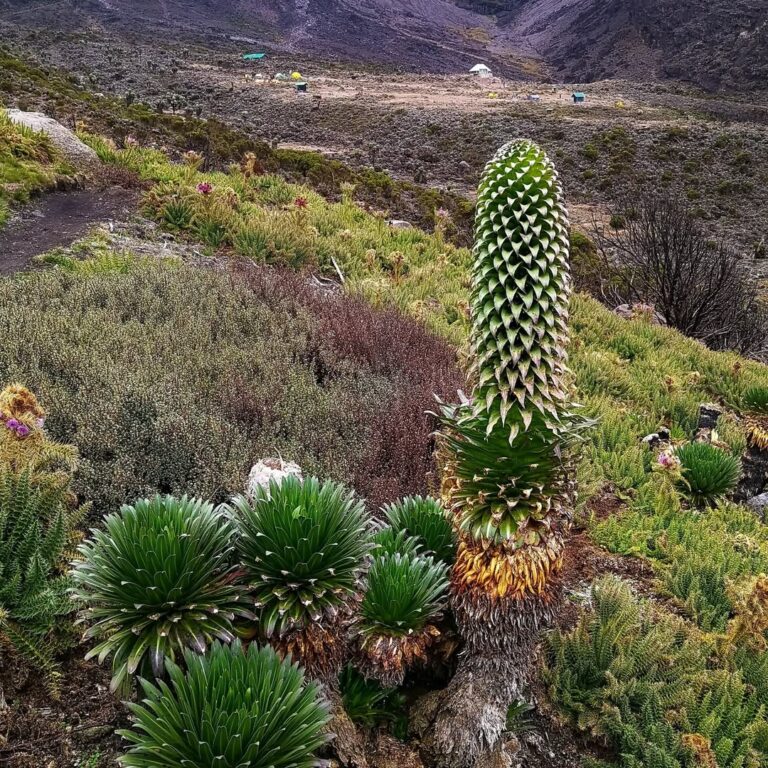
There are no trees at Barafu. No shrubs. Only loose volcanic rock, gravel, and the occasional patch of moss clinging to a sheltered boulder. At 4,673m, you’re well into the alpine desert zone — the fourth of Kilimanjaro’s five ecological zones.
The ground is uneven. Tents are pitched in whatever flat-ish spots exist between the rocks. Porters who’ve done this many times know which spots are least exposed to wind. The porters on a Kilimanjaro Sky climb arrive at camp ahead of the climbing group and have tents set up and dinner prep underway by the time clients walk in.
The Approach to Barafu
On a 7-day Machame itinerary, climbers arrive at Barafu from Karanga Camp after a 4–5 hour walk on day 5. On 6-day Machame, climbers come directly from Barranco Camp over the Karanga Valley — a longer, harder day. On 8-day Lemosho, the profile mirrors 7-day Machame.
The walk from Karanga to Barafu is about 4 kilometres with 700m of elevation gain. It doesn’t sound like much on paper. At altitude, it’s enough.
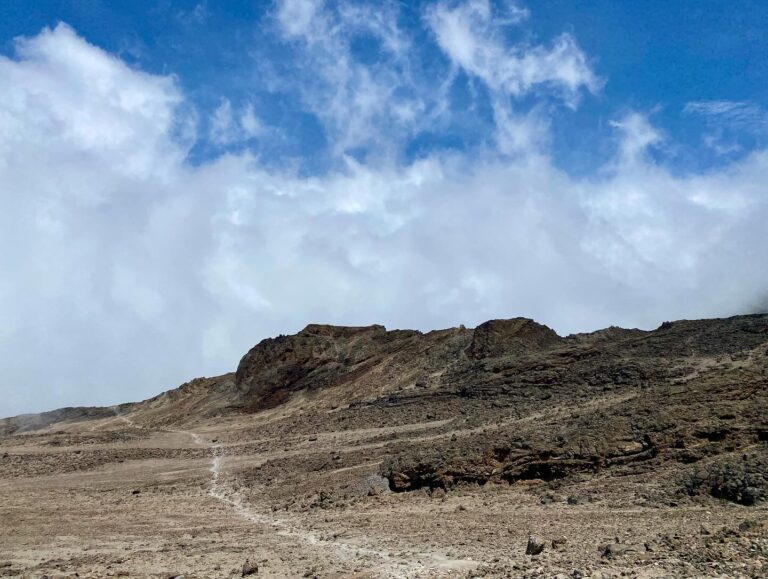
The trail climbs steadily through high alpine desert. The vegetation gets thinner as you ascend. Around 4,400m you pass the last low-lying scrub and enter pure rock and gravel terrain. The Barafu ridge comes into view maybe an hour before you reach it, and you spend that hour walking toward a rocky spine that doesn’t seem to get closer as quickly as you want it to.
The pace is deliberately slow. Pole pole. Your guides will slow you down before you realize you need to slow down. This is the day before summit night — your job is to arrive at Barafu as rested as possible.
What Barafu Feels Like
The first thing most climbers notice arriving at Barafu is the wind. The camp ridge is exposed on most sides, and wind accelerates over the ridge in a way that’s distinct from anywhere else on the mountain. Depending on the day, gusts can range from 10 to 40+ km/h. Temperatures in the afternoon run 0°C to 5°C. By evening they drop to -5°C to -10°C.
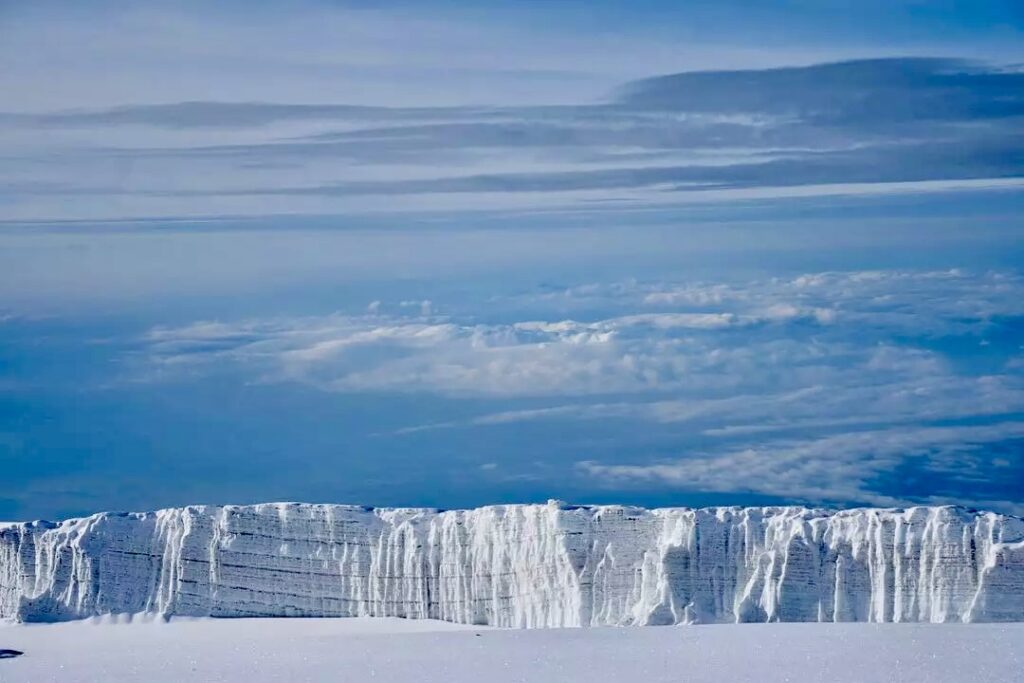
The second thing is the emptiness of the landscape. On the lower routes, you’ve been surrounded by vegetation — rainforest, moorland, giant groundsels. At Barafu, it’s rock, sky, and the glaciers visible above you on Kibo. The sun is brutal at this altitude when it’s out, and the cold is immediate when it disappears behind cloud. Sunglasses and sunscreen matter more here than climbers often expect.
The third thing is how your body feels. Most climbers arrive at Barafu with a persistent mild headache, a noticeable shortness of breath at rest, some loss of appetite, and a low-grade fatigue that isn’t normal. This is Acute Mountain Sickness (mild) for most people. It’s expected. It’s not dangerous in most cases. What matters is:
-Hydration. Dehydration amplifies every AMS symptom. Target 3–4 litres of water across the day.
-Eating. You won’t feel hungry. Eat anyway. Simple carbohydrates are easiest to keep down. Your body needs fuel for a 12–16 hour round-trip summit day.
-Resting. Lying flat in your tent lowers your heart rate and helps acclimatization. Short naps in the afternoon are good. Long naps that run into dinnertime can disrupt the evening rhythm.
-Honesty with your guides. If you feel worse than you expect to, say so specifically. Your guides can check pulse oximetry on demand, reassess, and make calls. The Kilimanjaro Sky safety protocols are built for this — SpO2 below 75% or a drop of 5%+ from previous readings triggers reassessment.
The Evening Rhythm at Barafu
A typical evening at Barafu runs something like this:
4:00–5:00pm: Climbers arrive. Tea, biscuits, a short rest. Guides check on each climber — pulse oximetry, visual assessment, questions.
5:30–6:00pm: Early dinner. Soup first. A simple main course — pasta, rice, stew — designed to be easy on an altitude-affected appetite. Most climbers eat less than they’d expect. Guides encourage you to eat anyway.
6:30–7:00pm: Summit briefing. Your guides walk through the night ahead — what time to wake, what to wear, what to carry, how pace will work, when breaks will happen. Questions get answered specifically. If you’re nervous, now is the time to say so.
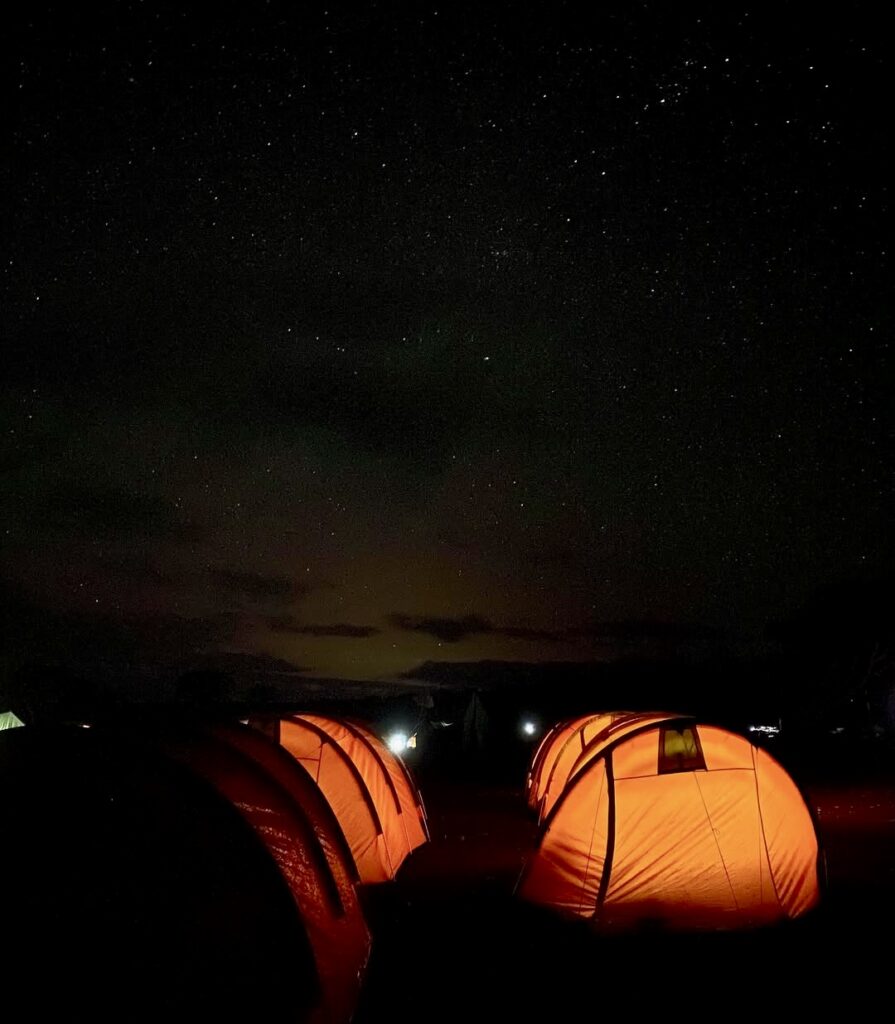
7:00–7:30pm: Climbers head to tents. The goal is 3–4 hours of sleep before the wake-up call. Most climbers don’t sleep well. Some sleep not at all. This is normal.
11:00pm: Wake-up call. A porter knocks on each tent. Hot tea is brought to climbers still in their tents. You eat a light breakfast — biscuits, porridge, whatever you can keep down. You layer up for the summit push. Headlamp on. Water bottles insulated against the cold.
11:45pm–Midnight: Walk out of camp. Summit day has started.
The Sleep Problem at Barafu
The hardest part of Barafu for most climbers isn’t the altitude or the cold — it’s trying to sleep at 4,673m with summit night in three hours.
Your body is under hypoxic stress. Your heart is working harder than it should be at rest. Your breathing is irregular — many climbers at this altitude experience Cheyne-Stokes breathing, a pattern where breath deepens and slows in cycles that can feel alarming but is physiologically normal. Headaches fade in and out. Nervous energy about summit night compounds it all.
A few things help:
-Don’t lie there counting the hours. Read, listen to audio, keep your mind off the clock.
-Warm water bottle at your feet. If camp has hot water, ask. It transforms how warm your sleeping bag feels.
-Ear plugs and eye mask. Wind hits the tent fly. Headlamps move through camp. Sensory reduction helps.
–Don’t catastrophize poor sleep. Climbers who get 1 hour of real sleep summit every day on this mountain. Adrenaline and acclimatization will carry you. Your guides know this.
You are not going to wake up feeling rested. Nobody does. The goal at Barafu is to lie flat, stay warm, and let your body recover as much as it can.
Summit Night Out of Barafu
The climb from Barafu to Stella Point is approximately 1,100 vertical metres over 5–7 hours of switchbacks up a steep scree slope. From Stella, it’s another 45 minutes along the crater rim to Uhuru Peak at 5,895m. Then you turn around and come back.
The descent is fast. Barafu back down to High Camp or Mweka Camp on the same day is another 4–6 hours and about 1,500–2,000 metres of descent, depending on your itinerary. The full summit day is typically 12–16 hours.
A few things that matter specifically out of Barafu:
Pace is set by your guide, not by you. On summit night, you will want to walk faster than your guide will let you. Do not. Climbers who go fast early burn out before Stella Point. Climbers who go slow summit.
Layering. Base layer, mid layer, insulated jacket, hard shell. Two pairs of gloves (thin liner + warm outer). Two pairs of socks. Buff or balaclava. Summit mittens over gloves if it’s particularly cold. Summit temperatures on Kilimanjaro are the reality, not the exception.
Hydration. Insulated bottles tucked close to your body. A hydration bladder tube left exposed will freeze within an hour. Most climbers don’t drink enough on summit night. Drink more than feels natural.
Headlamp. Fresh batteries. Tested before you leave the tent. A spare in your pack.
Barafu in the Arc of the Climb
Barafu is not a beautiful camp. The ground is hard, the wind is constant, the air is thin, and you are going to be cold. But it is one of the most important camps on the mountain — it’s where you recover just enough to make the summit push possible, and it’s where the hardest stretch of your week on Kilimanjaro begins.
Climbers who summit Kilimanjaro almost always describe Barafu afterwards with a kind of detached affection. It wasn’t comfortable. It wasn’t easy. But it was where they did what they came to do.
If you’re planning a climb and want to talk through which route — and which itinerary length — gives you the strongest chance of summiting from Barafu, get in touch with our team. We run small groups, 1 lead guide and 1 assistant guide per 2–3 climbers, and we’ll walk you through the trade-offs honestly. You can also read the packages page for details on what’s included, or the FAQs for the questions climbers ask most often.