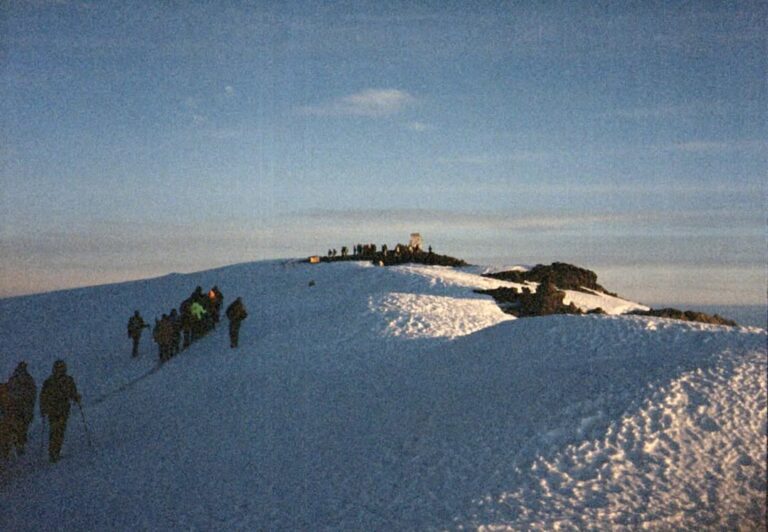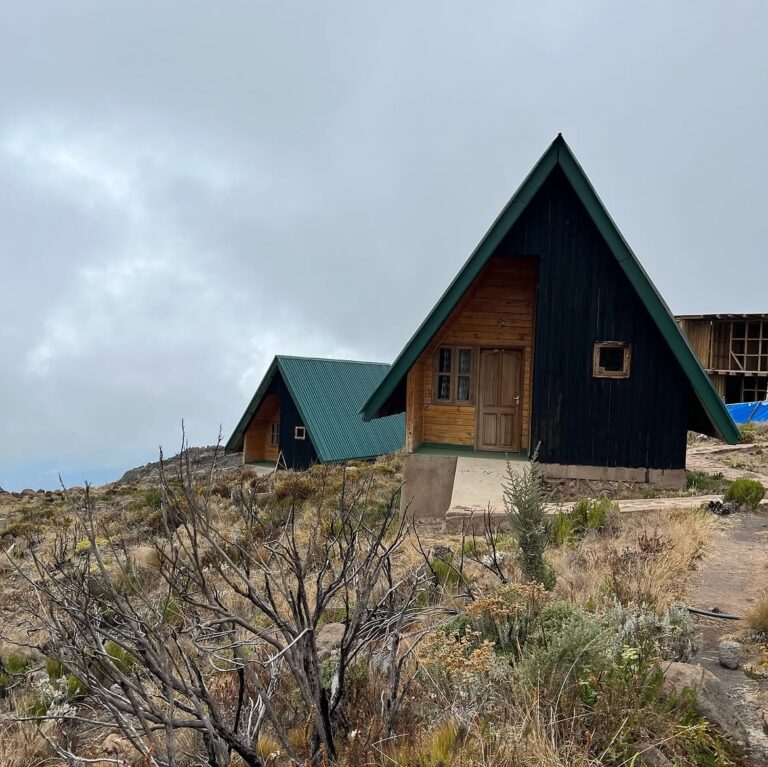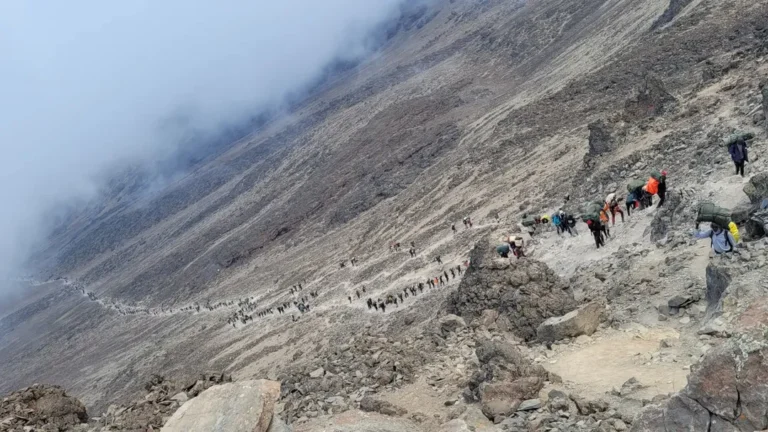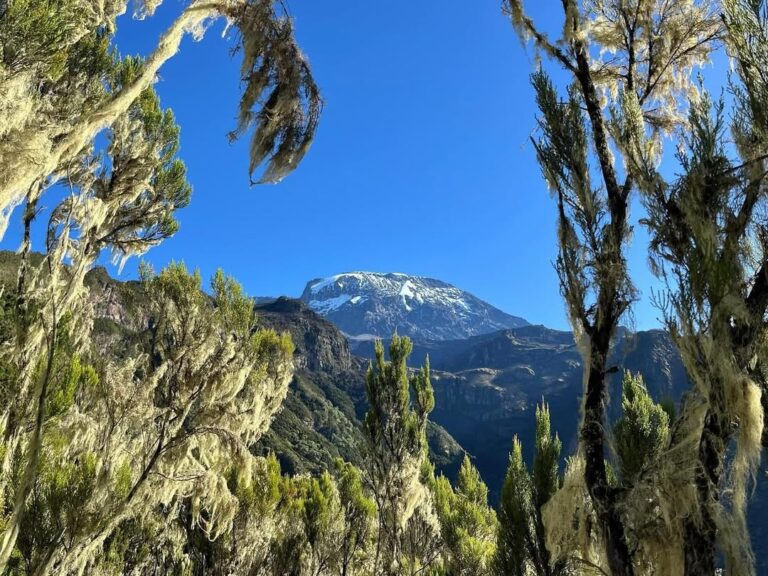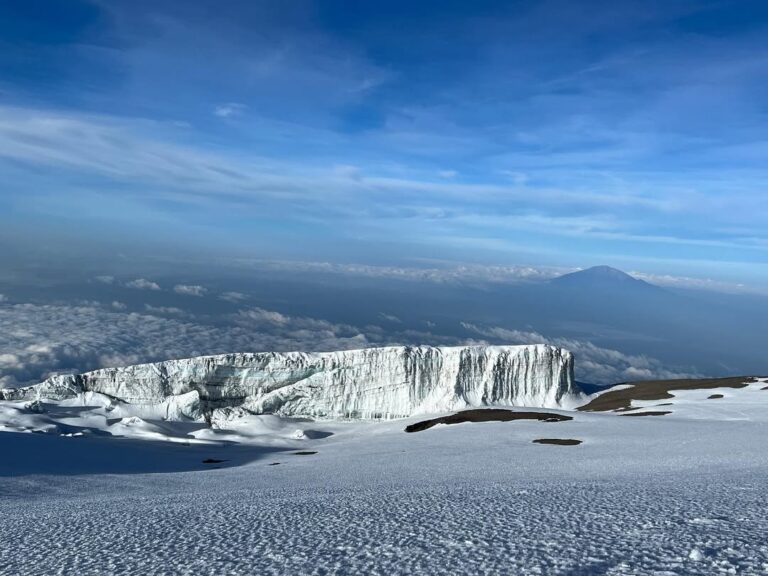
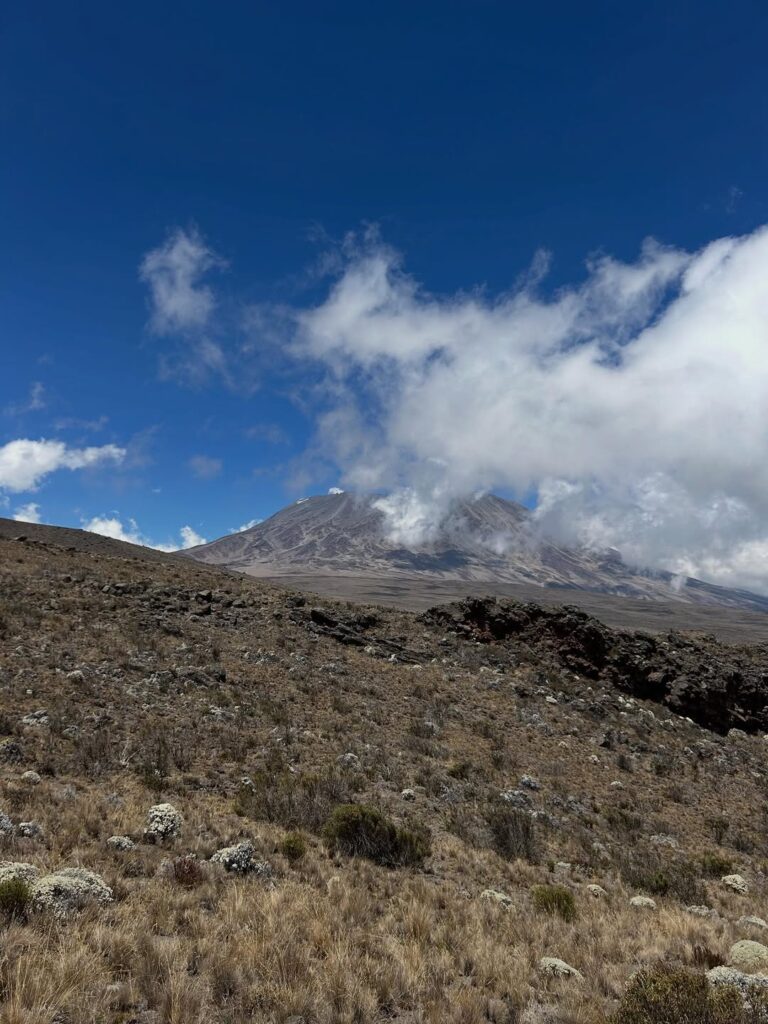
At the summit of Kilimanjaro, the air holds about 49% of the oxygen available at sea level. At Barafu (summit night camp, 4,640m), it’s about 57%. At Shira (around 3,800m), it’s about 62%.
Your body notices. Breathing on Kilimanjaro gets progressively harder as you climb, in a specific and predictable pattern, and the difference between “harder breathing” and “a breathing problem that needs attention” is something our guides are trained to read. Here’s what it actually feels like, what’s normal, what’s not, and what pole pole — the Swahili phrase our guides repeat all day — is really doing physiologically.
What Thinner Air Actually Means
A common misconception: at altitude, the percentage of oxygen in the air decreases. It doesn’t. Oxygen stays at 20.9% of air at every altitude on Earth.
What changes is atmospheric pressure. At sea level, that pressure pushes oxygen into your lungs, across the alveolar membrane, and into your blood efficiently. At 5,000m, the pressure is roughly half what it is at sea level, and each breath delivers only about half the oxygen molecules into your blood.
Your body has two immediate responses:
- You breathe faster. Resting breathing rate goes from ~15 breaths per minute at sea level to 20–30 at altitude. You notice this as constant, light breathlessness, especially when speaking or climbing a slope.
- Your heart beats faster. Your cardiovascular system works harder to move available oxygen around. Resting heart rate at 4,000m is often 20–30 beats per minute higher than at sea level.
Both are normal. Both are your body doing exactly what it should. The limit is that you can only push these compensations so far — and above about 5,500m, most people are near the edge of what the compensation can deliver.
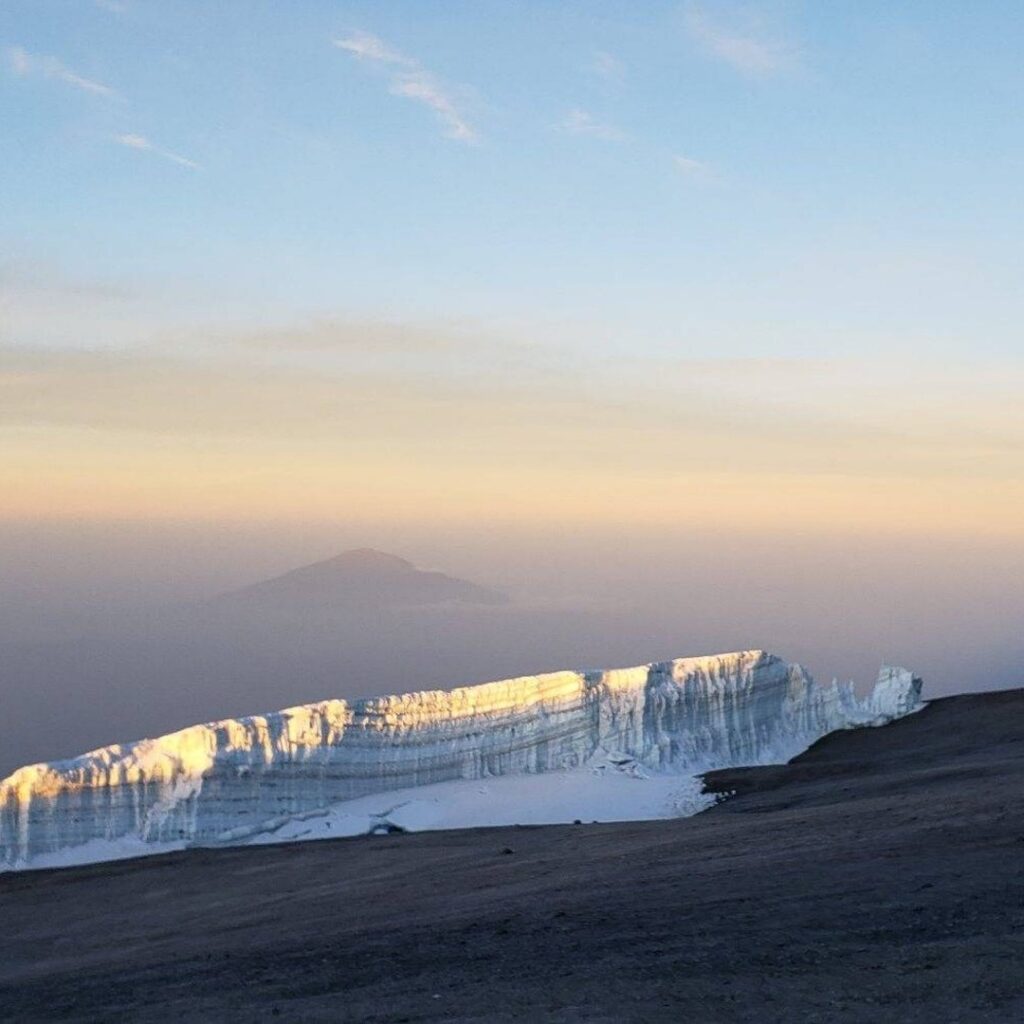
What It Feels Like at Each Altitude Band
Below 3,000m — Machame Camp, Simba, Mandara
Your breathing is slightly faster than at home, especially walking uphill. Most people don’t consciously notice it. If you were a visitor from sea level thrown straight into this altitude with no context, you might feel like you’d run a short distance and were catching your breath — even at rest. After a day or two of acclimatising, it normalises.
Sleep is largely unaffected at this altitude for most climbers.
3,000–4,000m — Shira, Barranco, Karanga
Walking uphill at this altitude feels noticeably harder than it would at sea level — maybe 60–70% of your sea-level capacity. Flat walking feels close to normal. Climbing a ladder at camp leaves you mildly winded. Talking while walking uphill feels inefficient; you stop talking and just walk.
Sleep starts to be affected. Many climbers experience periodic breathing — the cycle where your body breathes normally, pauses, then gasps awake. This is normal altitude physiology, not a breathing disorder. See our sleeping on Kilimanjaro guide for more detail.
4,000–4,700m — Barafu, School Hut, Kibo Hut
Walking uphill feels like serious work, even at pole pole pace. Your chest works harder. You can feel your heartbeat sitting still. Putting on boots or getting up from a squat makes you breathless. Eating a full meal feels harder — the body is already working hard to breathe, and digestion wants resources too.
Sleep is often fragmented. Some climbers lie awake for hours. Others sleep but wake up multiple times. Your SpO2 (pulse oximetry) reading, which was 95–99% at sea level, is now typically 80–88% at camp.
Our guides take SpO2 readings morning and evening at this altitude. Readings below 75%, or drops greater than 5% from the previous reading, trigger a reassessment and increased monitoring. Most climbers stay above 80% and are fine.
4,700–5,895m — Summit night, Uhuru Peak
Breathing is the dominant sensation. Each step up the scree slope feels disproportionate to the distance covered. You take 2–3 breaths between steps. Talking is minimal. You can hear yourself breathing constantly.
At Uhuru Peak itself, the 49% sea-level oxygen equivalent means even standing still, you’re breathing 25–30 times per minute at rest. Any exertion — taking off a backpack, bending to adjust a boot, taking photos — puts you into what feels like sprint breathing.
SpO2 readings at the summit, in people without AMS, run 65–80%. At sea level, anything below 90% would have a doctor concerned. At 5,895m, it’s expected.
For the full altitude picture, our Kilimanjaro altitude sickness guide covers what the body is actually doing and how AMS presents.
What’s Normal and What’s Not
Our guides have seen thousands of climbers at altitude. The pattern of what’s normal breathing-wise versus what needs attention is clear.
Normal
- Faster breathing at rest and during exertion.
- Breathless after any uphill push or pack adjustment.
- Periodic breathing at night — cycles of normal breathing, brief pauses, and recovery breaths.
- A dry cough at altitude — sometimes called the “Kilimanjaro cough” — from dry air and rapid breathing. Uncomfortable but rarely dangerous on its own.
- A mild headache on day one or two at altitude, easing with hydration and time.
- Some loss of appetite.
Needs attention
- Breathlessness at rest that doesn’t ease after 10–15 minutes of sitting still.
- A persistent wet, productive cough producing pink or frothy sputum.
- Chest gurgling or rattling sounds audible to you or your tent partner.
- Rapid heart rate at rest — above 120 bpm — that doesn’t settle.
- Blue-tinged lips or fingertips that don’t resolve with oxygen.
- Confusion, loss of coordination, persistent severe headache, hallucinations.
The first four are markers of HAPE (high-altitude pulmonary oedema) — fluid entering the lungs. The last two combined with breathlessness suggest HACE (high-altitude cerebral oedema). Both are medical emergencies that require immediate descent. On our climbs, they trigger the four-tier evacuation protocol: oxygen administration at altitude, stabilisation, assisted descent, vehicle transfer to KCMC Hospital in Moshi, with helicopter evacuation available for severe cases.
Both are rare. Both are preventable, and when they do develop, they develop gradually. Our guides watch for early signs — that’s what morning and evening check-ins are for.
What Pole Pole Actually Does
Every day, all day, our guides walk with clients at a pace that feels slower than natural — pole pole, “slowly slowly” in Swahili. Clients in good physical shape sometimes want to push faster. Resist. Here’s what pole pole is actually accomplishing.
Oxygen matching. At slow pace, your oxygen demand is closer to your oxygen supply. You can maintain a stable breathing rhythm without chasing a deficit. Faster pace creates oxygen debt — the body needs more than the available supply — and you start compounding fatigue.
Acclimatisation preservation. Acclimatisation is the body’s gradual adjustment to lower oxygen: more red blood cells, improved oxygen-carrying efficiency, better metabolic response. This adjustment requires time and requires not pushing the body too hard at the start. Going fast on day two burns acclimatisation capacity that you need for summit night.
Energy banking. A climber who walks slowly for six days arrives at Barafu with energy reserves. A climber who pushes hard early arrives at Barafu already depleted. Summit night is not a test of peak fitness — it’s a test of what’s left after five days. Pole pole preserves what’s left.
Our 95–98% summit success rate across Machame and Lemosho comes largely from guide discipline on pace. It’s genuinely the single most important factor.
Breathing Techniques That Help
A few practical breathing techniques our guides teach clients who struggle at altitude:
Pressure breathing. On the uphill sections at high altitude, purse your lips slightly and exhale with deliberate pressure. This increases back-pressure in your lungs and improves oxygen transfer. Breathe in through your nose if you can; exhale through pursed lips. Sounds like a quiet “pfff.” Many climbers use this without being taught, instinctively.
Rest step. At altitude, on steeper ground, pause briefly with each step — straighten your back leg so your skeleton (not your muscle) holds your weight for a beat before the next step. A half-second pause, not a stop. The rhythm: step, breathe, step, breathe. This matches your walking rhythm to your breathing rhythm.
Deep abdominal breathing at rest. Sitting at camp in the evening, place a hand on your stomach and breathe so that your stomach rises and falls (not just your chest). Five minutes of this before bed often improves sleep at altitude.
What doesn’t help: Paper bag breathing (doesn’t apply at altitude — that’s for hyperventilation, not low-oxygen situations), holding your breath (reduces saturation further), or trying to “catch up” with fast breathing after exertion. Breathe steady, walk slow.
What About Supplemental Oxygen?
Some operators include supplemental oxygen on every climb. Our approach is different: we carry oxygen cylinders and medical oxygen as part of the standard guide kit on every climb, for safety — and we use it when needed, for altitude-related medical events. We don’t use it routinely to help healthy clients summit.
The reason is climbing ethics and climb quality: supplemental oxygen masks the body’s signals and can enable people to push into altitude territory they shouldn’t be in. On Kilimanjaro, healthy climbers who pace properly don’t need it. The better path is proper acclimatisation time (7-day Machame or 8-day Lemosho over a 5-day Marangu), guide-led pacing, and, if recommended by your doctor, Diamox.
On the question of Diamox — an acetazolamide medication that increases ventilation and improves oxygen saturation — see our Diamox on Kilimanjaro guide for the full picture. It helps many climbers. It’s not a miracle pill. Consult your doctor before travel.
For more on our onboard oxygen and emergency protocols, our oxygen on Kilimanjaro post covers what’s carried and when it’s used.
The Honest Bottom Line
Yes, breathing gets hard on Kilimanjaro. It gets noticeably hard at 4,000m, genuinely hard at 4,600m, and the hardest you’ve ever breathed while still being healthy at 5,895m.
It’s also manageable. Hundreds of thousands of people summit Kilimanjaro each year, most of them without altitude climbing backgrounds, many of them in their 40s, 50s, 60s. The combination of time (7–9 days on the mountain), pace (pole pole), hydration (3–4 litres a day), nutrition (eat even when appetite drops), and competent guiding gets healthy adults to the top.
What matters is respect for the process. Don’t sprint the first day. Don’t skip meals. Don’t ignore early AMS signs because you’ve invested a lot in the climb. Trust the guides on pace. The breathing gets hard, and with the right approach, it stays within the range of hard-but-manageable right up to the summit.
If you have specific concerns — asthma, a previous respiratory condition, or a history of altitude trouble on prior trips — talk to us before booking, and talk to your doctor. Our FAQs cover many of the common questions, and our team is happy to answer anything specific. See our routes overview for the longer itineraries that give the best acclimatisation — often the single best thing you can do to make the breathing easier.