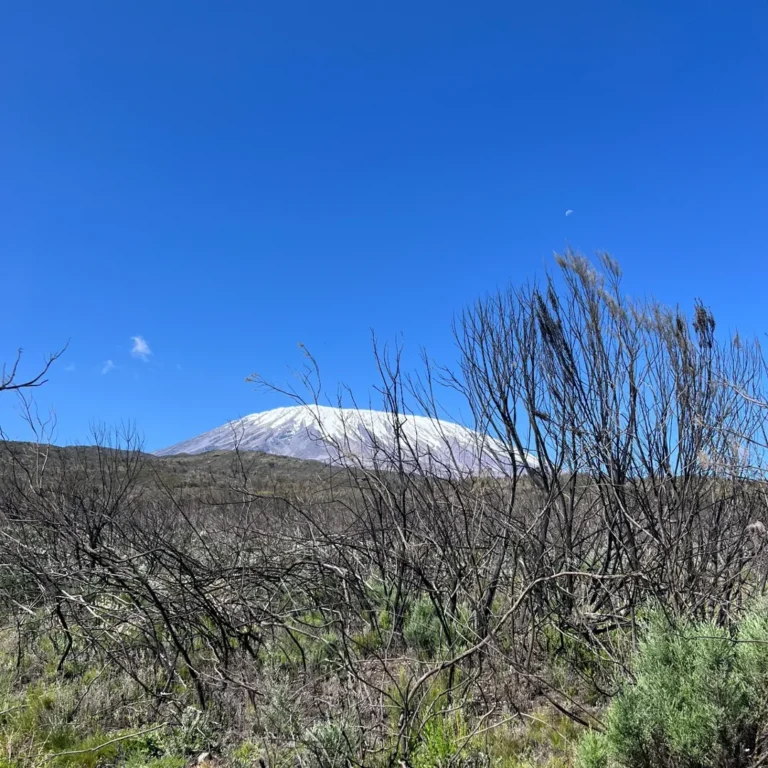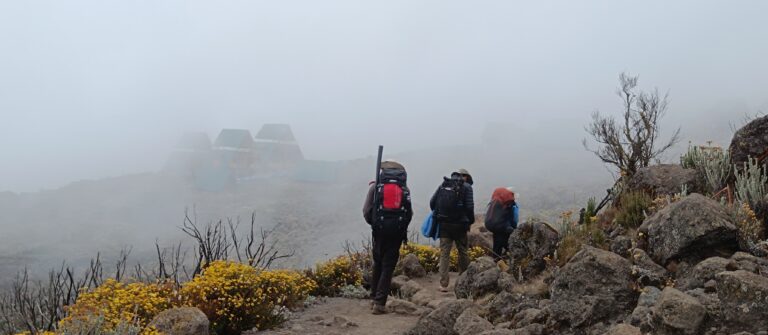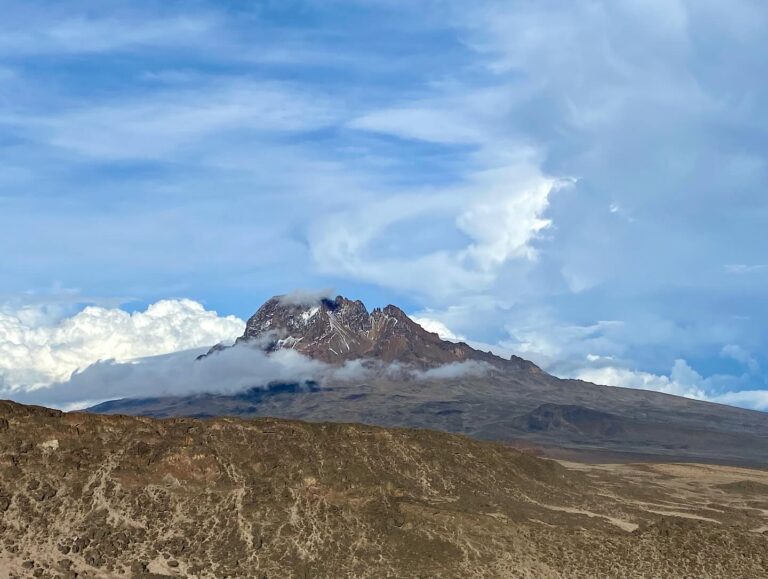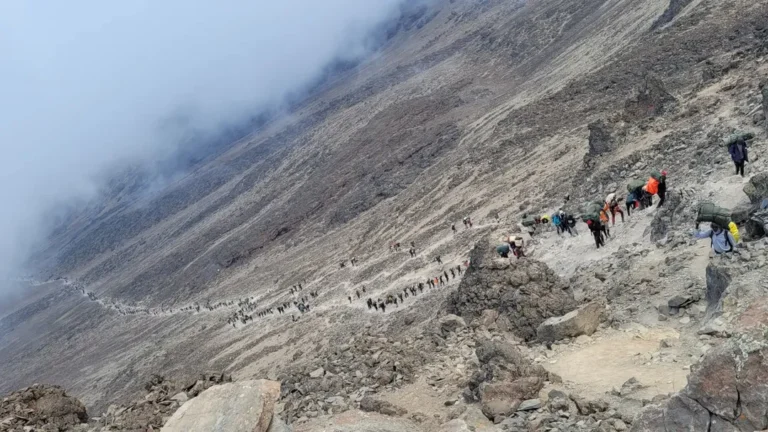
Kilimanjaro is, among other things, a climb through one of the most complete altitudinal sequences of plant life on earth. In roughly seven days, you walk from tropical banana groves to lichen-crusted volcanic rock above 5,500m (18,044 ft) — and you pass through five distinct plant communities along the way. Several of the species you’ll see grow nowhere else on the planet.
Most climbers notice the dramatic ones — the giant groundsel that look like plants from another world, the torch-like lobelia at 4,000m (13,123 ft). Many miss the subtler story: the old-growth forest, the everlasting flowers, the lichens painted across summit rock in orange and black. This guide covers both.
The Five Zones in One Picture
Plants on Kilimanjaro don’t arrange themselves randomly. They form bands that follow altitude and moisture, with sharp transitions where temperature, rainfall, or soil change rapidly. From base to summit, the major plant zones are:
- Cultivated zone (800–1,800m/2,624-5,905 ft): Farmland. Bananas, coffee, maize, vegetables.
- Montane forest (1,800–2,800m/5,905-9,186 ft): Dense tropical rainforest. Giant trees, epiphytes, understory.
- Heath and moorland (2,800–4,000m/9,186-13,123 ft): Giant heather below, open moorland above. Endemic giant plants.
- Alpine desert (4,000–5,000m/13,123-16,404 ft): Sparse, low vegetation. Tussock grasses, everlasting flowers, scattered groundsel.
- Summit zone (5,000m+/16,404 ft+): Lichens and mosses only. No vascular plants above about 5,500m.
/This zonation is the reason the Kilimanjaro weather changes so dramatically with altitude — the same climatic shifts that shape temperature, rainfall, and wind also shape the plant communities you walk through.
Zone 1: The Cultivated Slopes
Below the national park boundary, Kilimanjaro’s slopes are worked land. This is the zone you drive through on the way to the trailhead. What grows here is a product of centuries of Chagga agriculture and a more recent overlay of cash crops.
Bananas are the staple. The Chagga kihamba garden system grows many banana varieties — cooking bananas (mbuya), beer bananas (used for brewing mbege), sweet dessert bananas, and small red varieties.
Coffee — specifically Arabica coffee — is the most visible cash crop. Kilimanjaro coffee grows in the shade of banana trees and scattered larger trees in the kihamba layer. The bright red cherries ripen between September and January depending on elevation and microclimate.
Maize, beans, yams, taro, and vegetables fill the ground layer. Avocado, mango, and citrus trees appear in the upper canopy. In the wetter areas, macadamia nuts are an increasingly important crop.
Indigenous shade trees — species like Albizia, Cordia, and Grevillea — structure the system. The kihamba is not a plantation. It’s a layered polyculture that looks like forest at first glance.
If you spend time at a coffee tour in the foothills or visit Ekanubi Underground before your climb, this is the landscape you’ll be walking through. It’s worth understanding what you’re looking at. (For the cultural context, the Chagga people of Kilimanjaro goes into the agricultural system in more depth.)
Zone 2: The Montane Rainforest
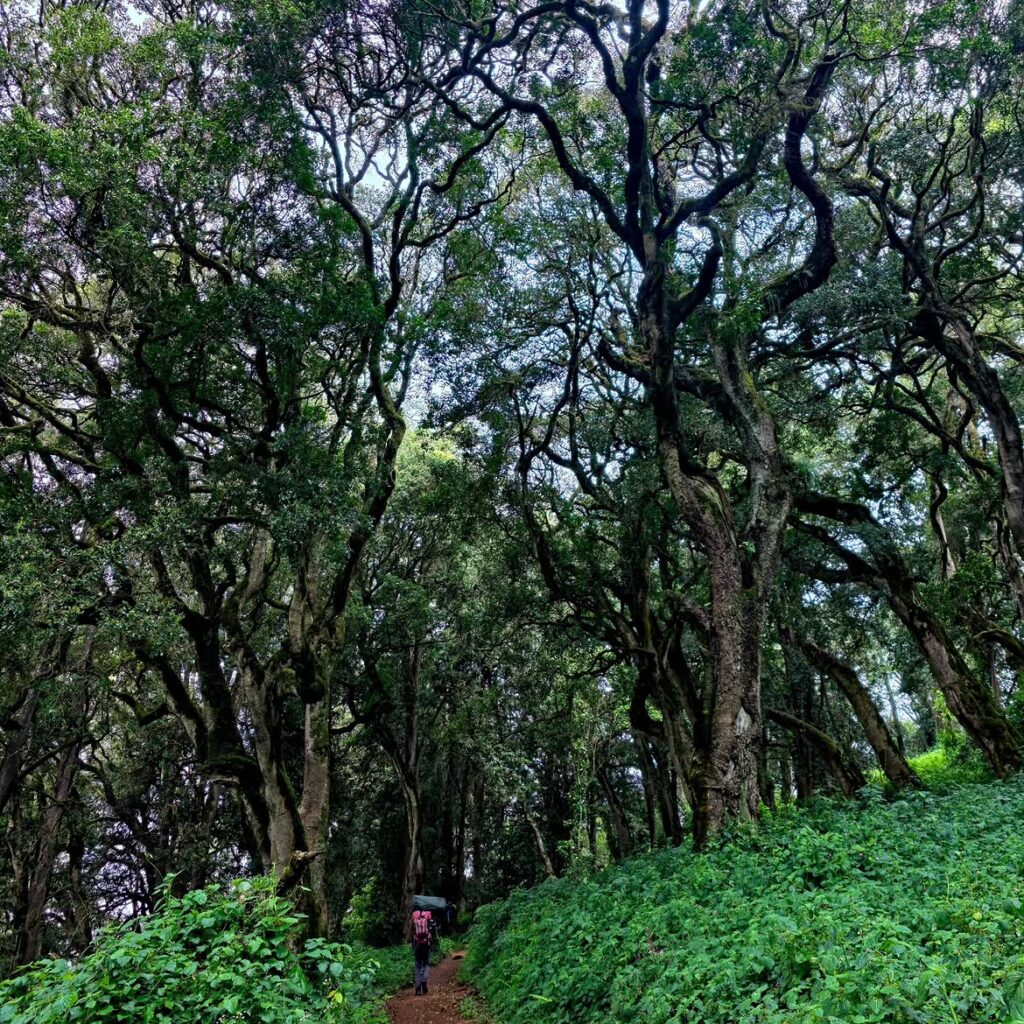
You enter the mountain proper when you cross into the montane forest belt — typically around 1,800m. This is one of East Africa’s best-preserved tropical montane forests, and if your route starts low (Machame, Lemosho, Umbwe, Marangu), you’ll spend the first day and sometimes part of the second day inside it.
The Canopy
Several old-growth tree species define the structure:
Camphorwood (Ocotea usambarensis) is one of the dominant emergent trees, reaching 40m or more. Valuable timber, now protected within the national park.
Podo (Podocarpus latifolius) is a large conifer with small, leathery leaves — related to yews. Slow-growing, long-lived.
Hagenia (Hagenia abyssinica) has distinctive feathery compound leaves and drooping flower clusters. You’ll see this tree transitioning from forest to moorland in the upper forest belt.
Fig trees (Ficus species) — large, buttressed, often draped with epiphytes and strangler figs.
Wild banana (Ensete ventricosum) grows along streams and moist gullies — a tall, un-branched relative of the cultivated banana, with enormous paddle-like leaves.
The Understory and Epiphytes
The forest floor is densely vegetated where light allows. Tree ferns — particularly Cyathea species — create prehistoric-looking groves in damper areas. Ground orchids, various shrubs, and a dense layer of herbs fill the understory.
Above, the trees are thick with epiphytes — plants that grow on other plants without being parasitic. Spanish moss (Usnea species, also called “old man’s beard”) drapes the branches in pale green curtains. Orchids, ferns, and bromeliads attach themselves wherever a branch is stable.
The forest has many moods. In the early morning it’s often still, with shafts of light and visible bird activity. By mid-afternoon, cloud fills the canopy and a fine drizzle falls. At dusk, the forest gets loud — tree hyrax, monkeys, birds settling in. Take time on this day. You’ll miss a lot if you just push through.
Impatiens kilimanjari — the Endemic Flower
Worth knowing: Kilimanjaro has an endemic flower that grows only on this mountain. Impatiens kilimanjari is a small red-and-yellow flower found in moist forest areas, particularly along stream banks and trail edges between roughly 2,000 and 2,700m (6,501 and 8,858 ft). Ask your guide to point one out. It’s small but striking — red petals with a yellow throat — and you won’t see it anywhere else on earth.
Zone 3: Heath and Moorland — the Strange Zone
This is where Kilimanjaro’s plant life gets genuinely unusual. Above the forest treeline, around 2,800m (9,186 ft), the landscape opens up and the vegetation shifts into something that looks, at first, faintly alien.
Giant Heather
The lower moorland is dominated by giant tree heather — Erica arborea and Erica excelsa. In Europe and the Mediterranean, these species grow as low shrubs. On Kilimanjaro, they reach 4 or 5 metres tall, forming a heathland canopy. The branches are draped with yellow-grey lichens and mosses, and the small white flowers appear at various times of year.
Walking through giant heather is strange. It has the feel of a miniaturised forest — a recognisable shrub grown to tree size. This is a pattern you’ll see repeated with several other plants on the mountain.
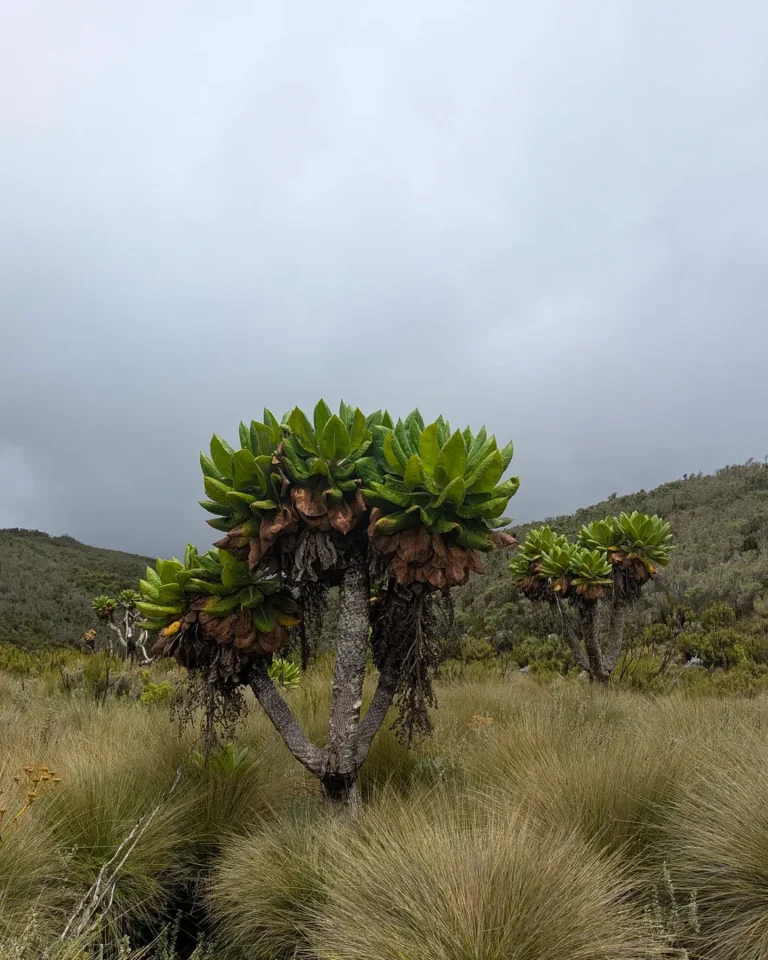
Giant Groundsel (Dendrosenecio)
Above the heather, at roughly 3,500m (11,482 ft) and up, you enter the territory of Kilimanjaro’s most famous plants: the giant groundsel, Dendrosenecio kilimanjari and its relatives.
These are trees. Or something that looks like trees, built from the wrong material. Each groundsel has a thick, woody trunk — often 3 to 6 metres tall — topped with a rosette of large, cabbage-like leaves. In season, a tall flower spike rises from the centre. They grow in scattered groves across the moorland, particularly in damper valley floors and along streams.
Giant groundsel are what’s called “afroalpine giants” — plants that evolved in response to the tropical-high-altitude environment, where days are warm but nights are freezing year-round. The thick trunks retain water and warmth. The rosette of leaves closes up at night to protect the growing tip. Dead leaves stay attached to the trunk, insulating it.
The species on Kilimanjaro are endemic. Dendrosenecio kilimanjari is found only here. There are related species on other East African mountains (Mount Kenya, the Rwenzoris) but each mountain has its own variants.
Good places to see them: the Barranco Valley on the Machame and Lemosho routes is famously full of giant groundsel. Shira Plateau has scattered stands. The Saddle area between Kibo and Mawenzi has some of the highest-altitude specimens.
Giant Lobelia
The moorland’s other signature plant is the giant lobelia — primarily Lobelia deckenii on Kilimanjaro. Unlike the tree-form groundsel, the lobelia grows as a massive rosette topped by a tall, torch-like flower spike — sometimes 2m or more in height — packed with small blue-purple flowers.
Like the groundsel, the lobelia has extraordinary adaptations for the environment. The rosette closes at night. Water held in the leaf bases helps regulate temperature. When the plant flowers — once in its life, after many years of growth — the flower stalk is a dramatic event visible from some distance.
Lobelias are most visible in the moorland and lower alpine zone, between about 3,000m and 4,200m. They often grow alongside giant groundsel in the same valleys.
Everlasting Flowers
Amid the big, strange plants, the moorland floor is scattered with “everlasting flowers” — small, papery-petalled flowers in the Helichrysum genus. Helichrysum newii, H. citrispinum, and several others grow here. They’re called everlasting because the papery petals hold their shape and colour for extended periods, even after the plant has died back. You’ll see them in white, yellow, and pink, often growing in low cushions against rocks and in sheltered spots.
Zone 4: Alpine Desert
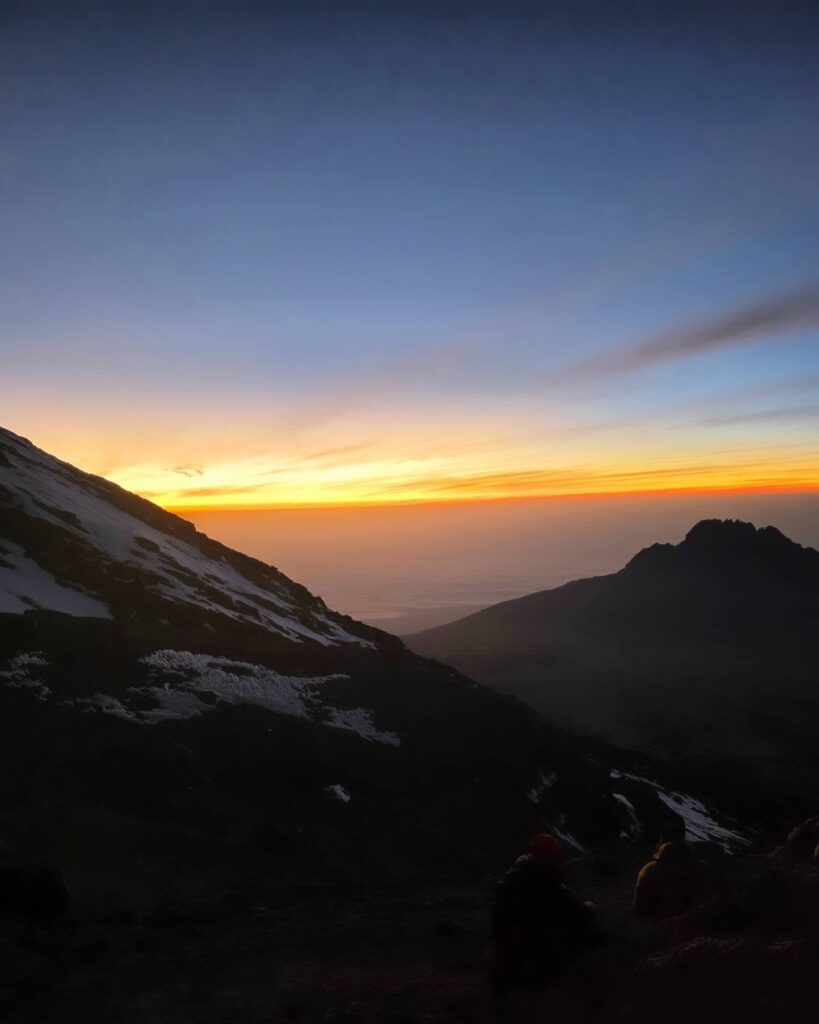
Above 4,000m (13,123 ft), the moorland thins into what ecologists call the “alpine desert” — a zone of low annual rainfall (under 250mm) and intense diurnal temperature swings. Plant cover drops dramatically.
What grows here is specialist. Small tussock grasses. Isolated cushion plants. Scattered everlastings. A few hardy groundsels at the lower end of the zone. The soil is loose volcanic ash and scree, and wind movement across this zone rearranges the surface constantly.
Lichens become increasingly visible — orange Caloplaca, black rock lichens, and crustose species that form slow-growing patches on exposed stones. Lichens are the most successful organisms in this zone; they’re a symbiosis of fungus and algae that can survive freezing, drying, and intense UV.
A slow walk across the alpine desert — typically the long day between Barranco or Barafu and the high camp — gives a strange feeling of being above life. Not quite: tiny plants are underfoot, and an occasional insect buzzes past. But the density of living things drops to near zero.
Zone 5: The Summit Zone — Lichens Only
Above 5,000m (16,404 ft), and particularly above 5,500m (18,044 ft), vascular plants disappear. The only life that persists on summit rock is the lichen and moss community — incredibly slow-growing, desiccation-tolerant organisms that colonise bare stone.
The orange and yellow lichen patches visible on summit boulders and near the crater rim can be centuries old. They grow at rates measured in millimetres per decade. They fix small amounts of carbon, contribute to very slow weathering of the rock, and represent the upper limit of life on this mountain.
Above the crater rim, on the final summit pitch and at Uhuru Peak itself, you are effectively in a sterile environment. The ice, the rock, the thin air. No plants. This is part of what makes standing there feel the way it does — for those few minutes, you’re somewhere that life, in most of its forms, can’t reach.
Why Kilimanjaro’s Flora Matters
Kilimanjaro’s vegetation isn’t just scenery. It’s one of the most studied examples of afroalpine plant ecology in the world, and several of the species here are important in understanding how plants adapt to tropical high-altitude environments. The giant groundsel and giant lobelia specifically have been subjects of decades of ecological research.
The plant communities are also under pressure. Climate change is shifting temperature and moisture bands upward. Fire — both natural and human-caused — has damaged parts of the moorland in recent decades. The retreat of the summit glaciers is changing water regimes across the upper mountain. What you see today is a snapshot of a system in transition.
This matters for how you climb. The national park rules — stay on trails, don’t camp off-designated sites, pack out all waste — are there partly to protect these plant communities. The Kilimanjaro national park fees you pay go directly into park maintenance, conservation, and ranger infrastructure. Use the trails correctly; don’t collect plants; leave the mountain as you found it.
Botanical Highlights by Route
Different Kilimanjaro routes give different flora experiences. A short summary for plant-interested climbers:
- Machame: Excellent montane forest day; the Barranco Valley is dense with giant groundsel and lobelia. Generally the best moorland botanising of the popular routes.
- Lemosho: The longer forest approach through the Lemosho Glades is particularly rich — fewer crowds means more quiet time for observation. Shira Plateau adds a distinctive high-moorland environment.
- Marangu: Forest day is good; the Saddle crossing exposes you to alpine desert flora.
- Rongai: Drier northern approach; different moorland community, fewer giant groundsel but a distinctive feel.
- Northern Circuit: Longest route, most varied botanical experience, remotest stretches of moorland.
- Shira: Starts on the Shira Plateau — straight into high-altitude moorland vegetation with giant groundsel visible from day one.
If plants specifically are a major interest, Lemosho or the Northern Circuit give you the most time in the most biologically interesting zones.
One Practical Note
If you want to get the most out of Kilimanjaro’s flora, ask your guide. Many Chagga guides have grown up with these plants — they know the local names, the traditional uses, and the ecological patterns in ways that short field guides can’t capture. The best botanical moments on the mountain often come from a guide pausing to point out something you would have walked straight past.
And if you’re planning a climb and want to time it for flower season, the main flowering period for many of the moorland species (including some lobelia and everlastings) is after the rains — roughly June to September and January to February. The best time to climb Kilimanjaro guide covers the trade-offs around timing in detail.
Walking through five ecological zones in a week is not a normal travel experience. Most climbers don’t register how unusual this is. Slow down where you can. The plants are half the story.