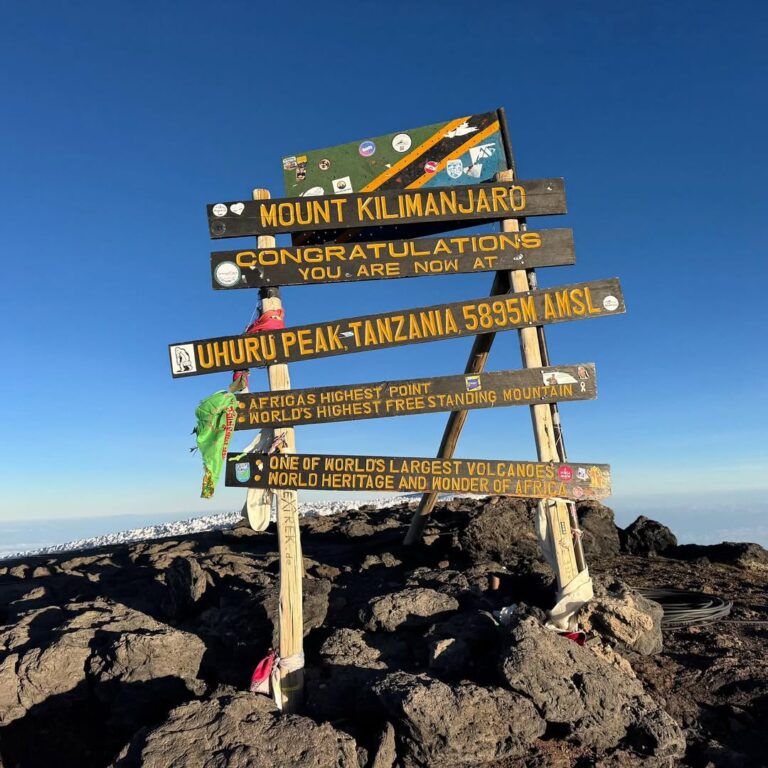
Of all the kit decisions on a Kilimanjaro climb, gloves are the one most people underestimate. Boots get obsessed over. Sleeping bags get researched carefully. Gloves get grabbed as an afterthought.
This is a mistake, and guides see it every summit night.
Cold hands on summit night are not just uncomfortable. They affect your grip on trekking poles. They affect your ability to open your bag, adjust your zip, drink from your water bottle, eat a cereal bar, or get your phone out to take a photo. They contribute to the general misery loop that makes people want to stop walking. And in the extreme cases — inadequate gloves in a windy summit night at -20°C felt temperature — they become a genuine safety concern.
Here’s the system that works.
Why Gloves Matter More Than People Expect
Hands are extremities. When your core body temperature drops, your body pulls blood away from extremities — hands, feet, ears — to protect the vital organs. This is physiologically correct. It also means that at altitude, in cold and wind, your hands can go from comfortably warm to numbingly cold faster than you’d expect.
Summit night temperatures at the crater rim typically range from -10°C to -20°C (14°F to -4°F). Wind is common on the ridge between Stella Point and Uhuru Peak. Wind chill at these temperatures can push felt temperature to -25°C or lower.
You’re also going to be wearing these gloves for 6–8 hours straight. They’re going to be managing sweat from exertion during the climb, then losing heat rapidly during rest stops, then needing to work while you fumble with a water bottle or trekking pole strap at 5,500m (18,044 ft) with fatigue-affected fine motor skills.
A single pair of ski gloves is not the answer.
The Three-Layer Glove System
Layer 1: Liner Gloves
Liner gloves are lightweight, close-fitting gloves — typically merino wool or silk — worn directly against the skin. Their purpose is:
- To provide a base level of warmth when conditions are mild (mornings at lower camps, during uphill effort on summit night when your body is generating heat)
- To allow you to use your hands precisely — phone, zip, pack buckle, headtorch — without removing your outer gloves
- To provide meaningful protection if you have to remove outer gloves for any reason at altitude
Merino wool liners are the most versatile choice. They manage moisture better than synthetics, provide reasonable warmth even when slightly damp, and can be worn for multiple days without becoming unwearable. Silk liners are lighter and even more packable, but less warm and less moisture-wicking.
What to avoid: thin cotton gloves that have no warmth once damp, tight athletic gloves that compress your hands and reduce circulation.
When to wear: Days 1–4 of the climb during active walking. All of summit night when conditions are mild. Keep on under outer gloves throughout summit night.
Layer 2: Insulated Outer Gloves
This is your primary summit night glove — a properly insulated, windproof, water-resistant outer glove worn over your liners.
The insulation specification matters. Down-filled gloves provide the best warmth-to-weight ratio; synthetic insulation performs better in damp conditions. For Kilimanjaro, either works — the mountain’s upper zones are dry — but a high-loft down outer glove from a reputable brand provides excellent warmth at low bulk.
Critical features to look for:
Windproofing. This is more important than waterproofing for summit night. The wind on the crater rim is dry. What it does is strip heat. A glove that blocks wind effectively at -15°C will keep your hands dramatically warmer than a glove that doesn’t, regardless of insulation weight.
Wrist coverage and strap. The gap between your jacket sleeve and your glove is a cold air entry point. Gloves with an extended wrist and an adjustable strap that seals against your cuff are meaningfully warmer than gloves that gap. On summit night, cold air finding that gap will wake you up to how thin a barrier skin is.
Dexterity enough to manage poles. You will be using trekking poles for all or most of summit night. Your outer gloves need to allow a functional grip on the pole grip without being so stiff that the pole becomes awkward.
Recommended brands and specifications: Black Diamond, Rab, Mountain Hardwear, and Outdoor Research all produce quality outer gloves in the relevant spec. Look for “summit” or “mountaineering” gloves rather than “ski” or “hiking” gloves — skiing gloves are often built for temperature ranges slightly above what summit night demands.
What to avoid: Fashion-influenced ski gloves that sacrifice insulation for aesthetics, “soft shell” gloves that provide grip but no real cold protection, gloves without windproof facing.
Layer 3: Mittens (Summit Night Backup)
Mittens are warmer than gloves at equivalent insulation weight because your fingers share warmth with each other instead of being individually insulated. The trade-off is dexterity — you lose finger independence in mittens.
For most Kilimanjaro climbers, mittens are a summit night contingency rather than primary wear. They come out if your outer gloves are not keeping your hands adequately warm, if conditions are more severe than expected, or if your hands go cold during a longer rest stop.
Oversized enough to wear over liner gloves and outer gloves combined — or alone if conditions are extreme — a pair of expedition mittens in your summit pack takes almost no space and provides meaningful security. On a cold summit night where something has gone wrong with warmth management, reaching into your bag for mittens is a good option to have.
When to use them: Not necessarily at the start of summit night. Your body is generating heat during the ascent and your hands may stay warm. By the section above 5,000m, during slower pace sections, or if you start to notice cold hands spreading into cold fingers, put the mittens on. Pre-emptive warmth management is far better than reactive.
Summit Night Glove Protocol in Practice
Here’s what the layering sequence actually looks like on summit night:
Leaving Barafu (~midnight): Liner gloves on, outer gloves on. You’re moving, generating heat, and the temperature hasn’t dropped to its lowest point yet. Mittens in your pack.
2,500–5,000m (8,202-16,404 ft) section (~1am–3am): Steady movement, variable warmth in hands depending on conditions. If wind picks up significantly, pull mittens on over outer gloves or switch to mittens alone.
Above 5,000m (16,404 ft) (~3am–6am): This is where hands get cold. Mittens should be readily accessible, not buried at the bottom of your summit pack. If your hands have been cold since 4,500m, they are going to be miserable by 5,500m. Address it early.
At Stella Point and crater rim: Wind exposure is highest here. If mittens aren’t already on, consider them. The walk from Stella to Uhuru is the section where hypothermia risk is highest and where many of the photos you’ve seen were taken — in which the subjects look cold, because they are cold.
During photo stop at Uhuru: You will need to remove outer gloves briefly to operate a phone or camera. Do this quickly. Liner gloves allow basic phone operation (or you’re using touchscreen-capable liner gloves) and keep your hands from bare exposure.
On the descent: Hands warm dramatically as you lose altitude and as the sun rises. By the scree section below Barafu, you may be in liner gloves only. Read the conditions and adjust — there’s no trophy for suffering unnecessarily.
What to Look for When Trying Gloves
Before you buy, the checklist:
Try them together. Liner gloves + outer gloves combined should fit comfortably without your fingers pressing against the fingertip seam. Compressed fingertips reduce blood flow. Your hands need room to move.
Check wrist seal. With your jacket sleeve pulled down, check the gap. A good outer glove should allow you to create a seal. Ideally, try this with the jacket you’ll actually be wearing on summit night.
Test trekking pole grip. If you have poles, grip them with the outer gloves on and verify you can hold the grip securely and operate the strap buckle. Awkward grip means awkward pole use for six hours.
Assess dexterity for pack access. Try operating a zip and opening a snack bar in the outer gloves. This is what you’ll be doing at 5,000m (16,404 ft). If you can’t do it at home, you won’t be able to do it there.
A Note on Hand Warmers
Chemical hand warmers (air-activated packs) are a useful supplement, not a substitute for proper gloves. Dropped into mittens or outer gloves during rest stops or the coldest sections of summit night, they add meaningful warmth.
Carry 4–6 pairs in your summit pack. Activate them as you leave Barafu or just before your hands start to get cold — once activated, they warm over 15–20 minutes and last 6–8 hours.
Rechargeable electric hand warmers are also viable and have the advantage of being reusable, though they add weight. If you run cold hands and cold feet in general, they’re worth considering.
The Full Summit Night Kit Picture
Gloves are one piece of the warmth system for summit night. For the complete layering guide — base layers, mid-layers, shell jacket, trousers, and everything else — see our dedicated post on what to wear for summit night on Kilimanjaro.
And for the broader kit list across the whole climb, our Kilimanjaro packing list has the complete breakdown.
If you’re working through the planning stages — deciding on route, dates, and what to bring — our planning guide covers the full sequence. And our team in Moshi is happy to answer specific kit questions, particularly if your circumstances are unusual (Raynaud’s syndrome, circulation issues, etc.). These are exactly the things worth surfacing before you arrive.