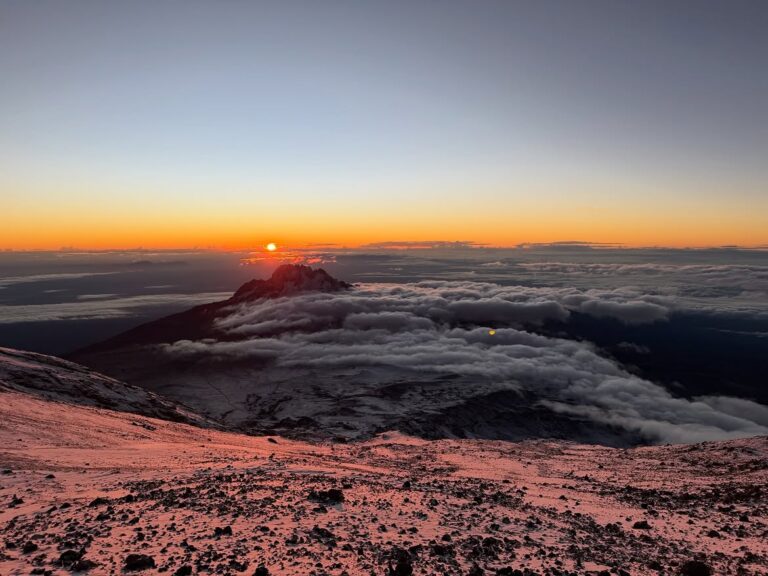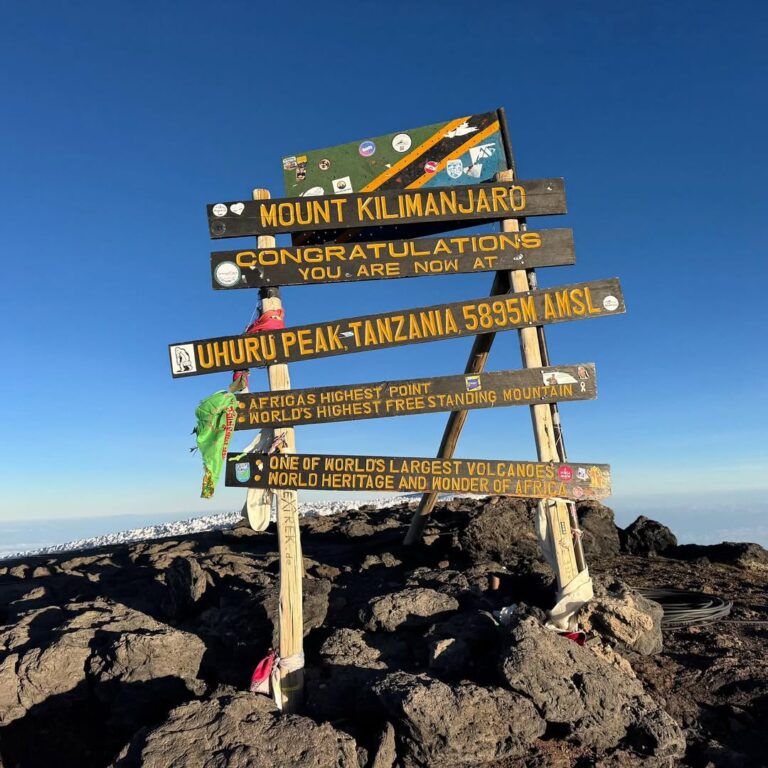
These are the two most popular high-altitude treks in the world. If you’re reading this post, you’ve probably narrowed your next big trip to one of them, and you want a straight answer on which one will be harder.
Short version: Kilimanjaro is physically harder on summit day. Everest Base Camp is harder across the full trip. Neither is a technical climb — both are trekking peaks — but they demand different things, and people who’ve done both generally describe them very differently.
Long version: the two treks differ in five ways that matter — altitude, duration, terrain, acclimatization profile, and logistics. This post goes through each one. By the end, you should have a clearer sense of which trek fits your body, your time, and your goals.
The Headline Numbers
| Metric | Kilimanjaro (Machame/Lemosho, Uhuru Peak) | Everest Base Camp (standard Lukla route) |
|---|---|---|
| Maximum altitude | 5,895m/19.340 ft (Uhuru Peak) | 5,364m (EBC) or 5,550m (Kala Patthar optional) |
| Sleeping altitude (highest night) | 4,673m/15.331 ft (Barafu) — or 5,730m/18.800 ft (Crater Camp, optional) | 5,140m (Gorak Shep) |
| Trek length | 6–9 days | 10–14 days |
| Total walking distance | 60–85 km | 130 km round trip |
| Total elevation gain | 4,000–5,000m (13,123-16,404 ft) | 2,500–3,000m (8,202-9,842 ft) |
| Typical summit success rate | 85–95% depending on route and operator | ~95% — most people reach EBC |
| Cost (guided, reputable operator) | $2,000–$4,500 | $1,500–$3,500 |
These numbers tell you something, but not everything. The feel of each trek is different in ways that don’t show up in a table.
Altitude: Kilimanjaro Goes Higher, Faster
Kilimanjaro’s summit at 5,895m (19,340 ft) is 531m (1,742 ft) higher than Everest Base Camp. That gap matters because altitude effects are non-linear — each additional 100m (328 ft) near the top has a bigger physiological impact than each 100m (328 ft) lower down.
But altitude isn’t only about the maximum point you reach. It’s also about how fast you get there.
Kilimanjaro typically takes you from sea level to 5,895m (19,340 ft) in 6 to 9 days. On a 6-day Machame, you gain roughly 900m per day on average, with one brutal summit day covering 1,200m of ascent (then 2,800m of descent) in 12 to 16 hours. The acclimatization profile is aggressive by any standard.
Everest Base Camp takes 10 to 14 days, but you reach Lukla at 2,860m (9,383 ft) by plane — so the trek starts already two-thirds of the way to sea-level-equivalent stress. Daily elevation gain is gentler, typically 300–600m per day, with built-in acclimatization days at Namche Bazaar (3,440m/11,286 ft) and Dingboche (4,410m/14,468 ft). You have time to adapt.
The result: Kilimanjaro pushes your body harder in less time. More climbers get Acute Mountain Sickness on Kilimanjaro than on EBC, proportionally, even though EBC climbers spend longer at altitude overall. If your body struggles with altitude, Kilimanjaro will challenge you more.
Summit Day: Kilimanjaro Is in a Different League
If you compare a typical day on each trek, the hardest day on Kilimanjaro is significantly harder than the hardest day on EBC.
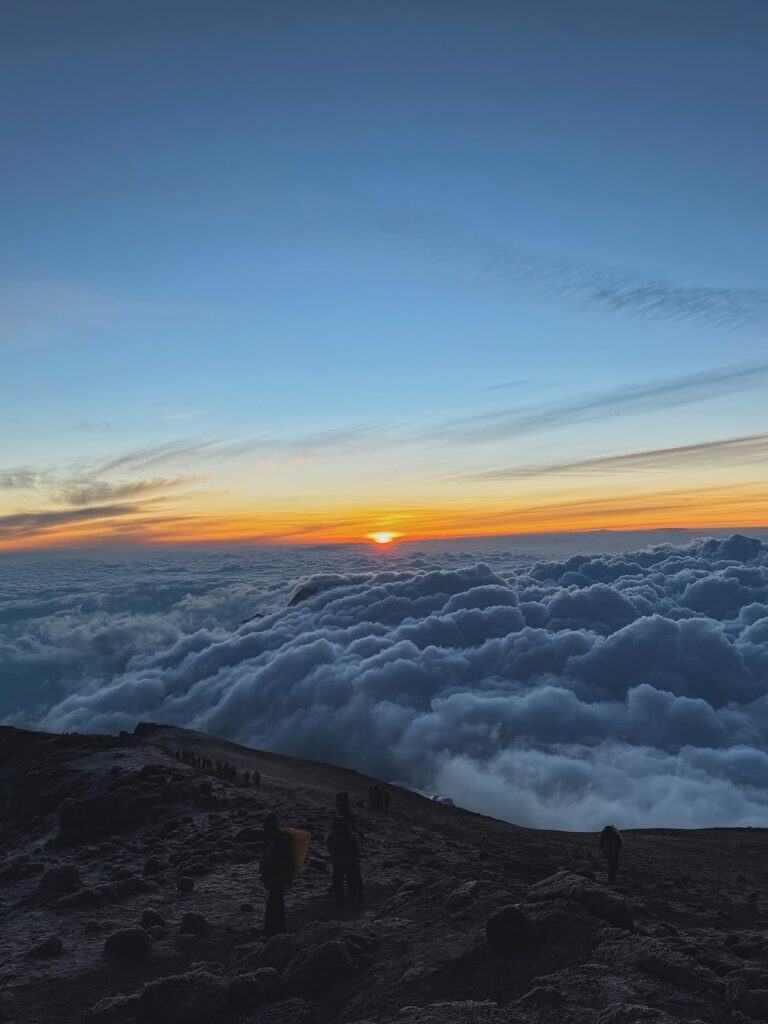
Kilimanjaro summit day (from Barafu Camp at 4,673m/15,331 ft to Uhuru Peak at 5,895m/19,340 ft and back down to Mweka Camp at 3,100m/10,170 ft):
- Wake-up call: 11pm
- Total duration: 12–16 hours of continuous movement
- Elevation gain: 1,222m (4,009 ft) ascent
- Elevation loss: 2,795m (9,169 ft) descent (yes, more than the ascent)
- Conditions: darkness, freezing temperatures (-10°C to -20°C), wind, altitude at 49% of sea-level oxygen
- Sleep the night before: typically 1–3 hours of broken sleep at 4,673m (15,331 ft)
This is the single hardest day of the trek. Everything about Kilimanjaro’s 95%+ success rate (on good routes with good operators) depends on this day going well.
EBC summit day (from Gorak Shep at 5,140m (16,863 ft) to Everest Base Camp at 5,364m (17,598 ft) and back):
- Wake-up call: 6am or 7am
- Total duration: 4–6 hours round-trip
- Elevation gain: 224m (734 ft)
- Elevation loss: 224m/734 ft (back to Gorak Shep)
- Conditions: daylight, cold (-5°C to -15°C typical morning), wind
- Sleep the night before: typically poor but not severe, at 5,140m (16,863 ft)
Kala Patthar (5,550m/18,208 ft), an optional side-peak many EBC trekkers add for panoramic Everest views, is a tougher day — 410m (1,345 ft) of gain pre-dawn to catch sunrise. But it’s still nothing like Kilimanjaro summit night.
If you ask people who’ve done both, this is where most will tell you Kilimanjaro is harder. The combination of nighttime, cold, altitude, and the sheer length of the effort separates Kilimanjaro summit day from anything on the EBC trail.
Terrain: EBC Walks Further, Kilimanjaro Walks Steeper
Neither trek involves technical climbing. Both are walking. The character of the walking, though, differs.
Kilimanjaro terrain changes dramatically with elevation:
- Rainforest trail at the base (slippery, muddy in the wet, gentle gradient)
- Moorland and alpine scrub in the middle (dry, rocky, moderate gradient)
- Alpine desert near the summit (loose rock, gravel, steeper)
- Scree slope on summit night (steep, slow, hard on legs in both directions)
Total distance on a 7-day Machame is around 60–65km. Elevation gain across the trek is roughly 4,500m (14,763 ft). Most days involve significant up-and-down within the day, not just net elevation gain.
Everest Base Camp terrain is more consistent:
- Rocky Himalayan valley trails, mostly gradual
- Suspension bridges across rivers
- Switchbacks on the bigger climbs (up to Namche Bazaar, up to Tengboche)
- Loose rock and moraine near the top of the valley
Total distance is 130km round trip. Elevation gain across the trek is 2,500–3,000m (8,202-9,842 ft) net, spread over more days.
The practical difference: EBC involves more days of walking, with lower daily elevation gain and more gradual trails. Kilimanjaro involves fewer days of walking, with higher daily elevation gain, steeper terrain, and a dramatic final push.
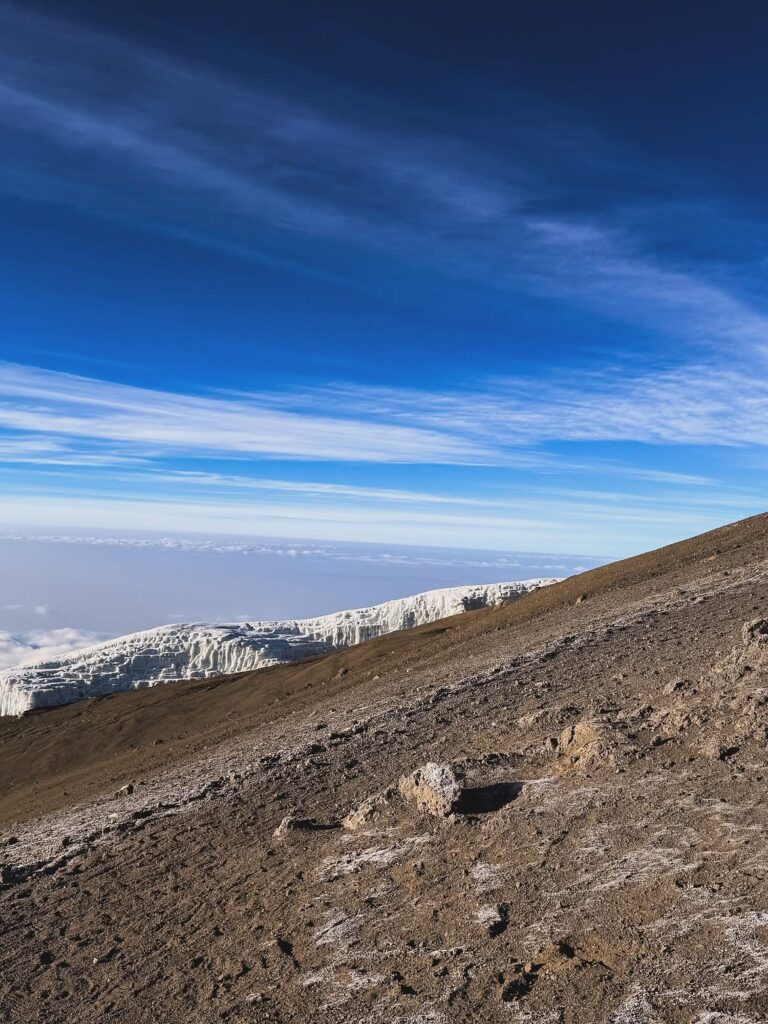
Acclimatization: EBC Has Time Built In, Kilimanjaro Has to Be Designed
Acclimatization is your body adjusting to lower oxygen — increasing red blood cell production, adjusting breathing patterns, shifting fluid balance. It takes time. There’s no shortcut.
Everest Base Camp has acclimatization built into the standard itinerary:
- Rest day at Namche Bazaar (3,440m/11,286 ft) with optional day hike to Everest View Hotel
- Rest day at Dingboche (4,410m/14,468 ft) with optional climb of Nagarjun Hill
- Gradual daily gain elsewhere (300–600m/984-1,968 ft typical)
- Several nights at 4,000m+ before attempting the push to 5,364m (17,598 ft)
Kilimanjaro acclimatization varies wildly by route and itinerary:
- 5-day Marangu has almost no acclimatization — just up and up. Summit success rate around 50%.
- 6-day Machame includes one “climb high, sleep low” move at Lava Tower. Summit success 85–90%.
- 7-day Machame adds a day at Karanga Camp for additional acclimatization. Summit success 90–95%.
- 8-day Lemosho includes two acclimatization nights. Summit success 92–97%.
- 9-day Northern Circuit is the best acclimatization profile on the mountain. Summit success 95–98%.
Translation: EBC has acclimatization baked into the standard route. Kilimanjaro requires choosing an itinerary long enough to acclimatize. A 6-day budget Kilimanjaro with poor acclimatization is genuinely harder than EBC. A 9-day Northern Circuit with excellent acclimatization is arguably easier than EBC for most bodies.
Logistics: EBC Has More Moving Parts
Kilimanjaro logistics:
- Fly to Kilimanjaro International Airport (JRO), roughly 45 minutes from Moshi
- One night in Moshi before the climb
- Climb and descent in 6–9 days, camping or huts
- One night in Moshi after
- Total on-ground time in Tanzania: 8–12 days
EBC logistics:
- Fly to Kathmandu, Nepal
- Fly Kathmandu to Lukla — a famously weather-dependent flight that gets cancelled often, sometimes for days. Budget extra days at both ends.
- Trek in and out: 10–14 days
- Return to Kathmandu
- Total on-ground time in Nepal: 14–18 days
EBC has more weather risk (Lukla flight cancellations can add 2–5 days unpredictably), more logistical complexity, and more days away from home. Kilimanjaro is logistically simpler — fly in, climb, fly out.
Cost: Similar Range, Different Inclusions
Both treks have huge cost variance depending on operator quality, group size, and what’s included. Rough ranges:
Kilimanjaro (reputable operator, mid-tier): $2,000–$4,500 per person. Includes park fees, guides, porters, tents, all meals on the mountain, transfers to/from Moshi, pre-climb briefing. Tips are separate (typically $250–$400 per climber). Flights to JRO are separate.
Everest Base Camp (reputable operator): $1,500–$3,500 per person. Includes Lukla flights, guide, porter (sometimes), teahouse accommodation, most meals, TIMS and Sagarmatha permits. International flights to Kathmandu separate.
Kilimanjaro’s park fees are unusually high — TANAPA charges around $80+ per climber per day in park fees alone, plus rescue fees and camping fees. This is why Kilimanjaro prices rarely drop below $2,000 from a legitimate operator. Operators quoting $1,200 or $1,500 are almost always cutting corners — usually on porter wages, guide training, or food quality. More on cost considerations in our detailed breakdown.
Cost-per-day works out roughly similar on both treks. Kilimanjaro tends to be more expensive per day but fewer days total.
Success Rates: The Apples-to-Apples Comparison
Both treks have high completion rates for trekkers who train, pick good operators, and pick reasonable itineraries.
Kilimanjaro summit success rates (data from TANAPA and operator records):
- 5-day Marangu: ~50%
- 6-day Machame: ~85%
- 7-day Machame: ~90%
- 8-day Lemosho: ~92–97%
- 9-day Northern Circuit: ~95–98%
Kilimanjaro Sky’s success rates on Machame and Lemosho sit in the 95–98% range — partly because we only run minimum 7-day Machame and 8-day Lemosho, never the shorter budget variants. Context on our safety protocols explains why.
EBC completion rate is typically quoted at 93–97% for trekkers on standard itineraries with reputable operators. Weather-related cancellations (mostly Lukla flights) reduce the “made it back to Kathmandu on schedule” rate somewhat, but the “reached EBC” rate among trekkers who started is high.
If summit success matters to you, both treks deliver it at similar rates when done right.
Who Should Do Kilimanjaro First
Do Kilimanjaro first if:
- You have a shorter time window (1–2 weeks of travel)
- You want a specific summit, not a base camp
- You’re in East Africa already or want to combine with a Tanzanian safari
- You’ve never done multi-day high-altitude trekking but you’re fit and want the achievement of a true summit
- Summit night — the mental and physical peak effort — appeals to you
Who Should Do EBC First
Do EBC first if:
- You have more time (2.5–3 weeks)
- You want to see the Himalayas, specifically the Everest massif
- You want a more gradual trek with built-in rest days
- You’re concerned about altitude tolerance and want the longer acclimatization profile
- You want to stay in teahouses and eat in villages rather than camp
- The experience of the trek (the valley, the culture, the journey) matters as much as reaching a specific point
The Bottom Line
Kilimanjaro is harder on your one hardest day. EBC is harder in aggregate — more days, more distance, more altitude exposure. Neither is a technical climb. Both are achievable for fit, well-trained trekkers who choose reputable operators and reasonable itineraries.
If you’ve only done one, the next one will be easier emotionally because you’ll know what altitude feels like. Many climbers end up doing both — often Kilimanjaro first (shorter, more convenient, specific summit), then EBC later (longer journey, deeper immersion).
If you’re leaning Kilimanjaro, we’d suggest starting with the routes overview to see which route matches your fitness and time. The Machame and Lemosho routes are the most popular for good reason. If summit success rate is the top priority, Lemosho 8-day or Northern Circuit 9-day are the itineraries with the best acclimatization profiles.
For questions about fitness prerequisites, altitude management, or how our safety protocols work, the FAQs cover the main points, and you can always get in touch directly.